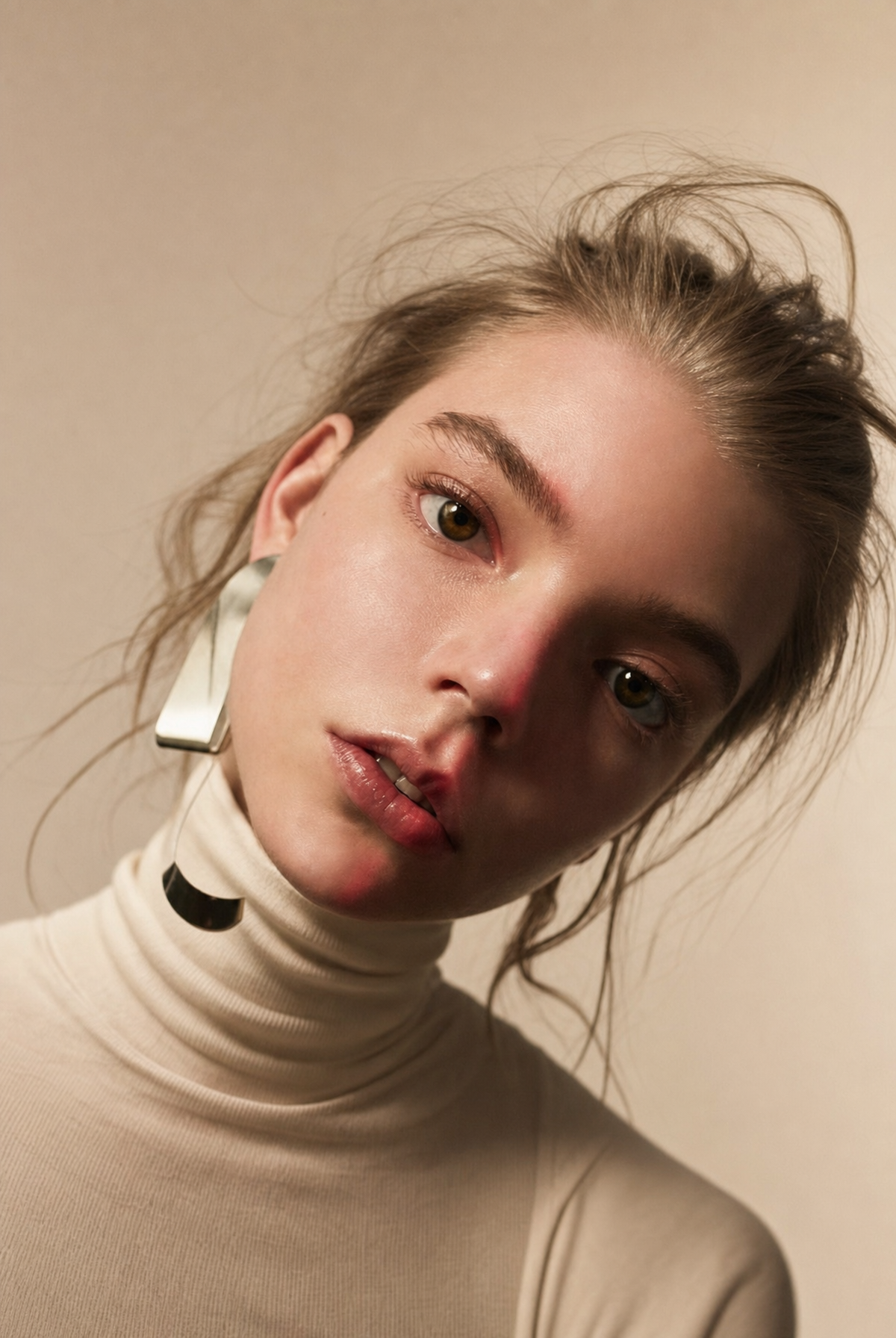
Why this works
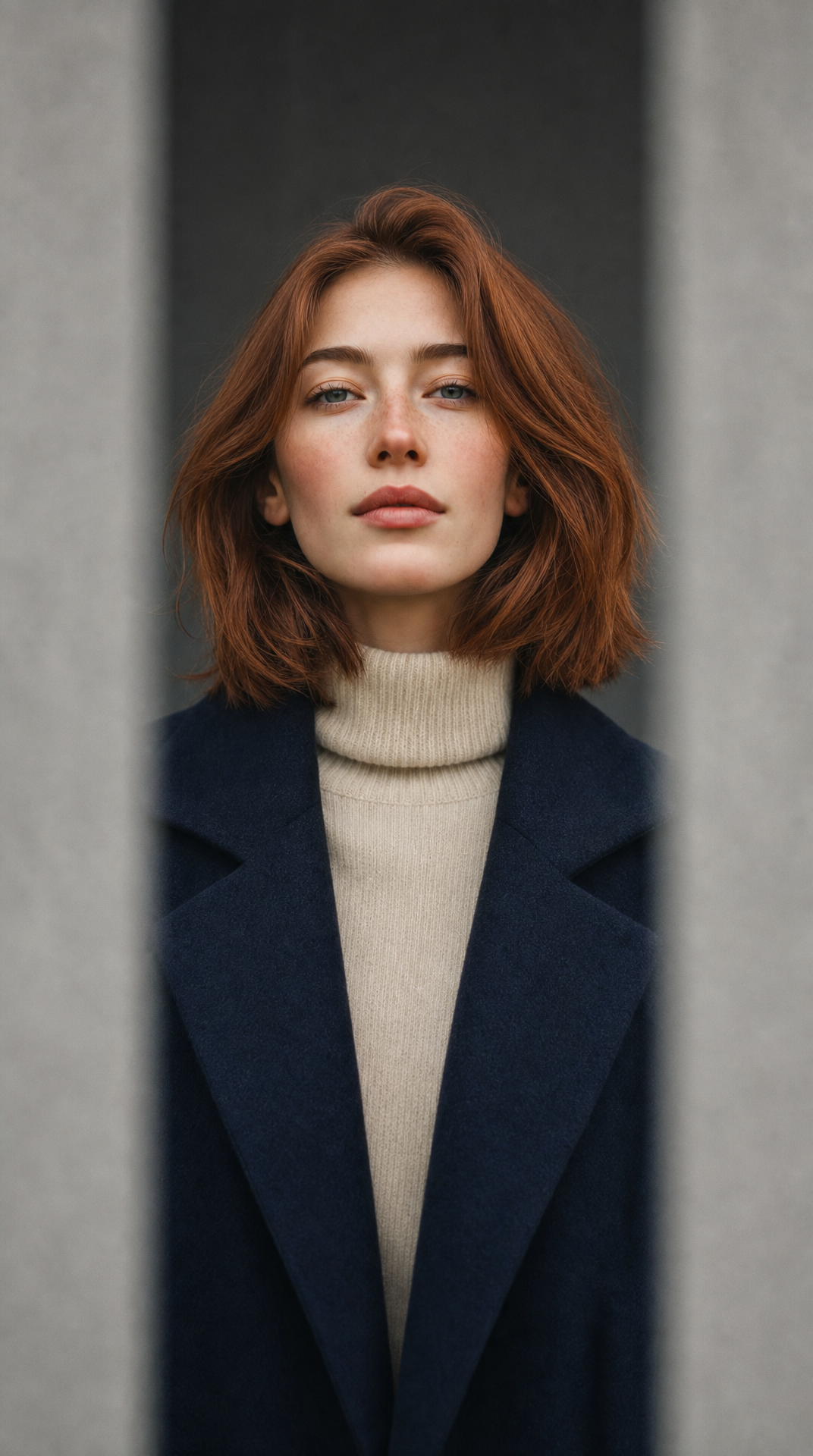
The centered composition and “slight three-quarter angle” keep the close portrait controlled while giving the face enough turn to avoid a flat ID-photo effect. “Cream turtleneck,” “deep navy coat,” and “shoulder-length auburn hair” create the key beige, dark blue, and brown color structure visible against the “dark minimalist background,” while “soft cinematic lighting” and “strong subject-background contrast” preserve the calm, focused mood without losing facial clarity. “Clean negative space” and “subtle warm-gray tones” prevent the security gate from becoming visually busy, so the sharp-focus portrait remains the dominant element.
FAQ
→How do I make the security gate more central and visually prominent?
Replace “dark minimalist background” with “clearly visible modern security gate with turnstile details behind her,” and change “clean negative space” to “structured architectural background with repeating gate lines.” Keep “centered composition” if you want the woman and gate to share equal visual weight; use “woman positioned beside the gate” for a stronger environmental portrait.
→How do I shift this from moody editorial to a brighter, more approachable fashion portrait?
Replace “moody modern atmosphere” with “bright, approachable contemporary atmosphere,” “soft cinematic lighting” with “diffused daylight with gentle front lighting,” and “dark minimalist background” with “light warm-gray security lobby.” Keep the “cream turtleneck” and “auburn hair,” since those phrases support the existing beige-and-brown warmth.
→How do I build a series of variations while keeping the same visual identity?
Keep the fixed core phrases “centered composition,” “slight three-quarter angle,” “cream turtleneck sweater,” “deep navy coat,” “soft cinematic lighting,” and “strong subject-background contrast.” Create variations by replacing only “security gate” with settings such as “airport checkpoint,” “subway turnstile,” or “museum entrance,” and swap “calm focused expression” for “quietly alert expression,” “composed anticipation,” or “subtle confident smile.”
Learn the technique behind this
- Why can't AI spell, and how do I get readable text in an image? — Older diffusion models had no character-level representation of text, so they produced letterform-shaped texture instead of words.
- Why does AI get hands and faces wrong, and how do I fix it? — Hands fail because they're small in frame, extremely variable in pose, and self-occluding — the model has less usable signal per pixel than for any other body part.
- How do I keep the same character across multiple images? — Text prompts alone won't hold a face across images — a description defines a type, not a person.
Related prompts
Woman in Teal Light, Shadowed Fashion Portrait
Eerie Elegance Among Marble Busts
Charcoal turtleneck with red eye-beam
Dreamy Macro Portrait in Cool Water