Why this works
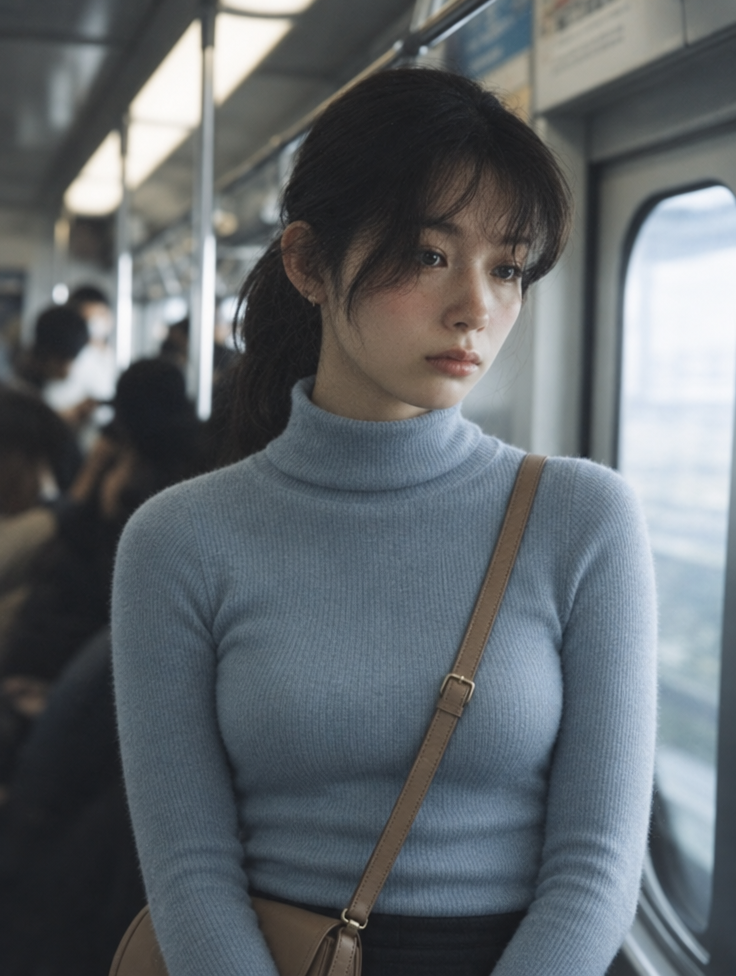
The phrase “young woman standing inside a subway train” establishes a recognizable, enclosed setting, while “natural candid framing” and the maintained standing pose give the full-body portrait an unforced documentary quality. “Soft overhead car lighting,” paired with a “slightly brighter, cooler color palette,” supports the image’s cool blue and deep black dominance; the tan crossbody bag supplies the warm brown accent. “Quiet, introspective expression,” “shallow depth of field,” and “subtle film-like grain” work together to isolate her from the train interior while preserving the realistic, moody texture of a candid photograph.
FAQ
→How do I change this prompt to make the woman feel more confident and visually prominent?
Replace “quiet, introspective expression” with “direct, confident gaze and relaxed upright posture,” and replace “natural candid framing” with “centered full-body editorial framing.” Keep “shallow depth of field,” but add “subject sharply separated from the subway background” so her presence remains dominant.
→How do I make the image warmer and less moody?
Replace “soft overhead car lighting” and “cooler, slightly brighter color palette” with “warm late-afternoon fluorescent light with gentle amber highlights.” Change “muted cool palette” to “warm neutral palette with honey, cream, and muted brown tones,” while replacing “moody quiet introspective atmosphere” with “calm, hopeful everyday atmosphere.”
→How do I build a series of variations while keeping this portrait recognizable?
Keep “young woman,” “light blue fitted turtleneck sweater,” “tan crossbody bag,” “standing pose,” and “realistic skin texture” unchanged. Create variations by replacing only “inside a subway train” with settings such as “quiet train platform,” “city bus at dusk,” or “empty station corridor,” and swap “soft overhead car lighting” for setting-specific phrases such as “cool platform fluorescents” or “warm bus interior lighting.”
Learn the technique behind this
- Why can't AI spell, and how do I get readable text in an image? — Older diffusion models had no character-level representation of text, so they produced letterform-shaped texture instead of words.
- How should a prompt be structured, and does word order matter? — A prompt that behaves predictably names one subject first, then what it is doing, then where, then the light, then the lens or medium, then the style.
- Which aspect ratio should I use, and how does it change the image? — Aspect ratio determines what the model composes, not how it's cropped afterwards.
Related prompts
Woman in Teal Light, Shadowed Fashion Portrait
Charcoal turtleneck with red eye-beam
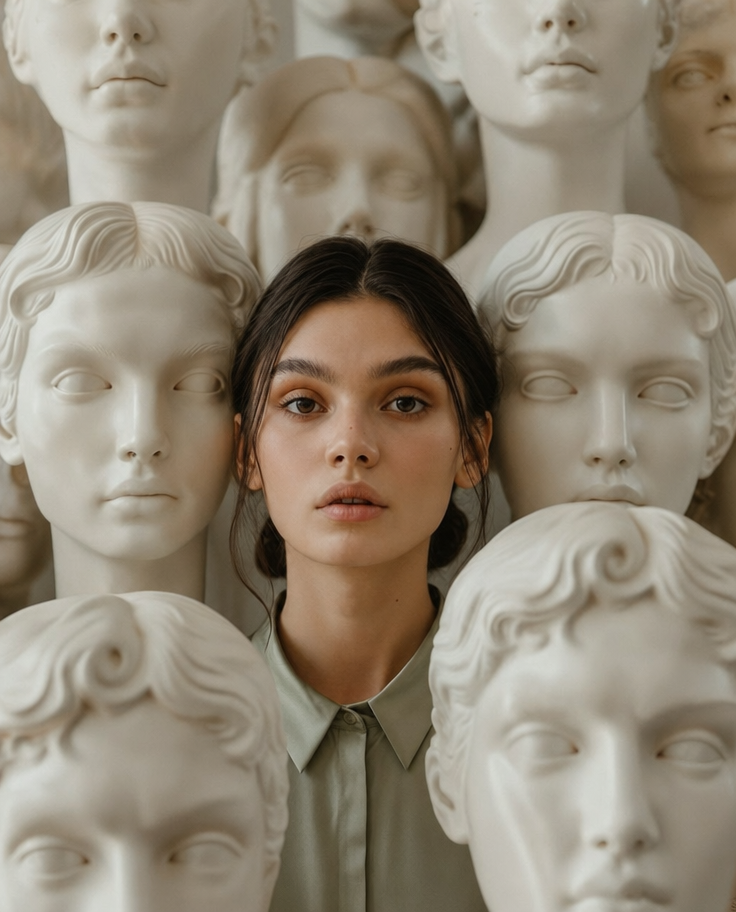
Eerie Elegance Among Marble Busts

Dreamy Macro Portrait in Cool Water