Why this works
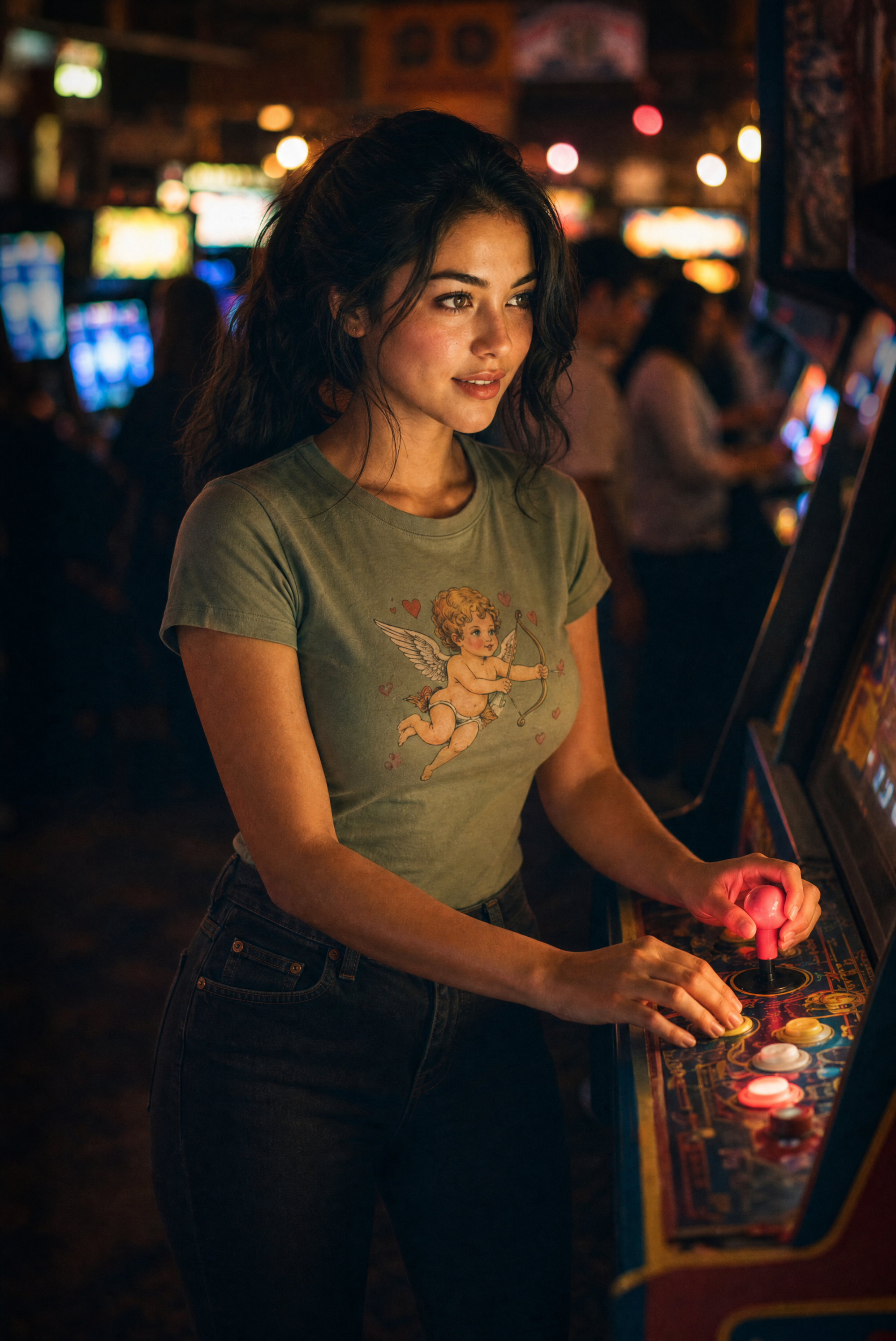
“Half-body candid portrait” and “face turned slightly toward the glowing cabinet” establish an observational, off-center moment rather than a posed gaming portrait, while “one hand on the joystick” gives the composition a readable action anchor. The warm orange highlights against the black arcade surroundings come from “warm neon reflections on her skin,” “nighttime urban arcade scene,” and “soft ambient glow,” creating the nostalgic, moody contrast visible in the image. “Shallow depth of field” and “colorful bokeh lights in the background” keep attention on her face, hand, and cabinet while “realistic skin tones and detailed fabric texture” preserve photographic credibility.
FAQ
→How do I make the woman more prominent than the arcade cabinet?
Replace “half-body candid portrait” with “tight chest-up portrait,” and add “the woman’s face and joystick hand dominate the foreground.” Replace “colorful bokeh lights in the background” with “a softly blurred arcade cabinet behind her,” keeping the cabinet recognizable but secondary.
→How do I shift this from warm nostalgia to a colder, more tense arcade mood?
Replace “warm neon reflections on her skin” and “soft ambient glow” with “cold blue and violet LED light cutting across her face.” Change “warm, nostalgic, moody” to “cool, suspenseful, nocturnal,” and replace the dominant orange palette with “deep black, electric blue, and violet.”
→How do I create a consistent series of variations from this portrait?
Keep “young woman,” “muted olive-green short-sleeve top,” “dark-wash jeans,” “loose ponytail,” and “cinematic editorial snapshot look” unchanged. Vary only the action and cabinet, using replacements such as “leaning toward a racing game,” “examining a claw machine,” or “pressing buttons on a rhythm-game cabinet,” while retaining “half-body candid framing” and “shallow depth of field.”
Learn the technique behind this
- Why can't AI spell, and how do I get readable text in an image? — Older diffusion models had no character-level representation of text, so they produced letterform-shaped texture instead of words.
- Why does AI get hands and faces wrong, and how do I fix it? — Hands fail because they're small in frame, extremely variable in pose, and self-occluding — the model has less usable signal per pixel than for any other body part.
- How should a prompt be structured, and does word order matter? — A prompt that behaves predictably names one subject first, then what it is doing, then where, then the light, then the lens or medium, then the style.
Related prompts
Woman in Teal Light, Shadowed Fashion Portrait
Eerie Elegance Among Marble Busts
Charcoal turtleneck with red eye-beam
Dreamy Macro Portrait in Cool Water