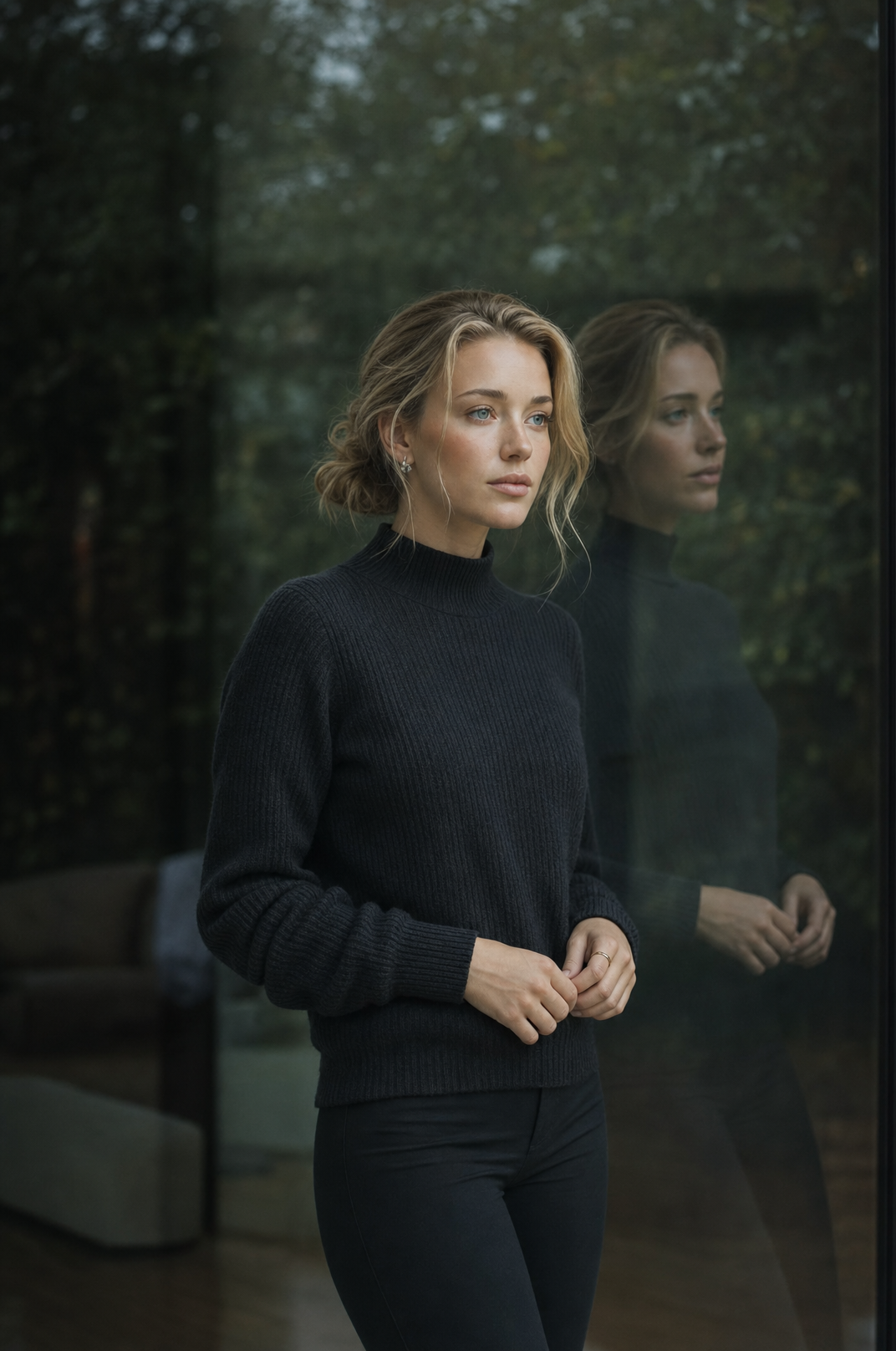
Why this works
The “vertical 2:3” format and “mid-shot framing” make the woman and glass wall read as a tall editorial composition, while the faint reflection adds a secondary vertical figure without competing with her. “Calm, introspective gaze slightly off-camera,” “low-key natural lighting,” and “soft shadows” establish the restrained mood; “cool slate and muted gold highlights” keeps the gray-dominant palette from feeling flat. “Shallow depth of field” concentrates attention on her ultra-detailed skin and loose face-framing strands, while “subtle film grain” reinforces the cinematic portrait finish.
FAQ
→How do I make the portrait feel warmer and less introspective?
Replace “calm, introspective gaze slightly off-camera” with “direct, confident gaze into the lens,” and change “low-key natural lighting” and “soft shadows” to “warm late-afternoon sunlight with gentle directional highlights.” Replace “cool slate and muted gold highlights” with “warm beige, amber, and terracotta tones.”
→How do I make the reflection a more prominent compositional element?
Replace “a faint, realistic reflection of her figure behind her” with “a clearly visible, sharply defined reflection occupying the glass beside her, slightly offset and fully recognizable.” Change “shallow depth of field” to “moderate depth of field” so the reflection retains detail, and replace “mid-shot framing” with “three-quarter vertical framing that includes the woman and most of the glass wall.”
→How can I build a variation using the same editorial treatment with a different subject?
Replace “same young woman” and “young blonde woman” with a specific subject such as “middle-aged male architect with short dark hair,” while keeping “cinematic editorial portrait,” “minimalist modern interior,” “large reflective glass wall,” “low-key natural lighting,” and “cool slate and muted gold highlights.” For a more distinct series variation, replace “lush greenery” with “sparse sculptural plants and concrete planters” while preserving the vertical 2:3 format and realistic glass reflection.
Learn the technique behind this
- How do I keep the same character across multiple images? — Text prompts alone won't hold a face across images — a description defines a type, not a person.
- Why does AI get hands and faces wrong, and how do I fix it? — Hands fail because they're small in frame, extremely variable in pose, and self-occluding — the model has less usable signal per pixel than for any other body part.
- Why can't AI spell, and how do I get readable text in an image? — Older diffusion models had no character-level representation of text, so they produced letterform-shaped texture instead of words.
Related prompts

Woman in Teal Light, Shadowed Fashion Portrait

Eerie Elegance Among Marble Busts

Charcoal turtleneck with red eye-beam

Dreamy Macro Portrait in Cool Water