Why this works
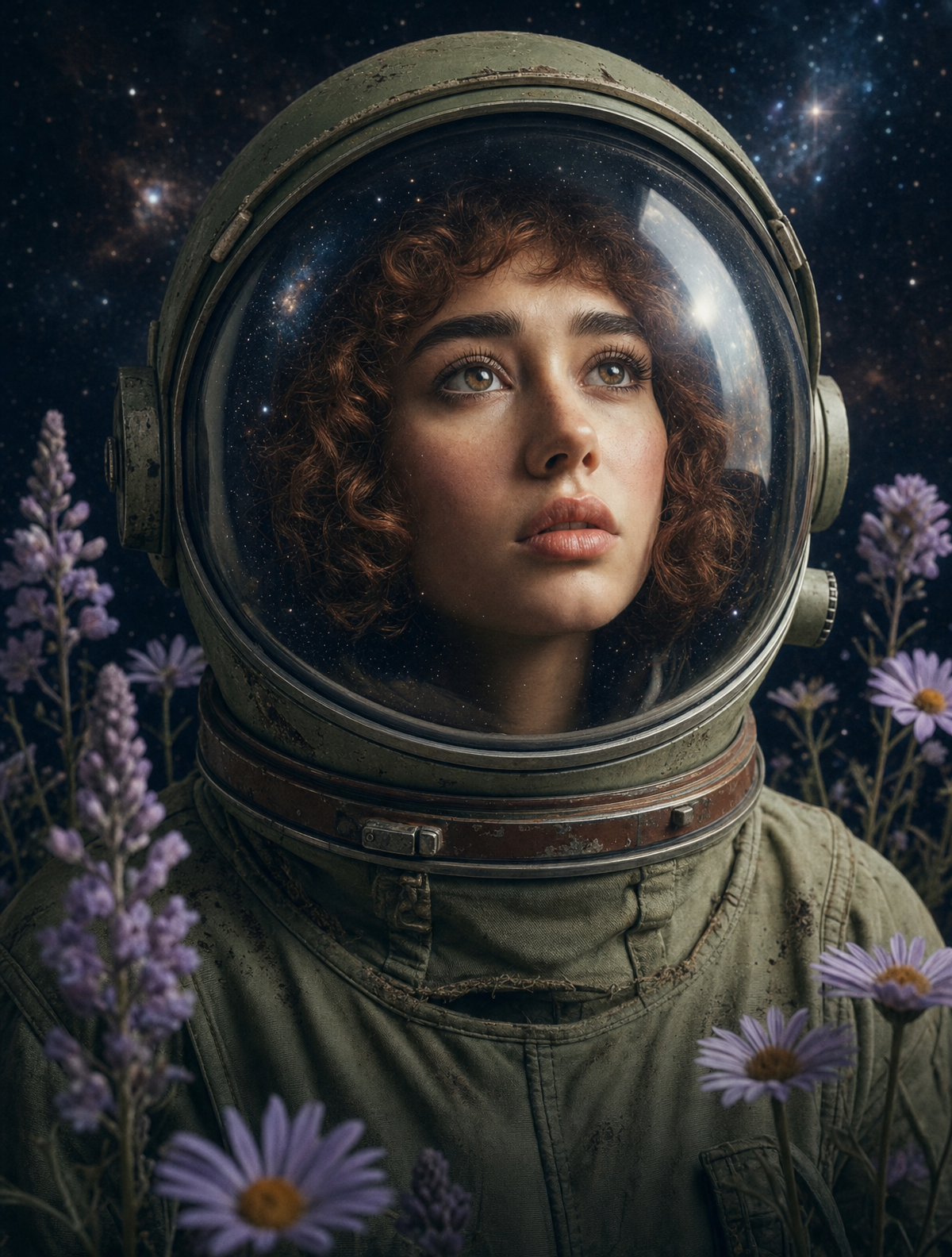
The “cinematic close-up” and “85mm lens look” keep the young woman’s face and worn olive-green helmet dominant, while “shallow depth of field” softens the star field and pale-purple wildflowers into atmospheric framing. “Soft dramatic rim lighting,” “reflective glass visor with subtle highlights,” and “eyes turned upward with a calm, contemplative expression” establish the quiet, dreamy mood through specific edges, reflections, and gaze direction. Gray visor tones, olive-green suit fabric, and pale-purple flowers form a restrained color harmony, while “star-filled cosmic background with faint nebula haze” supplies the surreal sense of scale without competing with the portrait.
FAQ
→How do I make the portrait feel darker and more tense?
Replace “calm, contemplative expression” with “alert, anxious expression” and “eyes turned upward” with “eyes fixed directly toward the camera.” Change “soft dramatic rim lighting” to “hard red side-lighting with deep visor shadows,” and replace “faint nebula haze” with “dense storm clouds and distant warning lights.”
→How do I make the wildflowers and cosmic setting more prominent?
Replace “cinematic close-up” with “environmental portrait, medium shot” and change “pale-purple wildflowers framing the lower foreground” to “a dense meadow of pale-purple wildflowers filling the lower half of the frame.” Reduce “shallow depth of field” to “moderate depth of field” so the flowers and nebula remain recognizable behind the astronaut.
→How do I build a consistent series of variations from this prompt?
Keep the fixed anchors “photorealistic,” “85mm lens look,” “soft dramatic rim lighting,” and “ultra-detailed helmet and suit textures,” then swap only the setting and accent color. For example, replace “star-filled cosmic background with faint nebula haze” with “icy moon landscape under a green aurora” and “pale-purple wildflowers” with “small white frost flowers,” while preserving the young woman, worn olive-green suit, upward gaze, and close portrait framing.
Learn the technique behind this
- Why can't AI spell, and how do I get readable text in an image? — Older diffusion models had no character-level representation of text, so they produced letterform-shaped texture instead of words.
- How should a prompt be structured, and does word order matter? — A prompt that behaves predictably names one subject first, then what it is doing, then where, then the light, then the lens or medium, then the style.
- Which aspect ratio should I use, and how does it change the image? — Aspect ratio determines what the model composes, not how it's cropped afterwards.
Related prompts
Woman in Teal Light, Shadowed Fashion Portrait
Eerie Elegance Among Marble Busts
Charcoal turtleneck with red eye-beam
Dreamy Macro Portrait in Cool Water