Why this works
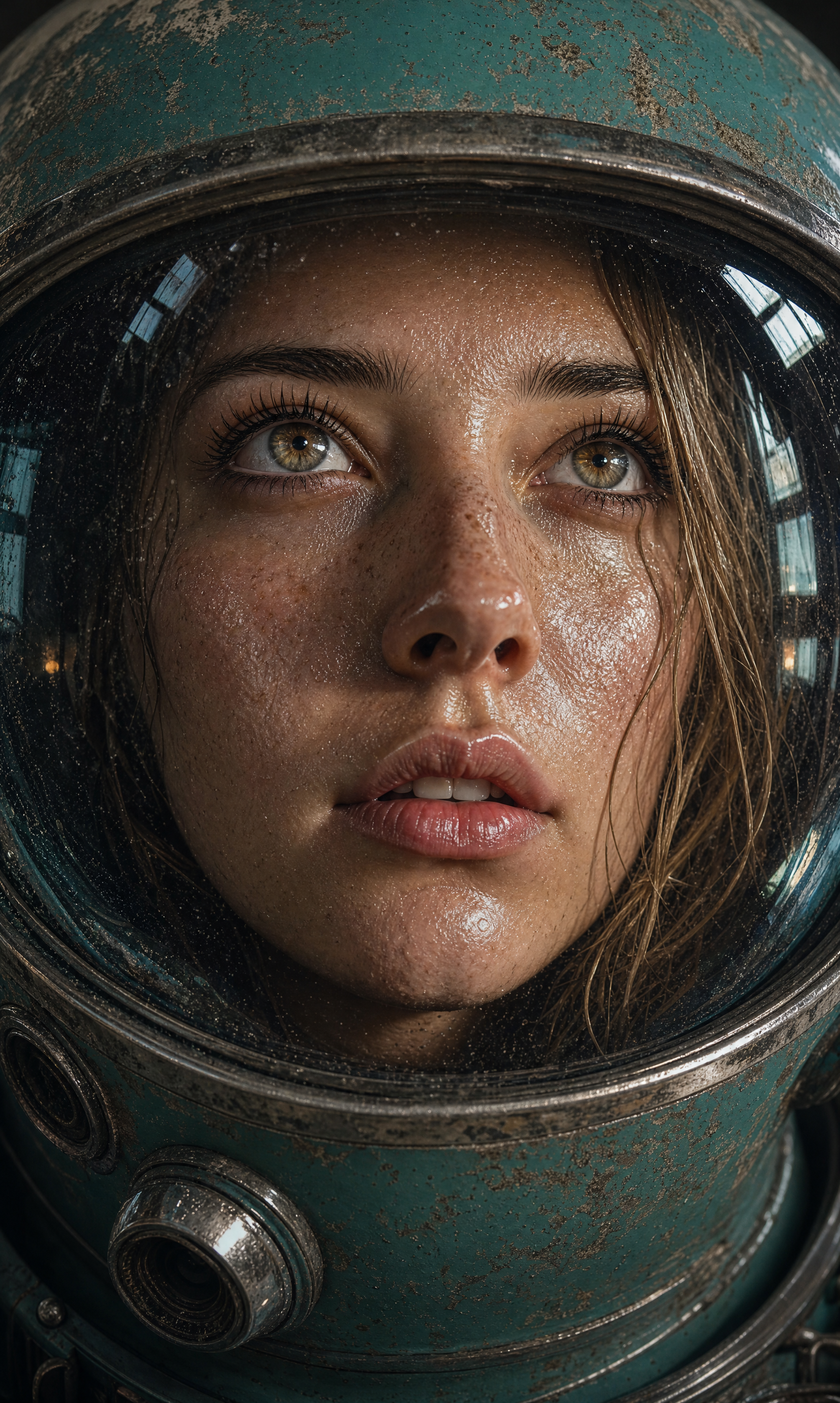
The extreme close-up macro view and “shot on a 50mm macro lens” make the face and visor fill the portrait, while “visible pores,” “light dusting freckles,” and “slightly damp hair strands” give the tight framing tactile detail. The mood comes from “cinematic low-key lighting” and “moody and atmospheric,” with “cool-toned realistic reflections on the visor” adding gray-blue separation against the image’s dominant black, brown, and gray tones. “Intense hazel-gold eyes looking slightly upward” supplies the focal point and a small upward gesture, while the “vintage, weathered teal space helmet” provides the strongest contextual contrast around the portrait.
FAQ
→How do I make the eyes more central and emotionally dominant?
Replace “intense hazel-gold eyes looking slightly upward” with “direct, unblinking hazel-gold eyes staring into the camera, centered in the frame,” and change “extreme close-up macro view through the glass visor” to “tight eye-level close-up centered on the eyes.” Keep “visible pores” and “50mm macro lens” for sharp iris and skin detail.
→How do I change the moody portrait into a warmer, more hopeful scene?
Replace “cinematic low-key lighting” with “soft warm sunrise lighting,” and change “cool-toned realistic reflections on the visor” to “amber-gold reflections and subtle sun flares across the visor.” Replace “moody and atmospheric” with “quietly optimistic and luminous,” while retaining the weathered helmet for continuity.
→How do I build a matching series with different space environments?
Keep “young woman’s face inside a vintage, weathered teal space helmet,” “extreme close-up macro portrait,” and “shot on a 50mm macro lens” unchanged, then replace the implied neutral backdrop with specific settings such as “inside a red-lit orbital station,” “on a dusty lunar surface,” or “beside a frost-covered spacecraft window.” Match each variation’s reflections to the setting by changing “cool-toned realistic reflections” to phrases such as “red emergency-light reflections,” “pale lunar reflections,” or “cold white spacecraft-light reflections.”
Learn the technique behind this
- Why can't AI spell, and how do I get readable text in an image? — Older diffusion models had no character-level representation of text, so they produced letterform-shaped texture instead of words.
- How should a prompt be structured, and does word order matter? — A prompt that behaves predictably names one subject first, then what it is doing, then where, then the light, then the lens or medium, then the style.
- Why does AI get hands and faces wrong, and how do I fix it? — Hands fail because they're small in frame, extremely variable in pose, and self-occluding — the model has less usable signal per pixel than for any other body part.
Related prompts
Woman in Teal Light, Shadowed Fashion Portrait
Eerie Elegance Among Marble Busts
Charcoal turtleneck with red eye-beam
Dreamy Macro Portrait in Cool Water