Why this works
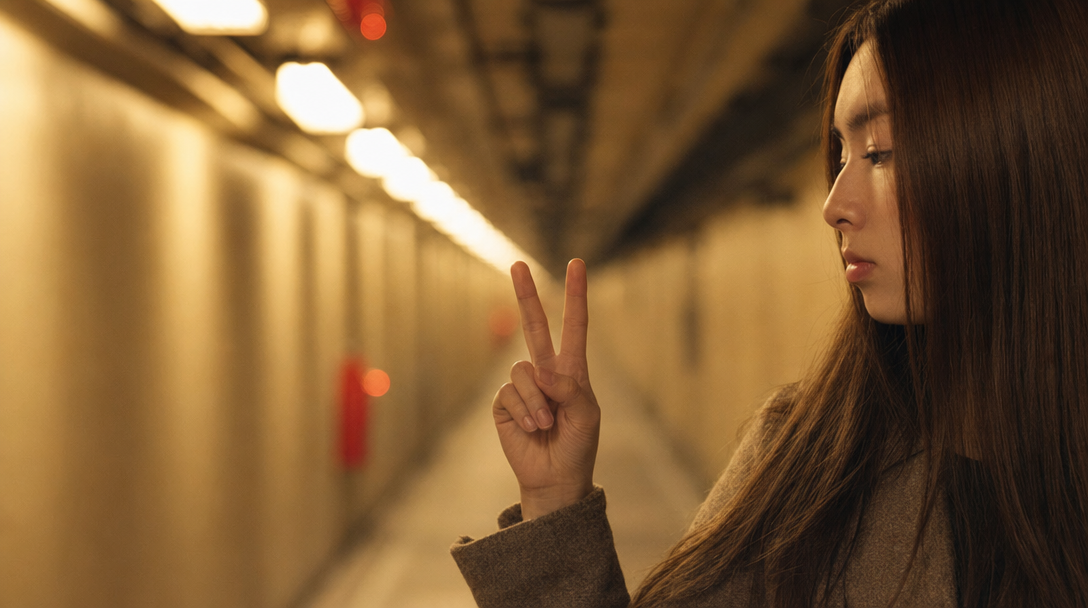
The portrait-closeup composition is anchored by “cinematic photorealistic side-profile portrait” and “35mm framing,” keeping the woman’s profile and two-finger gesture dominant while the tunnel recedes as context. “Shallow depth of field” and “softly blurred” corridor isolate her face, while “overhead warm sodium-style fluorescent lights” adds restrained warmth to the image’s beige, black, and gray palette. The contemplative mood comes directly from “calm contemplative mood,” reinforced by “natural skin tones” and the subdued underground setting rather than by dramatic contrast.
FAQ
→How do I make the peace-like gesture more prominent?
Replace “She holds two fingers up in a subtle peace-like gesture” with “she holds two fingers prominently beside her face in a clearly readable peace gesture,” and add “hands and face both in sharp focus.” To preserve the close portrait, keep “portrait-closeup” but replace “shallow depth of field” with “moderate depth of field focused on her face and raised hand.”
→How do I shift this from contemplative to tense and ominous?
Replace “calm contemplative mood” with “tense, watchful mood,” and change “overhead warm sodium-style fluorescent lights” to “flickering cold fluorescent lights with harsh overhead shadows.” Replace “slightly warmer, moody atmosphere” with “claustrophobic, ominous atmosphere,” while keeping “underground tunnel” and “softly blurred” to retain the enclosed, uncertain background.
→How do I create a series of variations without losing the visual identity?
Keep the fixed anchors “cinematic photorealistic side-profile portrait,” “chestnut-brown hair,” “35mm framing,” “natural skin tones,” and “detailed realistic textures.” For each variation, swap only the setting and lighting phrases, such as replacing “underground tunnel” with “rainy train platform” or “concrete parking garage,” and replacing “warm sodium-style fluorescent lights” with “cool blue station lights” or “late-afternoon window light.”
Learn the technique behind this
- Why can't AI spell, and how do I get readable text in an image? — Older diffusion models had no character-level representation of text, so they produced letterform-shaped texture instead of words.
- Why does AI get hands and faces wrong, and how do I fix it? — Hands fail because they're small in frame, extremely variable in pose, and self-occluding — the model has less usable signal per pixel than for any other body part.
- How should a prompt be structured, and does word order matter? — A prompt that behaves predictably names one subject first, then what it is doing, then where, then the light, then the lens or medium, then the style.
Related prompts
Woman in Teal Light, Shadowed Fashion Portrait
Eerie Elegance Among Marble Busts
Charcoal turtleneck with red eye-beam
Dreamy Macro Portrait in Cool Water