Why this works
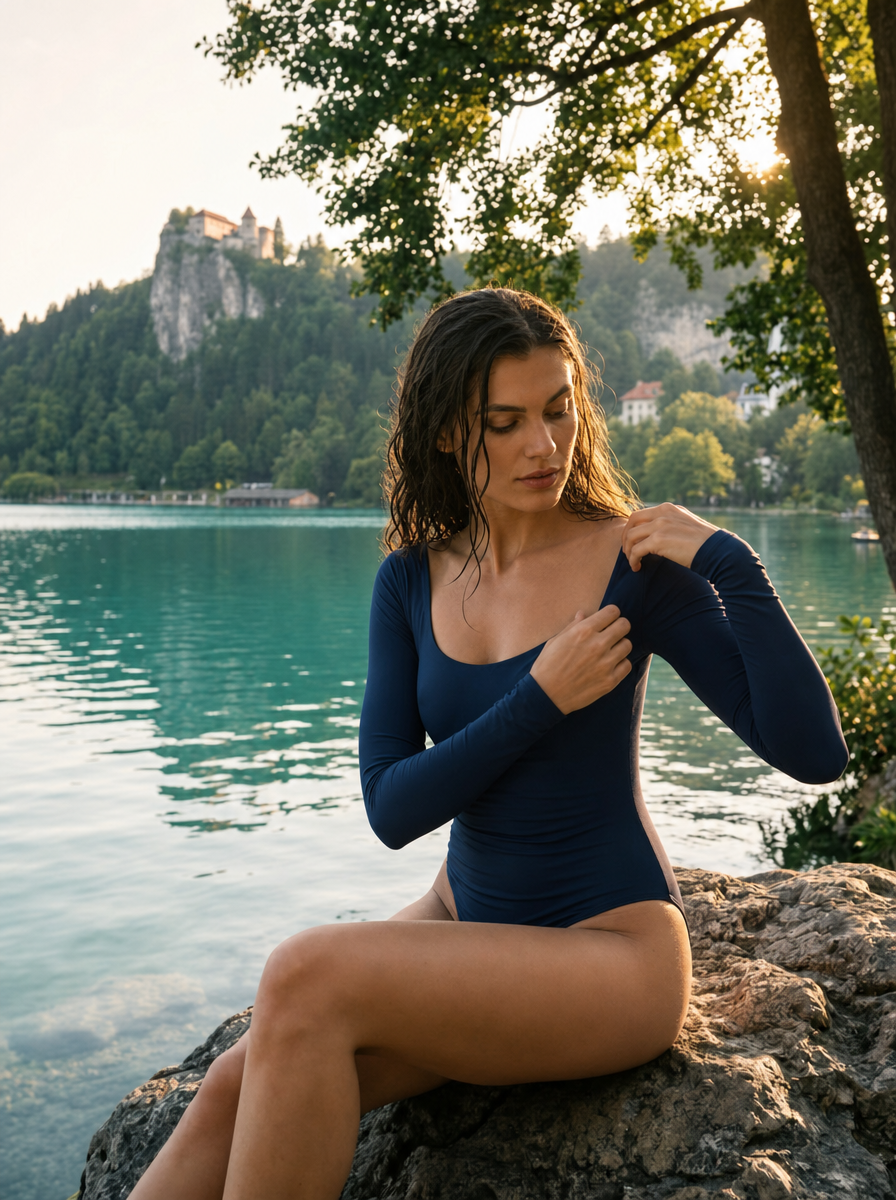
The phrase “young woman relaxing on a large boulder at the edge of a clear turquoise lake” establishes the full-body portrait’s grounded foreground, while “a distant stone castle” and “forested cliff” create layered depth behind her. “Overhanging branches framing the upper portion of the composition” supplies a natural visual border, and “shallow depth of field” keeps attention on the subject without erasing the castle and lake context. “Soft golden-hour daylight,” paired with “deep navy” swimwear, turquoise water, green forest, gray stone, and beige rock, produces a restrained blue-green harmony with warm skin highlights rather than a heavily stylized color treatment.
FAQ
→How do I make the distant castle more central and prominent?
Replace “a distant stone castle sits against a forested cliff” with “a prominent stone castle occupies the middle background across the lake, with clearly visible towers and masonry,” and change “shallow depth of field” to “moderate depth of field keeping both the woman and castle sharply detailed.”
→How do I shift this from serene travel photography to a moodier, more dramatic portrait?
Replace “soft golden-hour daylight” with “overcast late-evening light with cool shadows and a narrow warm break on the horizon,” and change “serene, scenic mood” to “quiet, contemplative, cinematic mood.” Keeping “clear turquoise lake” preserves the blue focal color while the cooler light deepens the forest and castle tones.
→How can I create a series of variations while keeping the same visual identity?
Keep “photorealistic travel photography look,” “deep navy one-piece swimsuit,” “damp and styled in loose waves,” and “soft golden-hour daylight” unchanged, then swap the setting phrase “a distant stone castle sits against a forested cliff” for variations such as “a pine-covered alpine ridge,” “a quiet lakeside village,” or “a volcanic shoreline.” Replace the gesture “gently smoothing the fabric at her shoulder” with consistent alternatives such as “resting one hand on the boulder” or “tracing the water’s edge” to vary pose without losing the relaxed portrait structure.
Learn the technique behind this
- Why can't AI spell, and how do I get readable text in an image? — Older diffusion models had no character-level representation of text, so they produced letterform-shaped texture instead of words.
- Which aspect ratio should I use, and how does it change the image? — Aspect ratio determines what the model composes, not how it's cropped afterwards.
- How should a prompt be structured, and does word order matter? — A prompt that behaves predictably names one subject first, then what it is doing, then where, then the light, then the lens or medium, then the style.
Related prompts
Tiny wanderer in pastel sunrise meadow
Portuguese Fishing Village at Golden Sunset
Quiet desk on a cliff terrace
Luxury yacht near chalk cliffs at dusk