Why this works
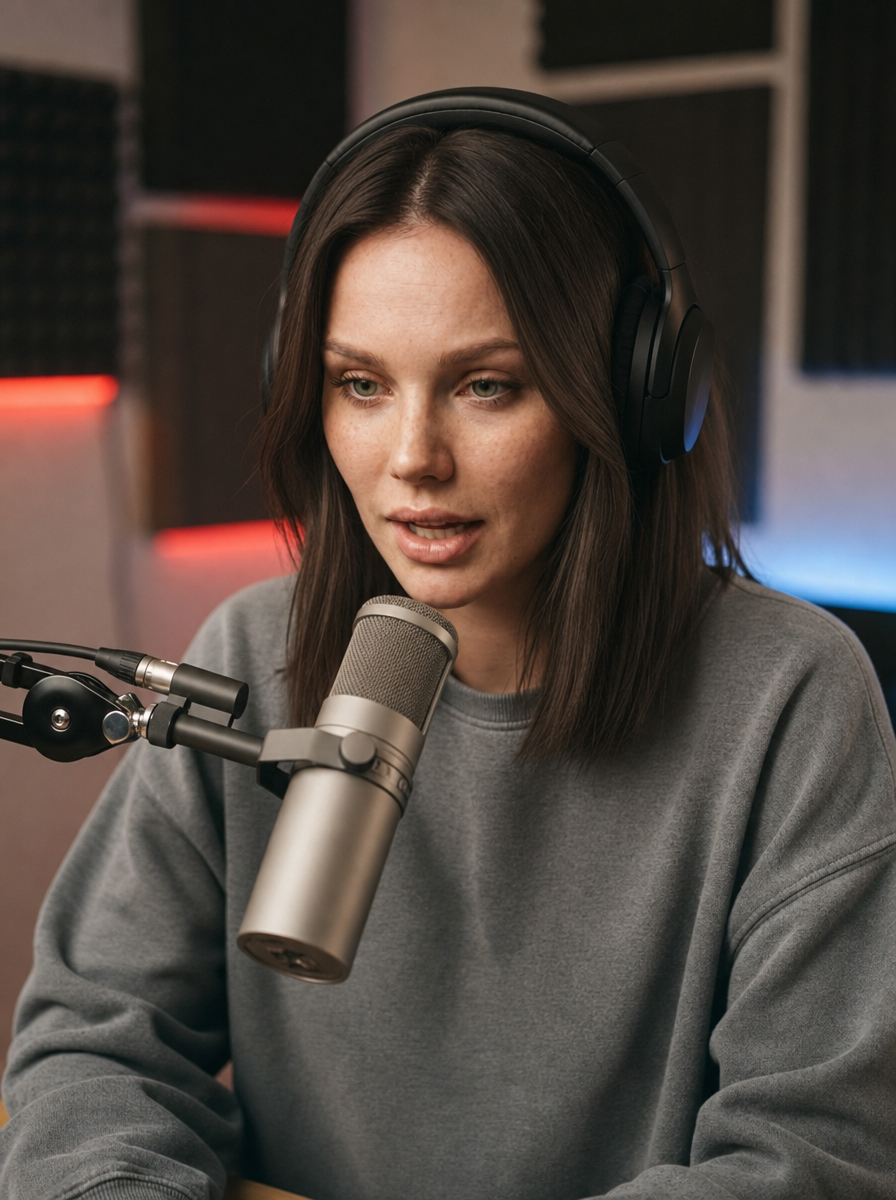
The portrait-closeup and “centered composition” keep the host’s face, over-ear headphones, and large matte silver microphone as the visual anchors, while “professional creator profile photo look” gives the framing a polished, purposeful feel. “Shallow depth of field” separates her from the “clean modern recording studio background,” and “soft teal and amber accent lighting” adds controlled creative contrast even though the generated image is dominated by black headphones and equipment against beige skin and sweatshirt tones. “Subtle natural skin texture” and “photorealistic” prevent the cinematic treatment from becoming overly stylized, preserving a credible professional portrait.
FAQ
→How do I make the microphone and podcast setup more prominent?
Replace “portrait-closeup” with “medium close-up showing the host from the chest up,” and change “large matte silver podcast microphone” to “large foreground microphone occupying the lower-right third of the frame.” Add “boom arm clearly visible” and “host turned slightly toward the microphone” to give the recording context more visual weight.
→How do I shift this from a polished profile photo to a warmer, more approachable portrait?
Replace “cinematic lighting” and “professional creator profile photo look” with “warm documentary studio lighting” and “friendly candid creator portrait.” Change “centered composition” to “relaxed three-quarter composition with a gentle smile,” and replace “soft teal and amber accent lighting” with “warm amber practical lights and soft beige background glow.”
→How do I build a consistent series with different hosts or podcast themes?
Keep the fixed structure “portrait-closeup,” “centered composition,” “photorealistic,” “shallow depth of field,” and “natural skin texture.” Swap the subject block beginning “young woman podcast host” for a specific host description, replace “heather-grey crewneck sweatshirt” with a consistent wardrobe color or garment, and vary “soft teal and amber accent lighting” by theme, such as “violet and blue accents” for technology or “red and gold accents” for culture.
Learn the technique behind this
- Why can't AI spell, and how do I get readable text in an image? — Older diffusion models had no character-level representation of text, so they produced letterform-shaped texture instead of words.
- How should a prompt be structured, and does word order matter? — A prompt that behaves predictably names one subject first, then what it is doing, then where, then the light, then the lens or medium, then the style.
- Which aspect ratio should I use, and how does it change the image? — Aspect ratio determines what the model composes, not how it's cropped afterwards.
Related prompts
Woman in Teal Light, Shadowed Fashion Portrait
Eerie Elegance Among Marble Busts
Charcoal turtleneck with red eye-beam
Dreamy Macro Portrait in Cool Water