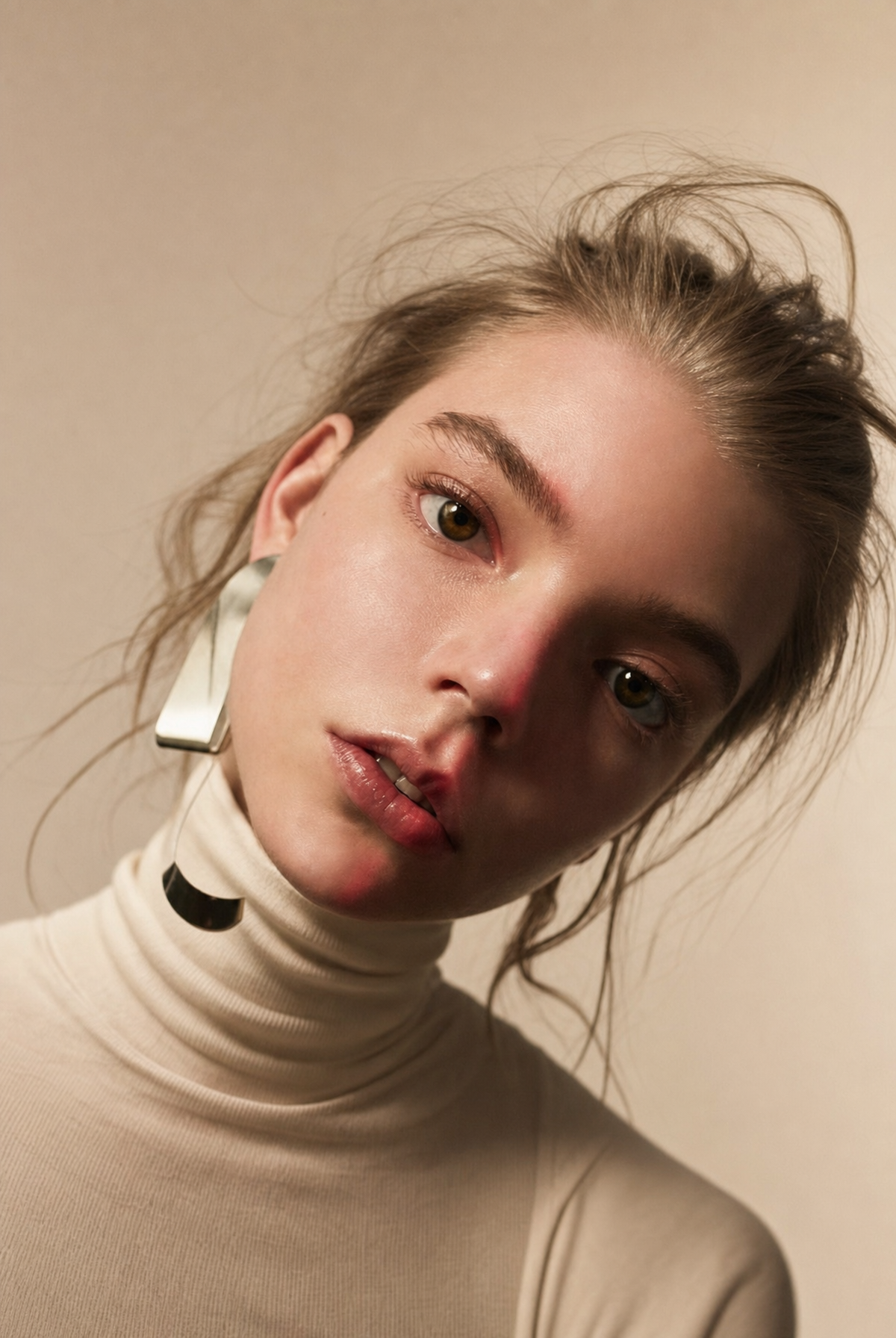
Why this works
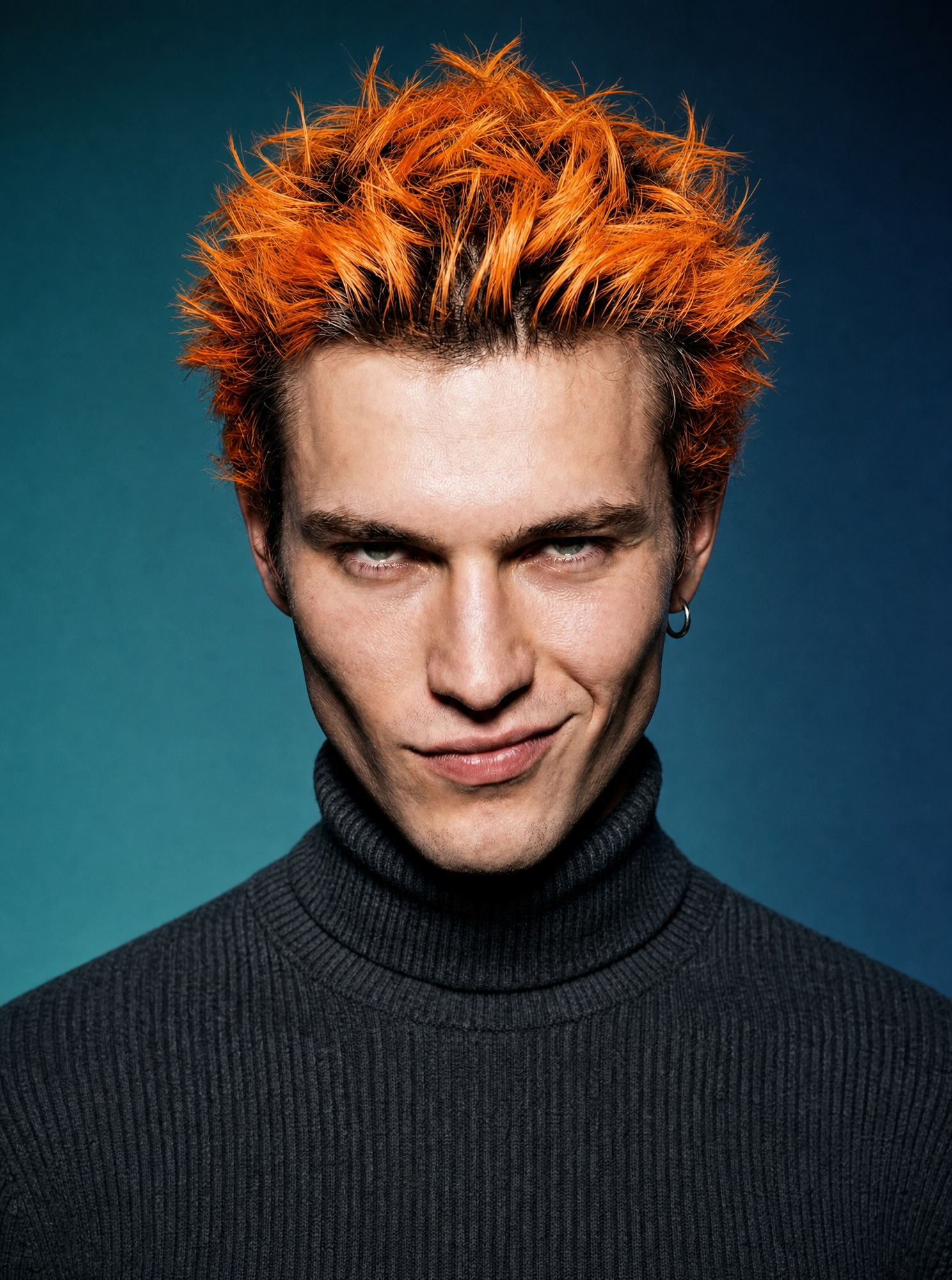
“Spiky bright orange hair” becomes the visual anchor against the “teal-to-ink blue gradient,” creating a strong orange-teal complement while the charcoal turtleneck supplies the black value that grounds the close-up. “Centered composition” and “head-and-shoulders framing” keep the face, hoop earring, and subtle smirk prominent, while “dramatic studio lighting with crisp skin detail” sharpens the cheekbones and textured knit. The “shallow depth of field” separates the subject from the clean gradient, preserving the confident, edgy mood without adding background clutter.
FAQ
→How do I make the portrait feel darker and more intimidating?
Replace “confident edgy slightly mischievous mood” with “brooding, intimidating, restrained mood,” and change “clean teal-to-ink blue gradient” to “deep black-to-navy gradient.” Replace “subtle smirk” with “controlled unsmiling expression” and keep “dramatic studio lighting,” adding “harder side light with deep facial shadows.”
→How do I make the orange hair and earring more prominent?
Replace “spiky bright orange hair” with “oversized flame-orange spikes, sharply separated strands,” and replace “a small hoop earring” with “large polished silver hoop earring catching the key light.” Change “head-and-shoulders framing” to “tight face-and-neck close-up” and add “hair and earring in crisp focus.”
→How do I build a varied portrait series from this prompt?
Keep “photorealistic studio portrait,” “centered composition,” and “crisp skin detail” fixed, then swap the hair, garment, and gradient in controlled steps: use “electric blue swept-back hair,” “cream cable-knit turtleneck,” and “violet-to-black gradient” for one variation, or “silver buzz cut,” “deep burgundy jacket,” and “amber-to-charcoal gradient” for another. Change “subtle smirk” to “quiet laugh” or “direct stern gaze” to vary expression while preserving the same portrait structure.
Learn the technique behind this
- Why can't AI spell, and how do I get readable text in an image? — Older diffusion models had no character-level representation of text, so they produced letterform-shaped texture instead of words.
- Which aspect ratio should I use, and how does it change the image? — Aspect ratio determines what the model composes, not how it's cropped afterwards.
- How should a prompt be structured, and does word order matter? — A prompt that behaves predictably names one subject first, then what it is doing, then where, then the light, then the lens or medium, then the style.
Related prompts
Woman in Teal Light, Shadowed Fashion Portrait
Eerie Elegance Among Marble Busts
Charcoal turtleneck with red eye-beam
Dreamy Macro Portrait in Cool Water