Why this works
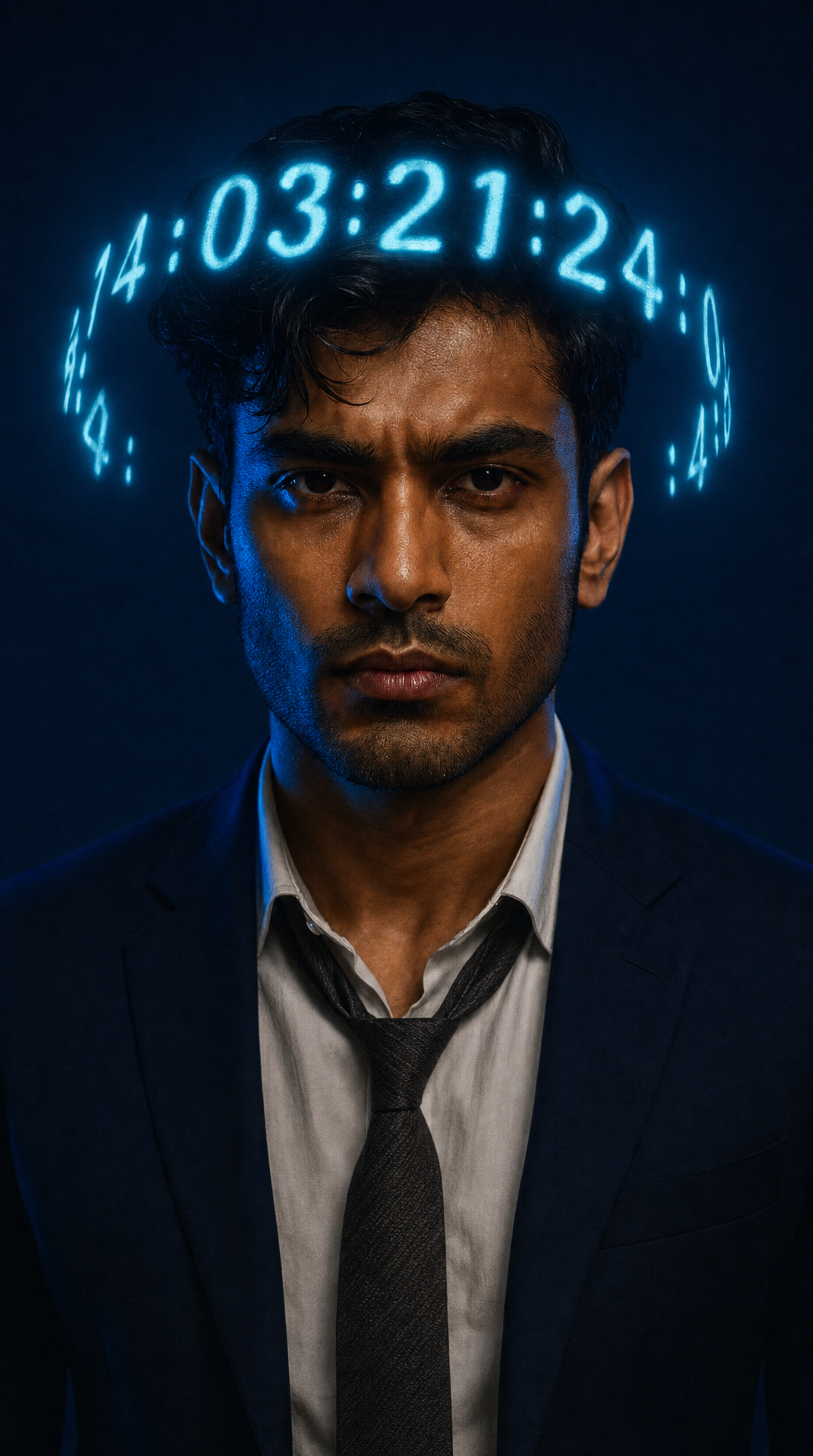
The “tight chest-up framing, facing camera” puts the expression, cheekbones, jawline, and loosely hanging tie in direct focus, while the “intense confident expression” supplies the portrait’s assertive mood. “Cool blue rim lighting” separates the dark-haired figure from the “dark indigo-to-blue gradient background,” and the “glowing cyan numeric halo arcing around his head” creates the futuristic focal ring. The navy jacket, charcoal tie, and blue background establish a controlled blue-gray harmony, while “subtle cinematic particulate bokeh” adds depth without competing with the face.
FAQ
→How do I make the portrait feel warmer and more approachable?
Replace “intense confident expression” with “relaxed, approachable smile” and change “cool blue rim lighting” to “soft warm key lighting with a gentle amber rim light.” Replace the “dark indigo-to-blue gradient background” with “muted terracotta-to-warm gray studio gradient,” while keeping the cyan halo only if you want a restrained futuristic accent.
→How do I make the glowing halo and futuristic design more prominent?
Replace “tight chest-up framing” with “head-and-shoulders framing with the subject placed slightly lower in frame,” and change “glowing cyan numeric halo arcing around his head” to “large luminous cyan holographic ring fully encircling the head, with legible floating numbers and faint interface markings.” Increase “subtle cinematic particulate bokeh” to “dense but softly defocused holographic particles,” while preserving the face as the sharpest element.
→How do I turn this into a consistent series with different subjects?
Keep the fixed phrases “Ultra-realistic 8K studio portrait,” “tight chest-up framing, facing camera,” “cool blue rim lighting,” and “dark indigo-to-blue gradient background.” Replace “a young South Asian man” with a controlled subject slot such as “an older East Asian woman” or “a Black nonbinary musician,” and swap the clothing description for a repeatable wardrobe variation such as “deep navy blazer and crisp white shirt.”
Learn the technique behind this
- Why can't AI spell, and how do I get readable text in an image? — Older diffusion models had no character-level representation of text, so they produced letterform-shaped texture instead of words.
- How should a prompt be structured, and does word order matter? — A prompt that behaves predictably names one subject first, then what it is doing, then where, then the light, then the lens or medium, then the style.
- Do negative prompts work, and what should go in one? — Negative prompts work on models that support a separate negative conditioning channel — mainly Stable Diffusion and FLUX-family models.
Related prompts
Woman in Teal Light, Shadowed Fashion Portrait
Eerie Elegance Among Marble Busts
Charcoal turtleneck with red eye-beam
Dreamy Macro Portrait in Cool Water