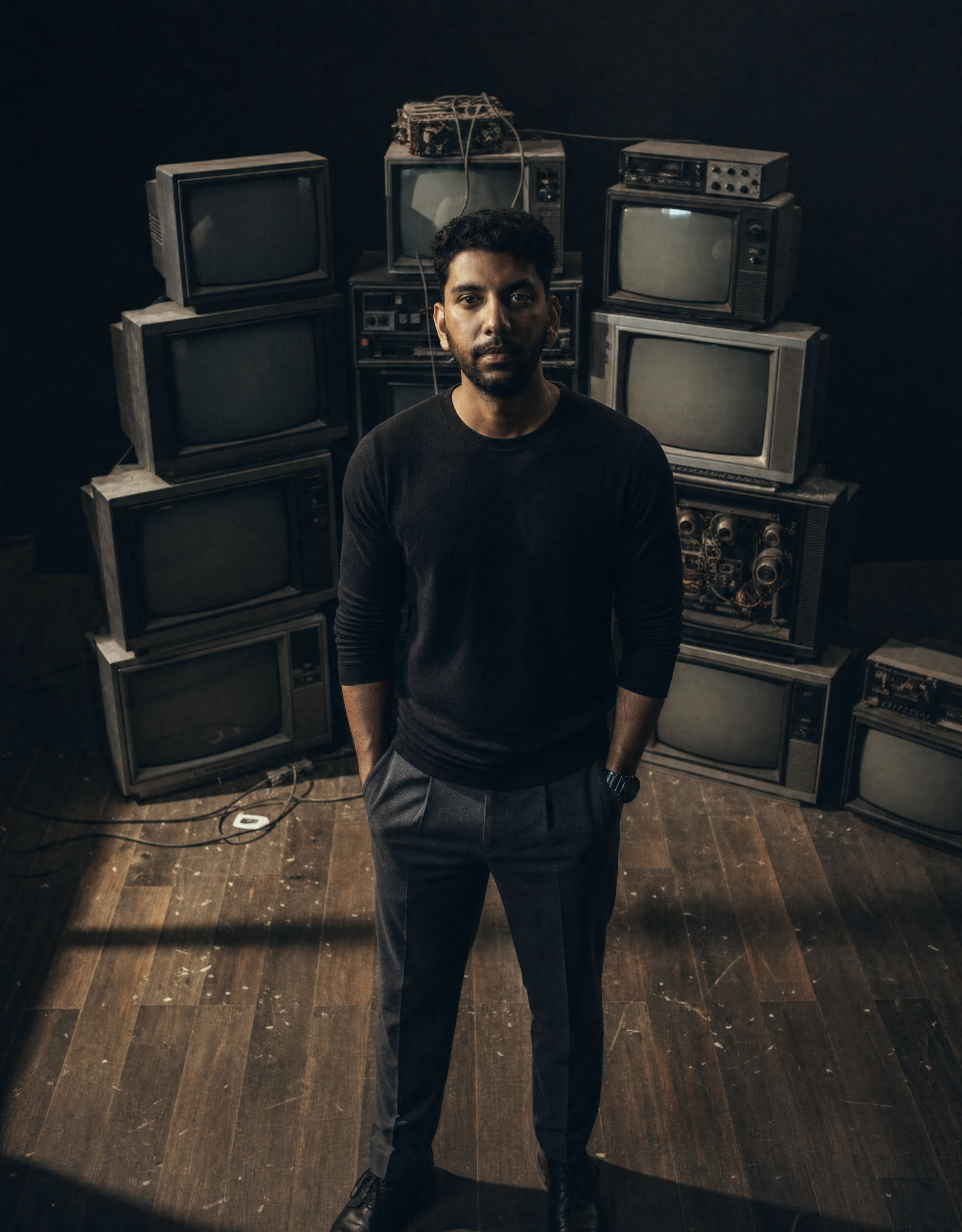
Why this works
“Centered composition” and the “85mm lens look” give the young man a controlled, portrait-oriented presence, while “shallow depth of field” separates him from the stacked CRT televisions without removing their context. The “cooler, slightly desaturated color palette with amber highlights” balances the dominant black clothing and brown wooden floor, and “deep low-key shadows” supplies the dramatic mood. “Gentle reflections on the CRT screens” and the explicitly visible “wooden floor” add nostalgic material detail that keeps the dim studio from becoming a flat black background.
FAQ
→How do I make the CRT wall more central and visually dominant?
Replace “Centered composition” with “the young man positioned in the lower third, framed by an imposing wall of CRT televisions,” and change “shallow depth of field” to “moderate depth of field keeping the stacked CRT screens sharply readable.” Keep “gentle reflections on the CRT screens,” but expand it to “visible amber screen reflections and scanline glow across the surrounding electronics.”
→How do I shift this from moody nostalgia toward a colder, more unsettling tone?
Replace “amber highlights” with “sickly green-blue highlights,” and change “cooler, slightly desaturated color palette” to “near-monochrome cyan-gray palette with restrained green phosphor glow.” For a harsher atmosphere, replace “gentle reflections on the CRT screens” with “flickering distorted CRT light and intermittent screen glare,” while retaining “deep low-key shadows.”
→How do I create a consistent series of variations using different subjects or settings?
Keep the fixed structure, including “photorealistic cinematic portrait,” “85mm lens look,” “shallow depth of field,” “stronger contrast,” and “cooler, slightly desaturated color palette with amber highlights.” Replace “a young man” with a defined subject such as “an older woman in a wool coat,” and replace “stacked vintage CRT televisions and retro electronics” with a matching environment such as “stacked analog radios and reel-to-reel tape machines,” while preserving “centered composition,” “hands in pockets,” and the visible “wooden floor” for continuity.
Learn the technique behind this
- How should a prompt be structured, and does word order matter? — A prompt that behaves predictably names one subject first, then what it is doing, then where, then the light, then the lens or medium, then the style.
- Why can't AI spell, and how do I get readable text in an image? — Older diffusion models had no character-level representation of text, so they produced letterform-shaped texture instead of words.
- Why does AI get hands and faces wrong, and how do I fix it? — Hands fail because they're small in frame, extremely variable in pose, and self-occluding — the model has less usable signal per pixel than for any other body part.
Related prompts
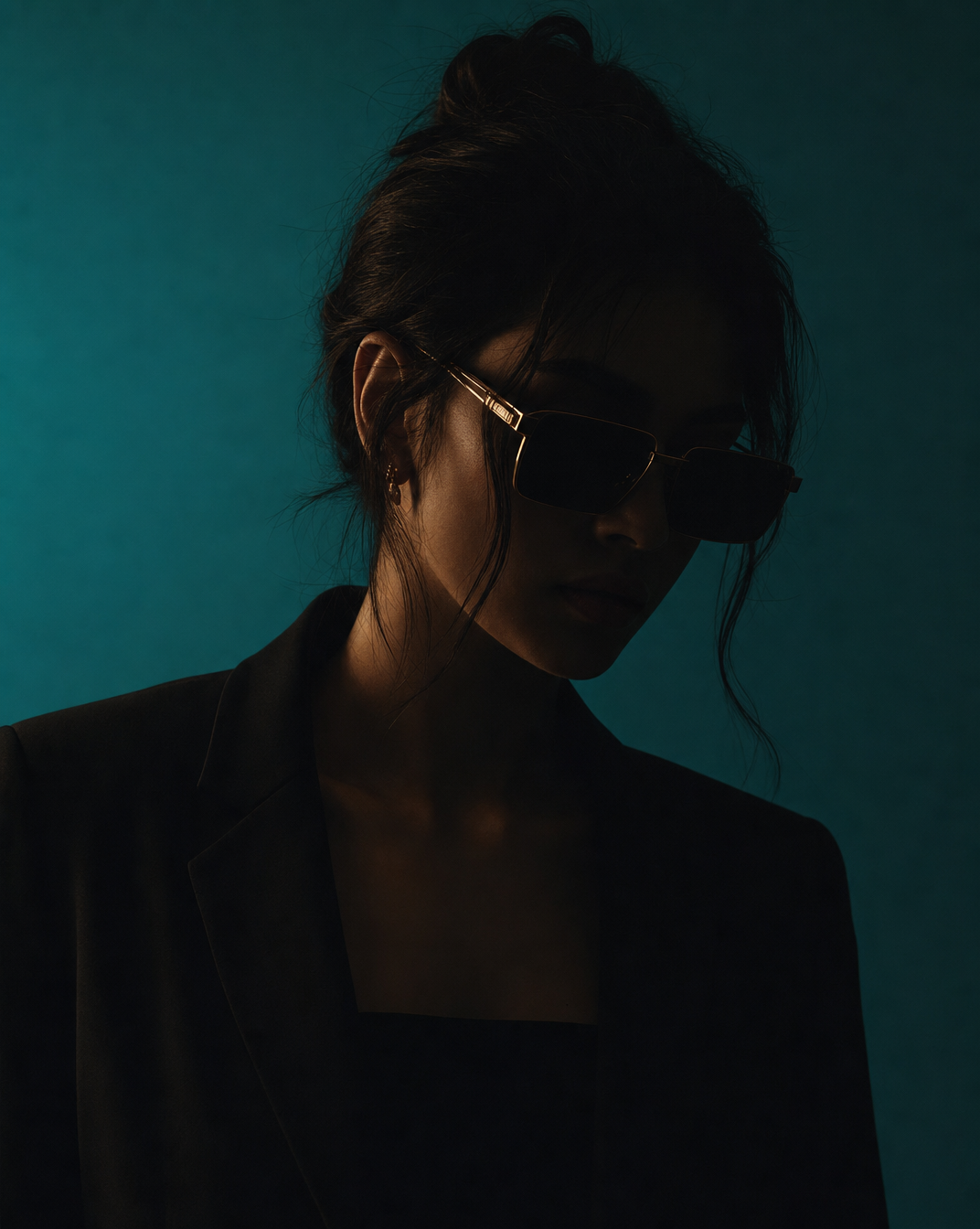
Woman in Teal Light, Shadowed Fashion Portrait

Eerie Elegance Among Marble Busts

Charcoal turtleneck with red eye-beam

Dreamy Macro Portrait in Cool Water