Why this works
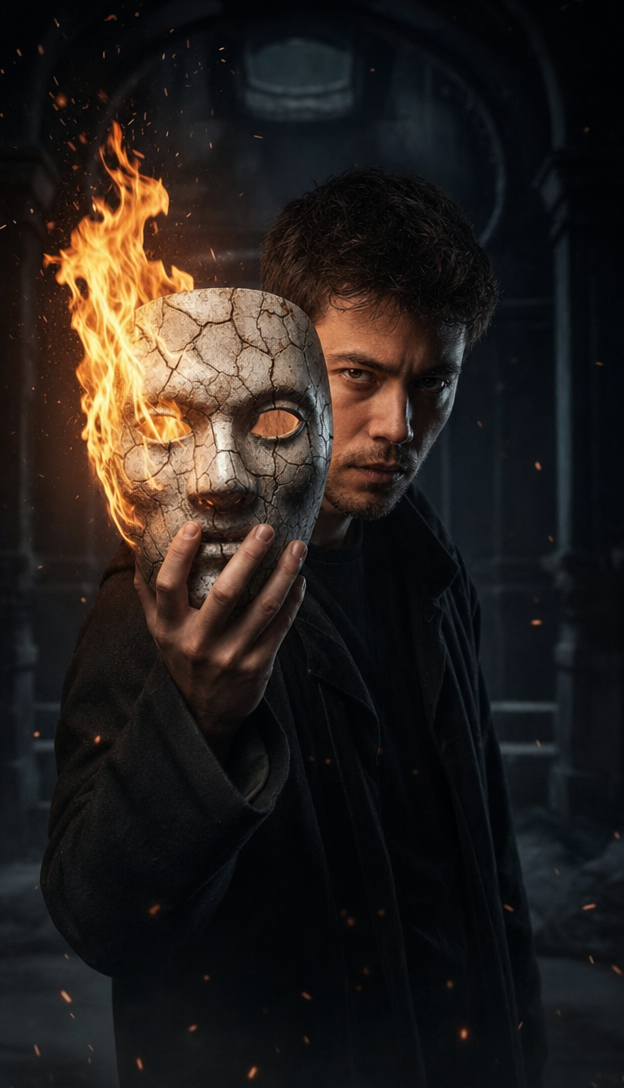
The tight face-and-mask framing comes directly from “tight framing on face and mask,” while “only the right half of his face clearly visible” makes the mask and the visible eye compete for attention. The dark gray stone, orange fire, and “strong warm rim light from the flames” create a controlled gray-orange harmony, with “deep shadows across his face” supplying the tense, severe mood. “Sharp micro-details,” “cracked ancient stone-textured,” and “fine sparks and embers drift through the air” give the portrait tactile surface detail and a sense of motion against the dark background.
FAQ
→How do I make the burning mask more visually dominant?
Replace “tight framing on face and mask” with “mask-dominant close-up, mask occupying most of the foreground,” and change “with only the right half of his face clearly visible” to “the man’s face partially obscured behind the mask.” Strengthen “one side burning orange” to “one entire side engulfed in bright orange flame, casting the primary light.”
→How do I make the portrait feel colder and more ominous instead of fiery and dramatic?
Replace “glows with orange fire” and “strong warm rim light from the flames” with “glows with cold blue-white fire” and “strong icy rim light from the mask.” Change the dominant palette from “gray, orange” to “charcoal gray, bone-white, desaturated blue,” while keeping “deep shadows across his face” for the severe tone.
→How do I create a consistent series using this character in new scenes?
Keep the identity anchors “short dark brown hair,” “slightly heavier stubble,” “young man,” and “ancient cracked stone-textured mask,” then replace the setting phrase “dark, moody background with drifting sparks and embers.” For example, use “abandoned cathedral interior with ash falling through broken windows” or “rain-soaked industrial alley with reflected firelight,” while preserving “cinematic vertical composition” and “sharp micro-details.”
Learn the technique behind this
- Why can't AI spell, and how do I get readable text in an image? — Older diffusion models had no character-level representation of text, so they produced letterform-shaped texture instead of words.
- How should a prompt be structured, and does word order matter? — A prompt that behaves predictably names one subject first, then what it is doing, then where, then the light, then the lens or medium, then the style.
- Why does the model ignore parts of my prompt? — Ignored instructions are almost always conflicts, counts, or spatial relationships — three things current models handle badly — rather than the model failing to read you.
Related prompts
Woman in Teal Light, Shadowed Fashion Portrait
Eerie Elegance Among Marble Busts
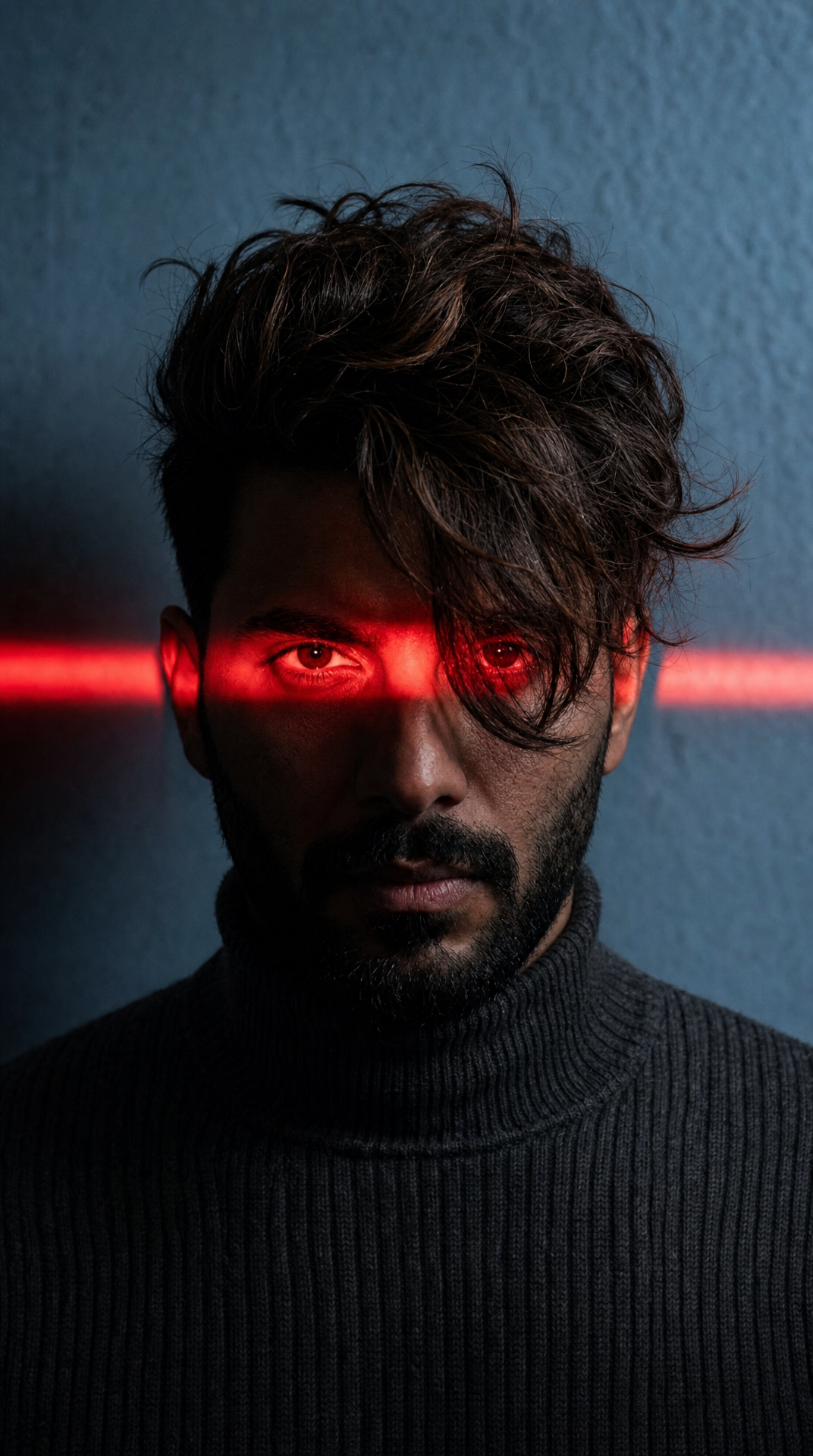
Charcoal turtleneck with red eye-beam

Dreamy Macro Portrait in Cool Water