Why this works
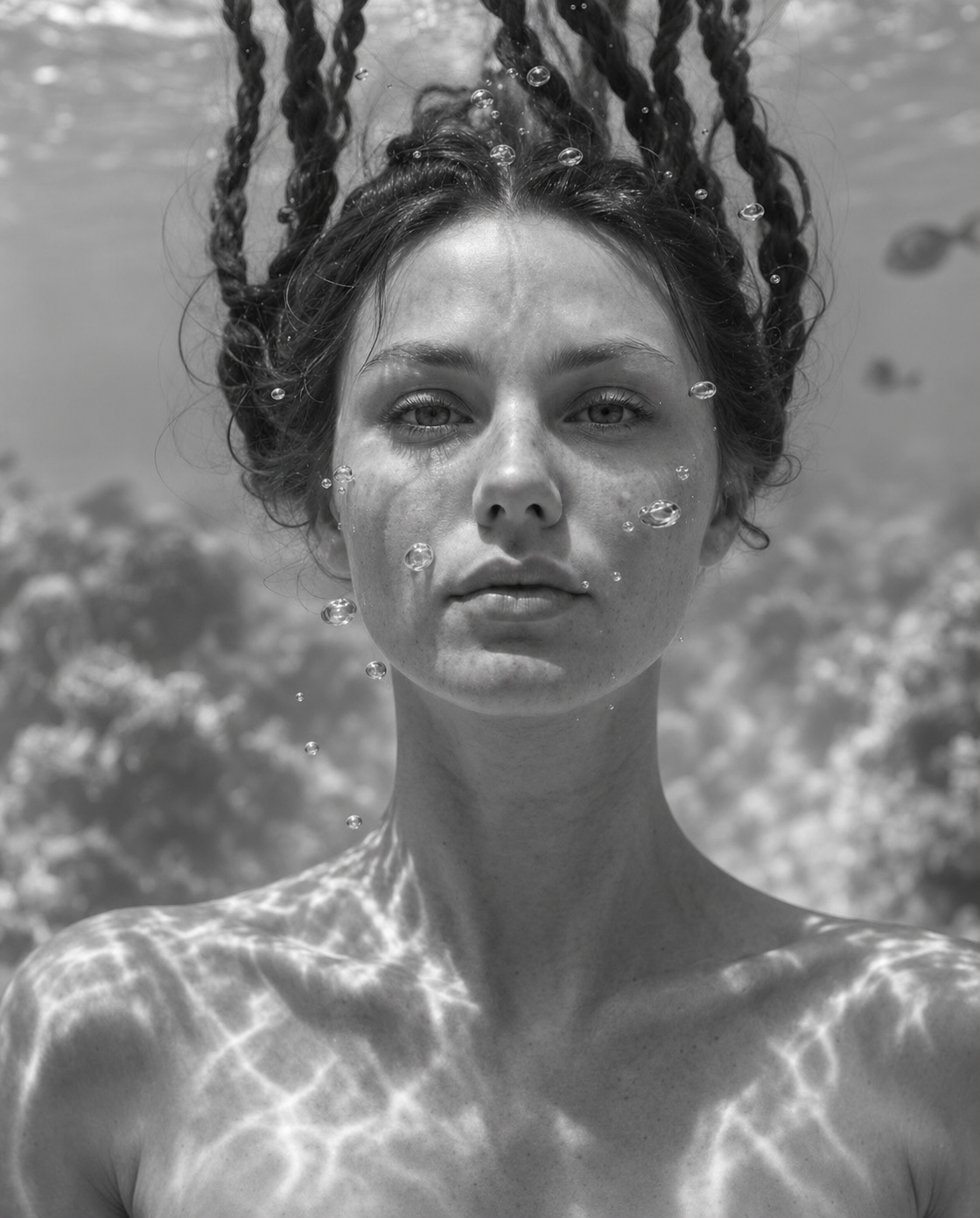
The close-up framing on the woman’s face and upper shoulders makes the portrait intimate, while “shallow depth of field” pushes the reef-like background and faint fish silhouettes into a quiet, low-detail backdrop. “High-contrast monochrome” concentrates the image into black and white, and “cinematic caustic light ripples across shoulders and collarbone” supplies the strongest graphic texture without competing with her face. “Longer, loose braids that float slightly upward,” “slow-rising air bubbles,” and the “serene dreamlike contemplative mood” establish underwater suspension and stillness.
FAQ
→How do I make the woman’s eyes and expression more prominent?
Replace “close-up framing on face and upper shoulders” with “extreme close-up centered on the eyes and upper face,” and change “shallow depth of field” to “razor-sharp focus on both eyes with the cheeks and background softly blurred.” Keep “faint fish silhouettes” but move them farther into the background so they do not compete with the expression.
→How do I make the portrait feel darker and more dramatic instead of serene?
Replace “serene dreamlike contemplative mood” with “tense, mysterious, psychologically dramatic mood,” and change “cinematic lighting” to “hard directional top-light with deep shadow across one side of the face.” You can also replace “a few slow-rising air bubbles” with “dense clusters of bubbles catching sharp highlights” for a more turbulent atmosphere.
→How do I build a matching series with different underwater subjects?
Keep the fixed visual spine, including “editorial black-and-white photography,” “high-contrast monochrome,” “shallow depth of field,” and “cinematic caustic light ripples,” then replace “woman underwater portrait” and “longer, loose braids” with a new subject and identifying detail such as “older man with a close-cropped beard and drifting linen shirt” or “young dancer in a translucent veil.” Preserve “close-up framing on face and upper shoulders” across the series so the varied subjects retain the same portrait structure.
Learn the technique behind this
- Why can't AI spell, and how do I get readable text in an image? — Older diffusion models had no character-level representation of text, so they produced letterform-shaped texture instead of words.
- How should a prompt be structured, and does word order matter? — A prompt that behaves predictably names one subject first, then what it is doing, then where, then the light, then the lens or medium, then the style.
- Why does AI get hands and faces wrong, and how do I fix it? — Hands fail because they're small in frame, extremely variable in pose, and self-occluding — the model has less usable signal per pixel than for any other body part.
Related prompts
Woman in Teal Light, Shadowed Fashion Portrait
Eerie Elegance Among Marble Busts
Charcoal turtleneck with red eye-beam
Dreamy Macro Portrait in Cool Water