Why this works
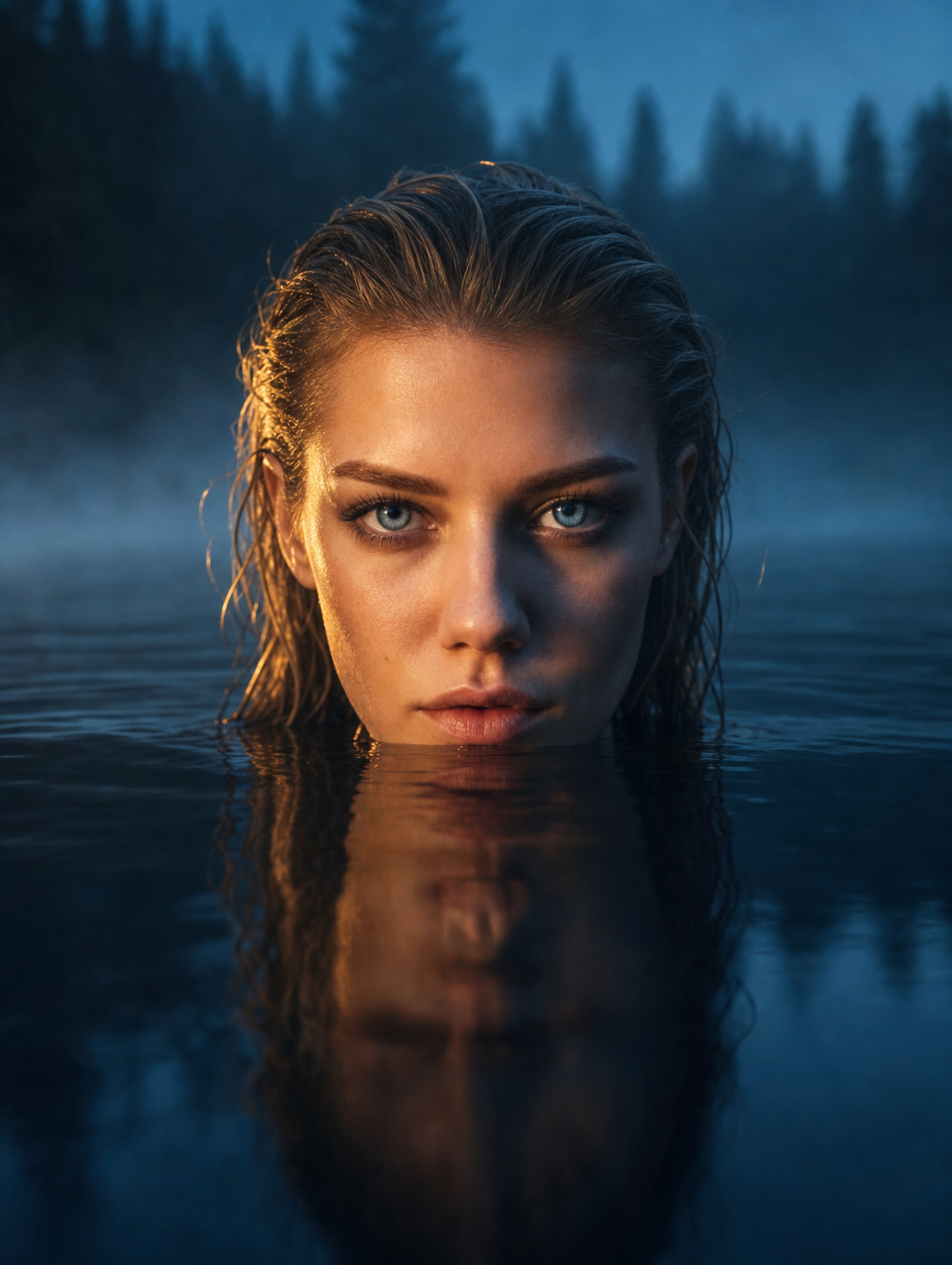
The portrait-closeup framing is anchored by “cinematic close-up” and “face and its reflection sharply featured,” keeping the woman’s icy-blue eyes and mirrored face as the visual center. “Warm golden rim light” against “cool blue ambient light” creates the intense color contrast, while “foggy night forest shoreline,” “murky dark water,” and “mist” supply the atmospheric black-brown field seen around the subject. “Long shallow depth of field” and “soft background falloff” isolate her face, while “crisp mirrored reflection” and “small ripples catching highlights” add a controlled second focal plane rather than letting the water become flat.
FAQ
→How do I make the woman’s eyes and expression more dominant?
Replace “cinematic close-up” with “extreme close-up from forehead to chin,” and change “face and its reflection sharply featured” to “eyes and upper face in razor-sharp focus, reflection secondary and slightly softer.” Keep “fierce, focused gaze directly toward the camera,” but add “eyes occupy the central third of the frame” to make the icy-blue stare more prominent.
→How do I shift this from ominous night drama to a colder, more haunted mood?
Replace “Warm golden rim light outlines her face” with “pale moonlit rim light outlines her face,” and change “cool blue ambient light” to “desaturated cyan ambient light.” Replace “subtle filmic color grading” with “cold, desaturated grading with deep teal shadows,” while keeping “mist” and “murky dark water” to preserve the haunted atmosphere.
→How do I create a series of variations without losing the core composition?
Keep “woman submerged to her neck,” “fierce, focused gaze directly toward the camera,” “cinematic close-up,” and “crisp mirrored reflection” unchanged. Swap only the setting and palette in controlled versions: replace “foggy night forest shoreline” with “abandoned flooded quarry at dawn,” “reed-filled marsh under an overcast sky,” or “rain-soaked urban canal,” then replace the paired lighting phrase with “soft gray daylight,” “muted green backlight,” or “neon magenta and cyan reflections.”
Learn the technique behind this
- Why can't AI spell, and how do I get readable text in an image? — Older diffusion models had no character-level representation of text, so they produced letterform-shaped texture instead of words.
- How should a prompt be structured, and does word order matter? — A prompt that behaves predictably names one subject first, then what it is doing, then where, then the light, then the lens or medium, then the style.
- Why does AI get hands and faces wrong, and how do I fix it? — Hands fail because they're small in frame, extremely variable in pose, and self-occluding — the model has less usable signal per pixel than for any other body part.
Related prompts
Woman in Teal Light, Shadowed Fashion Portrait
Eerie Elegance Among Marble Busts
Charcoal turtleneck with red eye-beam
Dreamy Macro Portrait in Cool Water