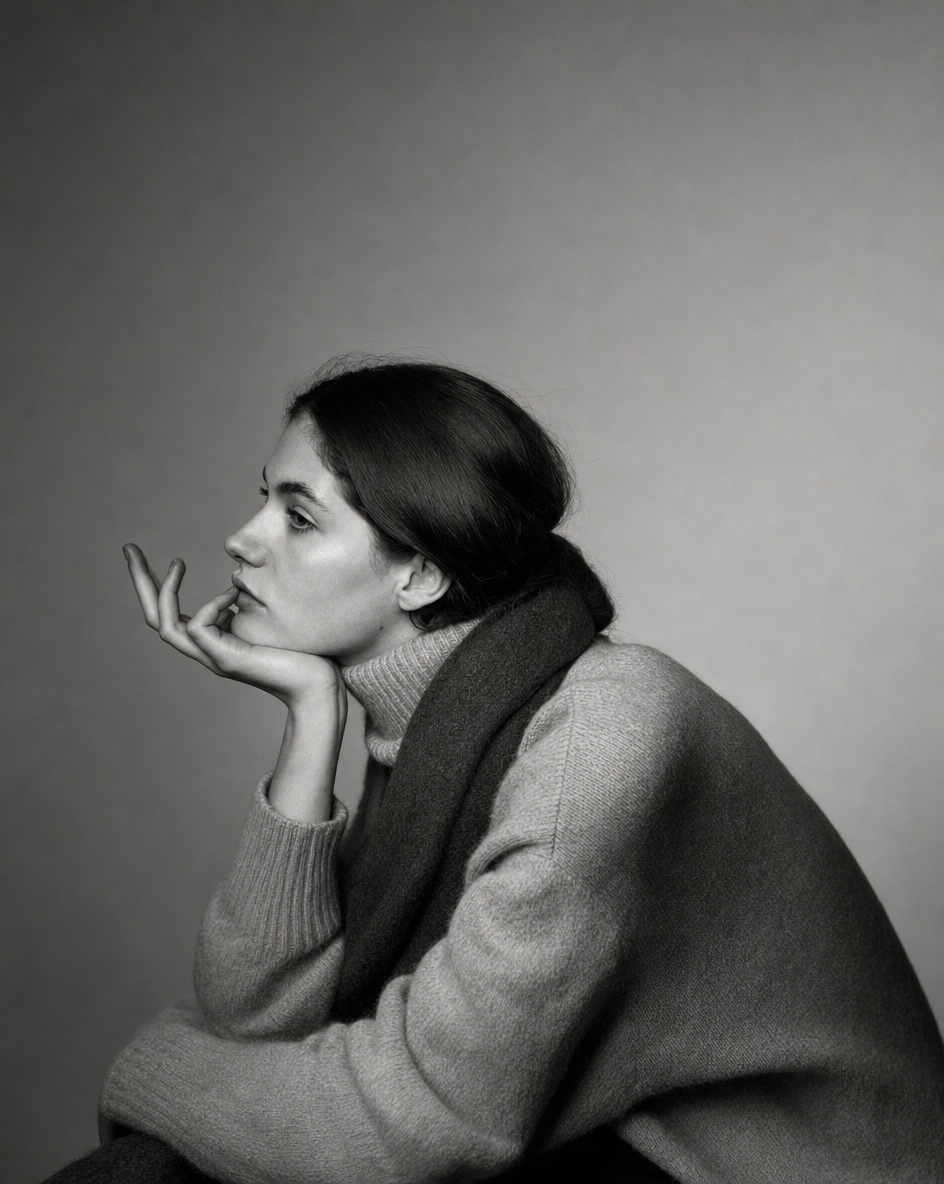
Why this works
The phrase “side profile, resting her chin on her hand” supplies both the contemplative gesture and the portrait-closeup structure, while “realistic studio framing” keeps attention on the face rather than the environment. “Soft but slightly more directional from one side” gives the black-and-white image gentle cheek and jaw definition, and “smooth mid-gray gradient” prevents the “black-and-white” treatment from collapsing into a harsh two-tone background. The calm, refined mood comes from the explicit language “quiet, introspective mood” and “elegant, realistic photography,” reinforced by the restrained wool textures rather than decorative styling.
FAQ
→How do I make the woman’s face and expression more prominent?
Replace “portrait-closeup” and “side-profile composition” with “tight head-and-shoulders close-up, face filling most of the frame, three-quarter profile,” and change “shallow depth feel but sharp subject detail” to “eyes, eyelashes, and skin texture in crisp focus, background fully softened.” Keep “chin resting on her hand” if the reflective gesture should remain visible.
→How do I shift the image from calm introspection to a more dramatic, serious mood?
Replace “soft but slightly more directional lighting from one side” with “hard chiaroscuro side-lighting with deep shadow across half the face,” and replace “smooth mid-gray gradient” with “dark charcoal studio backdrop.” Change “quiet introspective mood” to “tense, solemn mood,” while keeping “black-and-white” to preserve the restrained tonal range.
→How do I create a related series with different subjects or settings?
Keep the structural phrases “black-and-white,” “realistic studio framing,” “shallow depth feel but sharp subject detail,” and “soft, slightly more directional lighting from one side,” then replace the subject block with options such as “older man in side profile, hands folded beneath his chin” or “young violinist looking down at an instrument.” Swap “smooth mid-gray studio backdrop” for “textured plaster wall,” “foggy window,” or “minimalist library interior,” and retain “elegant, realistic photography” for visual consistency.
Learn the technique behind this
- Why can't AI spell, and how do I get readable text in an image? — Older diffusion models had no character-level representation of text, so they produced letterform-shaped texture instead of words.
- Why does AI get hands and faces wrong, and how do I fix it? — Hands fail because they're small in frame, extremely variable in pose, and self-occluding — the model has less usable signal per pixel than for any other body part.
- How should a prompt be structured, and does word order matter? — A prompt that behaves predictably names one subject first, then what it is doing, then where, then the light, then the lens or medium, then the style.
Related prompts
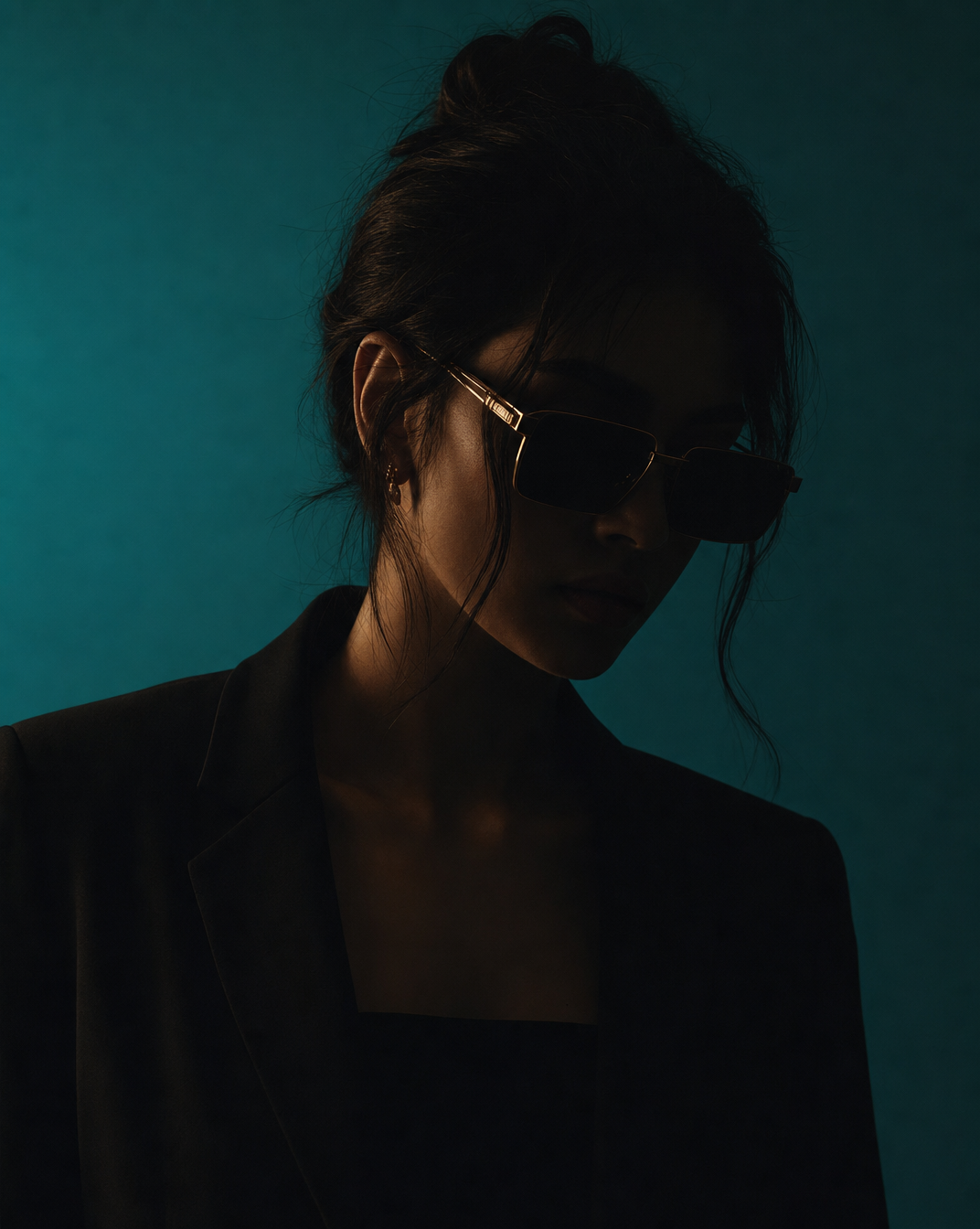
Woman in Teal Light, Shadowed Fashion Portrait

Eerie Elegance Among Marble Busts

Charcoal turtleneck with red eye-beam

Dreamy Macro Portrait in Cool Water