Why this works
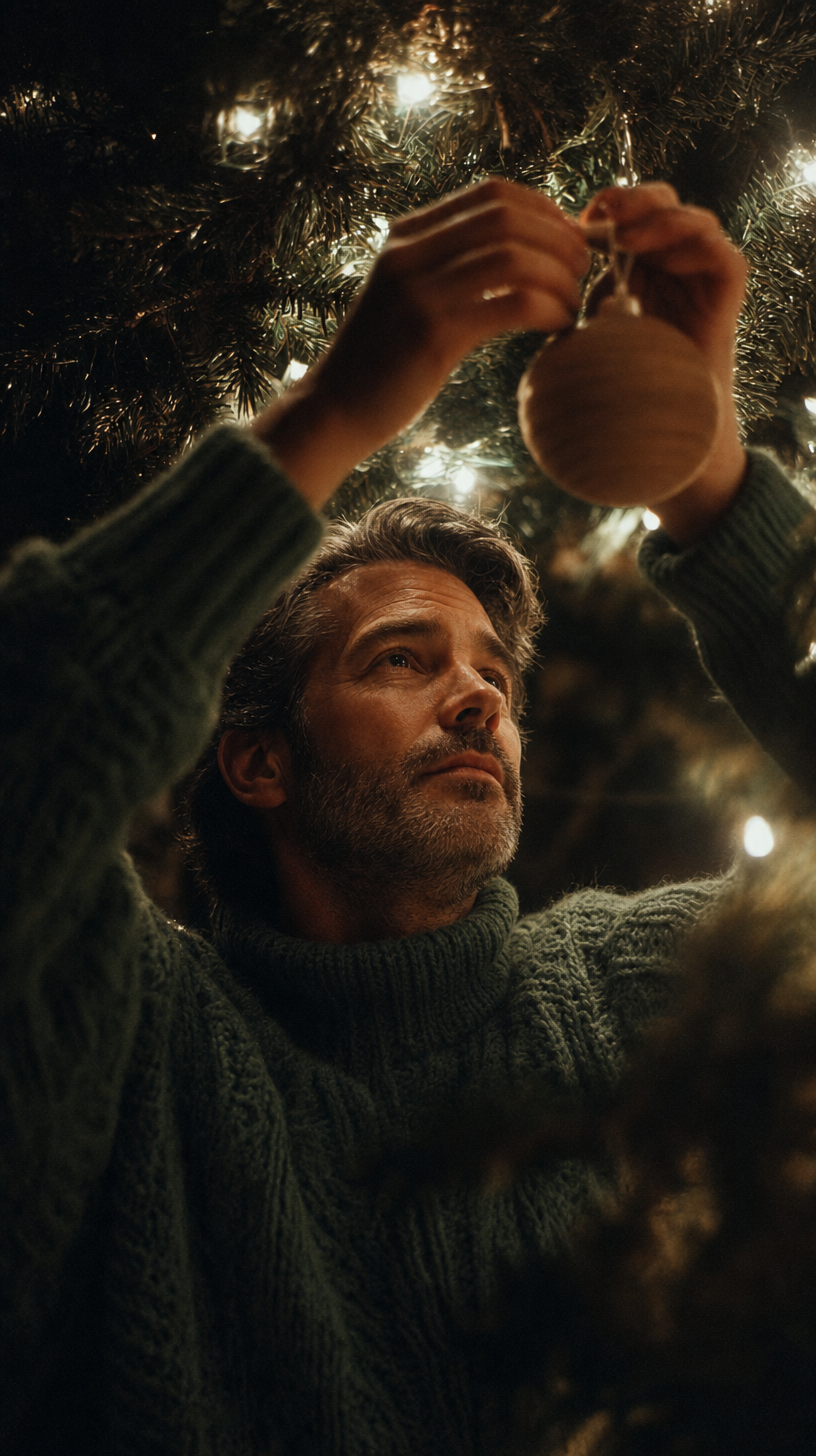
The gold and brown palette in the actual image traces directly to 'warm amber and bronze color palette' and 'warm golden fairy lights glowing softly among dark green pine branches' - that's the load-bearing color language, not some generic Christmas association. The intimacy of the shot comes from 'Cinematic close-up portrait' combined with 'shallow depth of field' and 'soft glowing bokeh', which flattens the background into soft light blobs and forces attention onto the man's face and reaching arms. 'Reaching up with both arms to hang a decorative wooden ornament' is what gives the pose narrative motion instead of a static headshot, and 'film grain' plus 'night-time indoor setting' is what kills any clinical studio-photo feel and makes it read as a captured memory rather than a posed portrait.
FAQ
→How do I make the Christmas tree and ornaments more prominent instead of the man's face?
Swap 'Cinematic close-up portrait' for something like 'Cinematic medium shot' or 'wide environmental portrait' and change 'shallow depth of field' to 'moderate depth of field' so the tree stays sharp. You'd also want to expand 'dark green pine branches' into a fuller description like 'fully decorated Christmas tree with ornaments, tinsel, and string lights' to give the background more to hold once it's in focus.
→How do I shift this from cozy and nostalgic to more dramatic or moody?
Drop 'warm amber and bronze color palette' and 'cozy intimate atmosphere' and replace them with 'cool blue undertones with a single warm light source' or 'high-contrast chiaroscuro lighting'. Keep 'fairy lights glowing softly' but change 'soft glowing bokeh' to 'sharp rim lighting with deep shadow' to pull it toward a more cinematic-thriller feel instead of a Hallmark-card one.
→How do I turn this into a series with different subjects or settings while keeping the same look?
Keep the phrases 'warm golden fairy lights glowing softly', 'amber and bronze color palette', 'soft glowing bokeh', and 'film grain' constant since those are what define the visual identity. Then swap only 'middle-aged man with salt-and-pepper dark hair wearing a forest-green cable-knit sweater' for other figures like 'young woman with curly red hair wearing a cream knit scarf' or 'elderly woman with silver hair wearing a burgundy cardigan', and change the action from 'hanging a decorative wooden ornament' to something like 'pouring hot cocoa' or 'wrapping a gift' to vary the narrative moment.
Learn the technique behind this
- Why does AI get hands and faces wrong, and how do I fix it? — Hands fail because they're small in frame, extremely variable in pose, and self-occluding — the model has less usable signal per pixel than for any other body part.
- Why can't AI spell, and how do I get readable text in an image? — Older diffusion models had no character-level representation of text, so they produced letterform-shaped texture instead of words.
- How should a prompt be structured, and does word order matter? — A prompt that behaves predictably names one subject first, then what it is doing, then where, then the light, then the lens or medium, then the style.
Related prompts

Tabby Cat Reaching for Green Ornament Under Tree
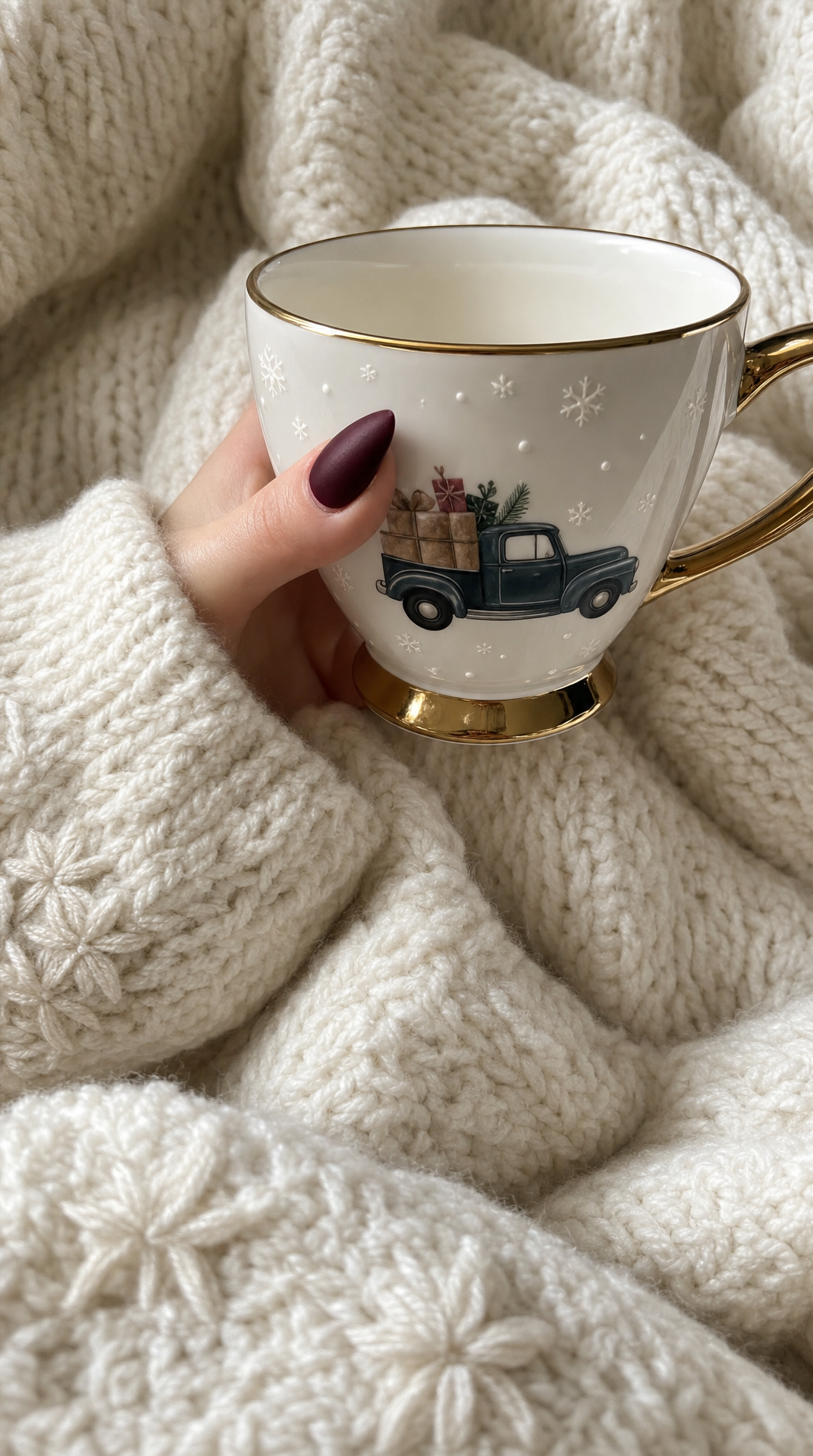
Burgundy nails holding festive snowflake teacup

Festive Fireplace with Navy and Burgundy Stockings

Emerald jeweled Christmas ornament with blue gems