Why this works
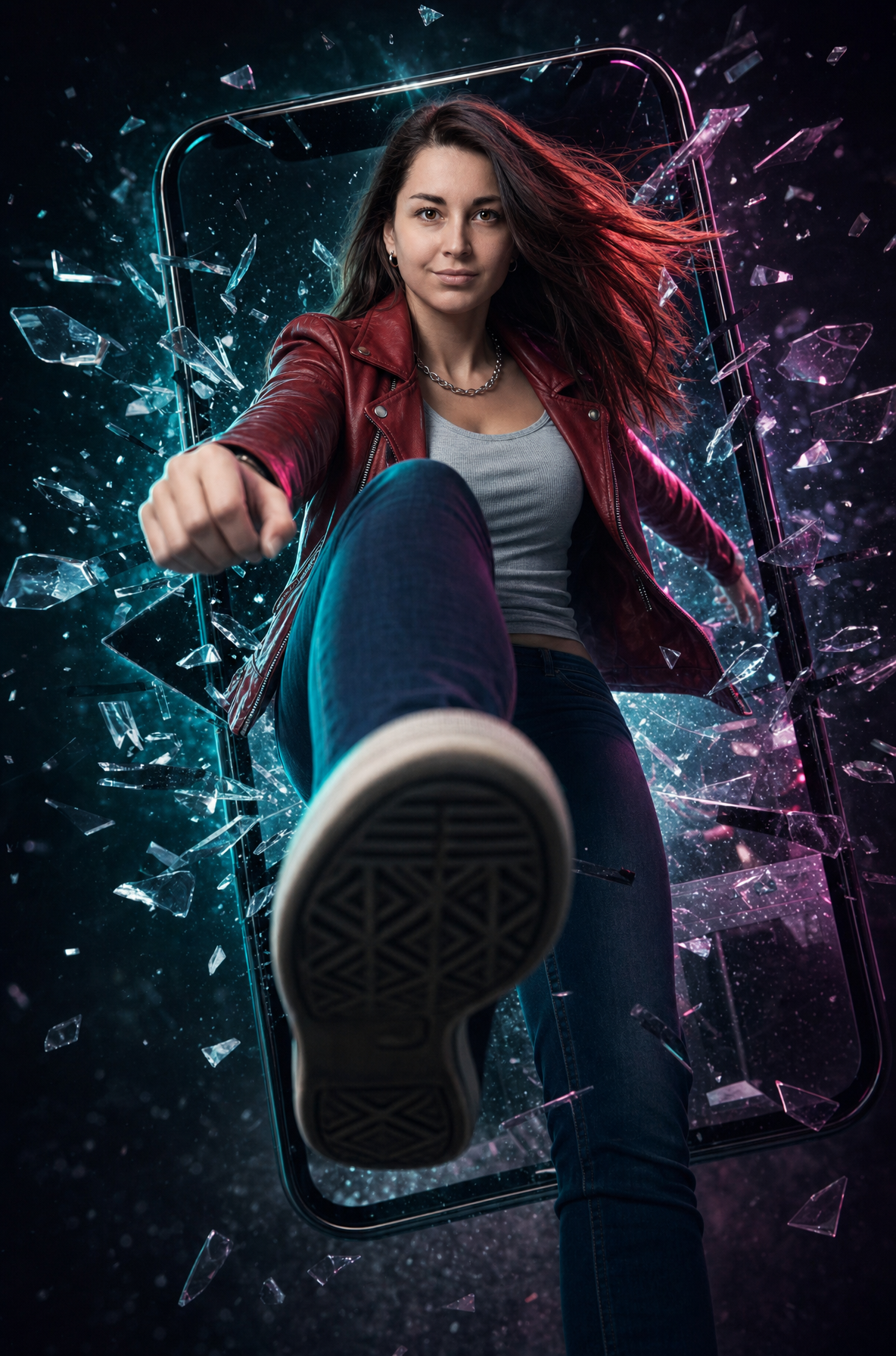
The phrase “low-angle action portrait” combined with “one leg extended toward the camera” makes the woman and her foreshortened leg dominate the candid-action composition, creating an immediate sense of impact and scale. “Bursting out of a giant smartphone through shattered glass” supplies the narrative focal point, while “flying glass shards frozen mid-motion” turns the escape into a crisp suspended moment rather than a blurred action scene. “Dramatic teal-and-magenta rim lighting” establishes the blue-pink color contrast against the “dark moody background,” with the red leather jacket providing the strongest warm accent; “high contrast” and “sharp focus” preserve the photorealistic, intense finish.
FAQ
→How do I make the woman’s face and upper body more central than the extended leg?
Replace “one leg extended toward the camera” with “three-quarter torso framing, face and upper body closest to the camera, legs receding behind her,” and change “low-angle action portrait” to “low-angle medium close-up.” Keep “sharp focus on the subject” so the face remains the visual anchor.
→How do I make this prompt feel darker and more ominous instead of energetic and colorful?
Replace “dramatic teal-and-magenta rim lighting” with “cold desaturated blue backlight with a narrow crimson edge light,” and change “red leather jacket” to “black worn leather jacket.” Add “deep shadows, muted color palette, ominous atmosphere” after “dark moody background,” while retaining “high contrast” for hard-edged tension.
→How do I build a matching series with different devices and poses?
Keep the structural phrases “photorealistic cinematic low-angle action portrait,” “dramatic rim lighting,” “flying glass shards frozen mid-motion,” and “dark moody background” unchanged. Swap “giant smartphone” for “giant transparent tablet,” “holographic smartwatch,” or “oversized laptop screen,” then replace “one leg extended toward the camera” with pose language such as “both hands reaching forward,” “twisting sideways through the display,” or “landing in a crouch.”
Learn the technique behind this
- Why can't AI spell, and how do I get readable text in an image? — Older diffusion models had no character-level representation of text, so they produced letterform-shaped texture instead of words.
- How should a prompt be structured, and does word order matter? — A prompt that behaves predictably names one subject first, then what it is doing, then where, then the light, then the lens or medium, then the style.
- Why does AI get hands and faces wrong, and how do I fix it? — Hands fail because they're small in frame, extremely variable in pose, and self-occluding — the model has less usable signal per pixel than for any other body part.
Related prompts
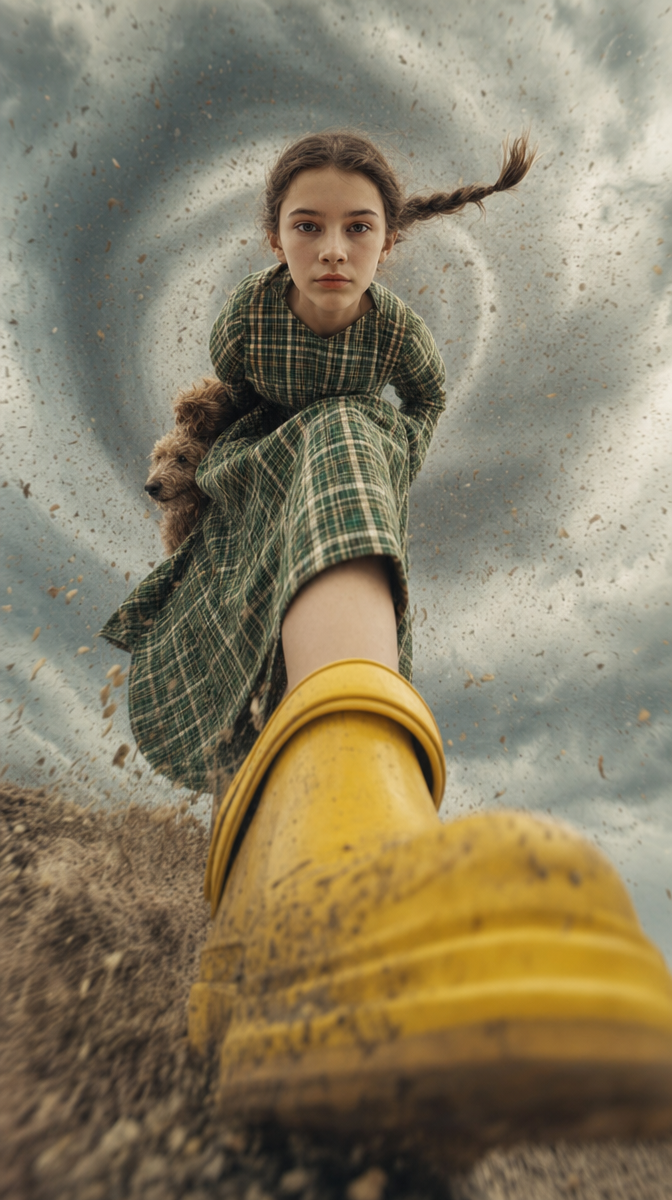
Young girl with dog in tornado
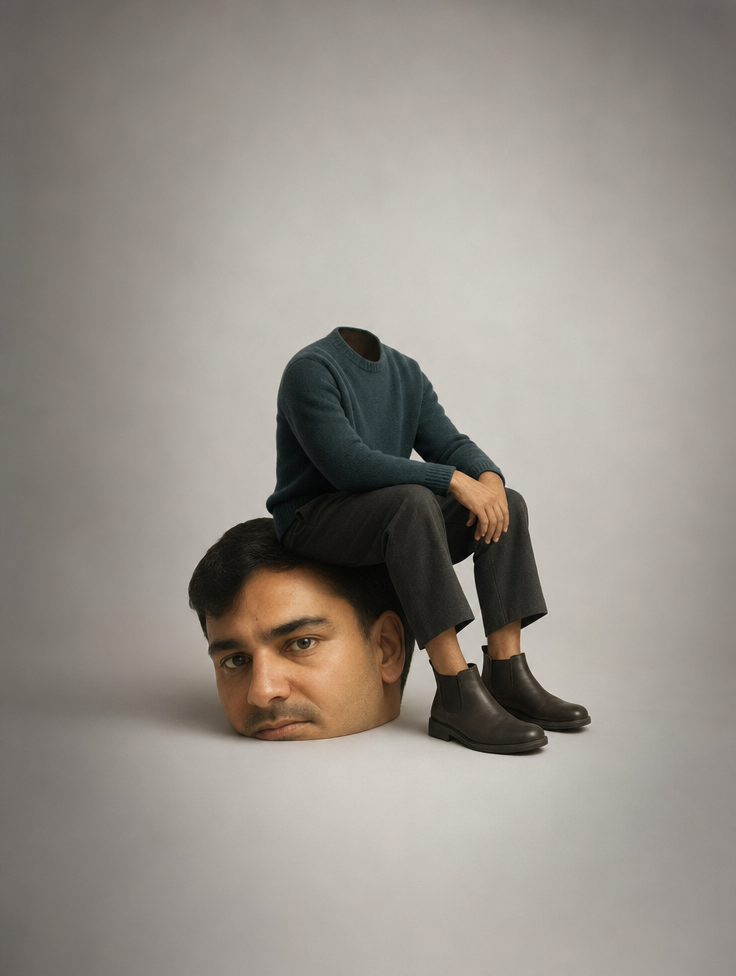
Headless sitter atop a giant head
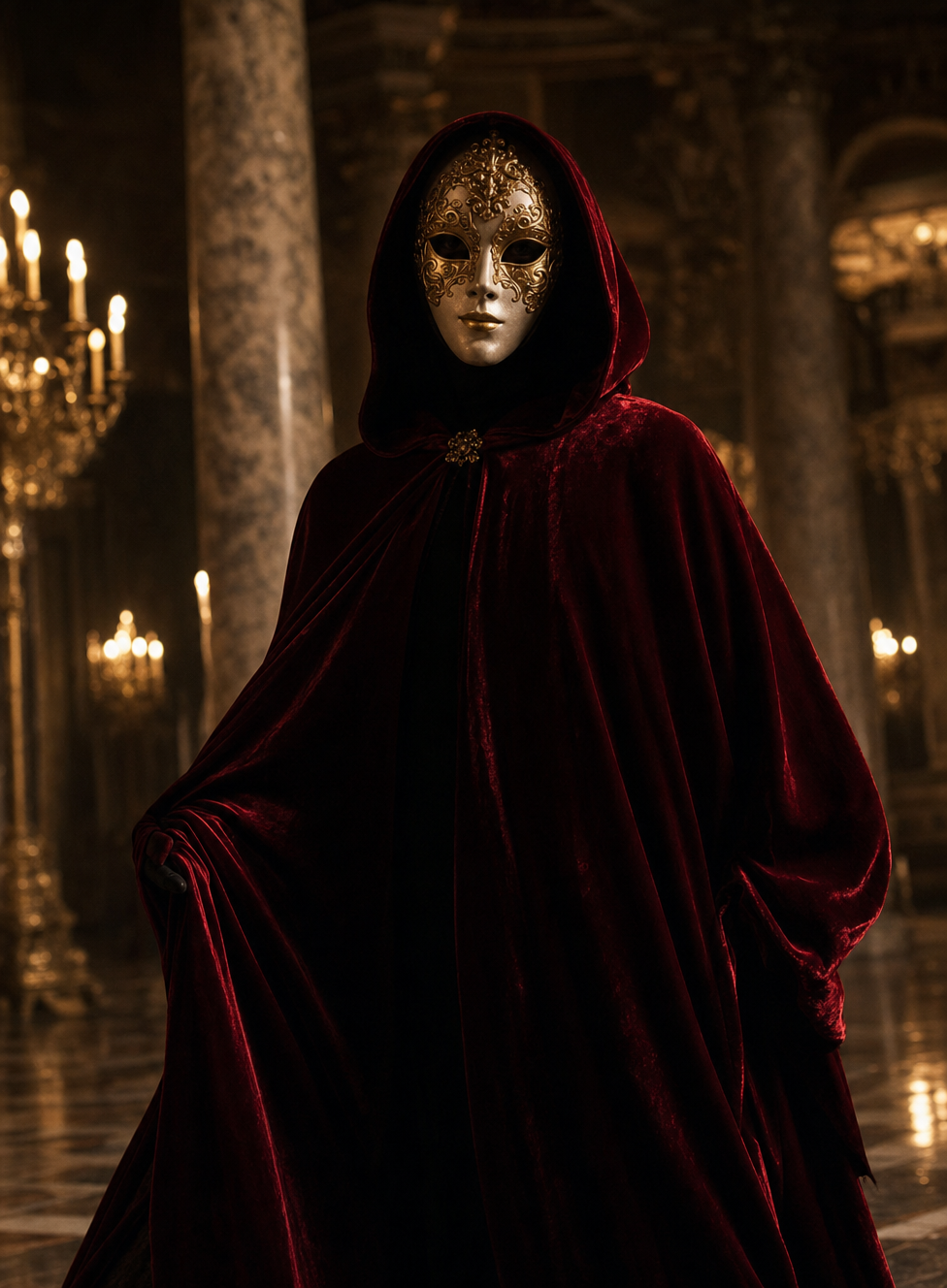
Crimson-Cloaked Specter in Candlelit Ballroom

Violet Holographic Hands Almost Touching