Why this works
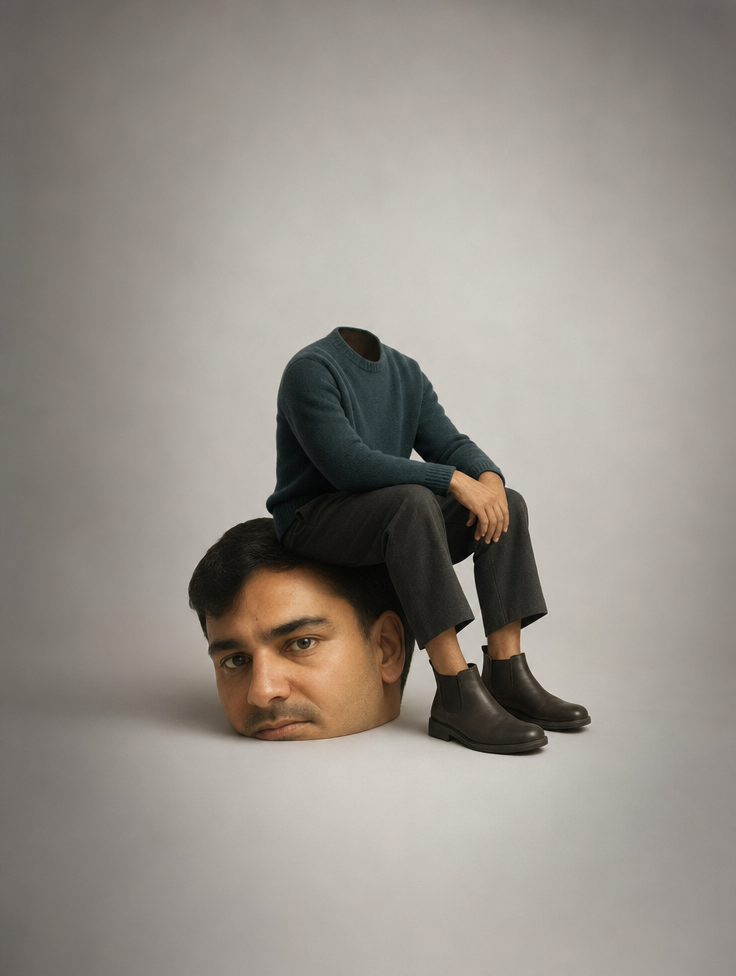
The phrase “headless person sitting on their oversized detached head” supplies the visual contradiction, while “realistic human anatomy” keeps the absurd pose grounded rather than cartoonish. “Full-body, centered, studio-framed composition” and “minimal centered composition” make the figure and oversized head read immediately against the clean space. The light-gray backdrop, “soft side-diffused lighting with gentle shadow falloff,” and dark teal-to-black clothing create restrained contrast, with the image’s brown and black dominance reinforcing its tactile, editorial seriousness.
FAQ
→How do I make the oversized detached head feel more central and imposing?
Replace “oversized detached head” with “massive detached head occupying the central lower frame, larger than the seated body,” and change “full-body, centered” to “slightly low-angle full-body composition with the head as the dominant foreground anchor.” Keep “crisp edges” so the enlarged form remains clearly readable.
→How do I shift the image from uncanny and serious to more playful and colorful?
Replace “long-sleeve dark teal sweater, knee-length trousers, and minimalist dark boots” with “bright coral sweater, mustard-yellow trousers, and cobalt-blue boots.” Change “light-gray studio backdrop” to “pale lavender studio backdrop with a soft mint vignette,” while retaining “realistic human anatomy” to preserve the strange editorial contrast.
→How do I build a series of variations without losing the core concept?
Keep “surreal conceptual editorial artwork,” “headless person sitting on their oversized detached head,” “realistic human anatomy,” and “minimal centered composition” unchanged. Swap only the outfit phrase, such as “structured white suit and polished black loafers,” then vary the setting phrase with options like “warm beige paper backdrop,” “empty brutalist gallery,” or “muted blue cyclorama,” while preserving “studio-grade realism fused with absurdist composition.”
Learn the technique behind this
- Why can't AI spell, and how do I get readable text in an image? — Older diffusion models had no character-level representation of text, so they produced letterform-shaped texture instead of words.
- How do I keep the same character across multiple images? — Text prompts alone won't hold a face across images — a description defines a type, not a person.
- How should a prompt be structured, and does word order matter? — A prompt that behaves predictably names one subject first, then what it is doing, then where, then the light, then the lens or medium, then the style.
Related prompts
Young girl with dog in tornado
Blue-Cloaked Figure Amid Teal Neon

Violet Holographic Hands Almost Touching
Charcoal-suited man on teal plane