Why this works
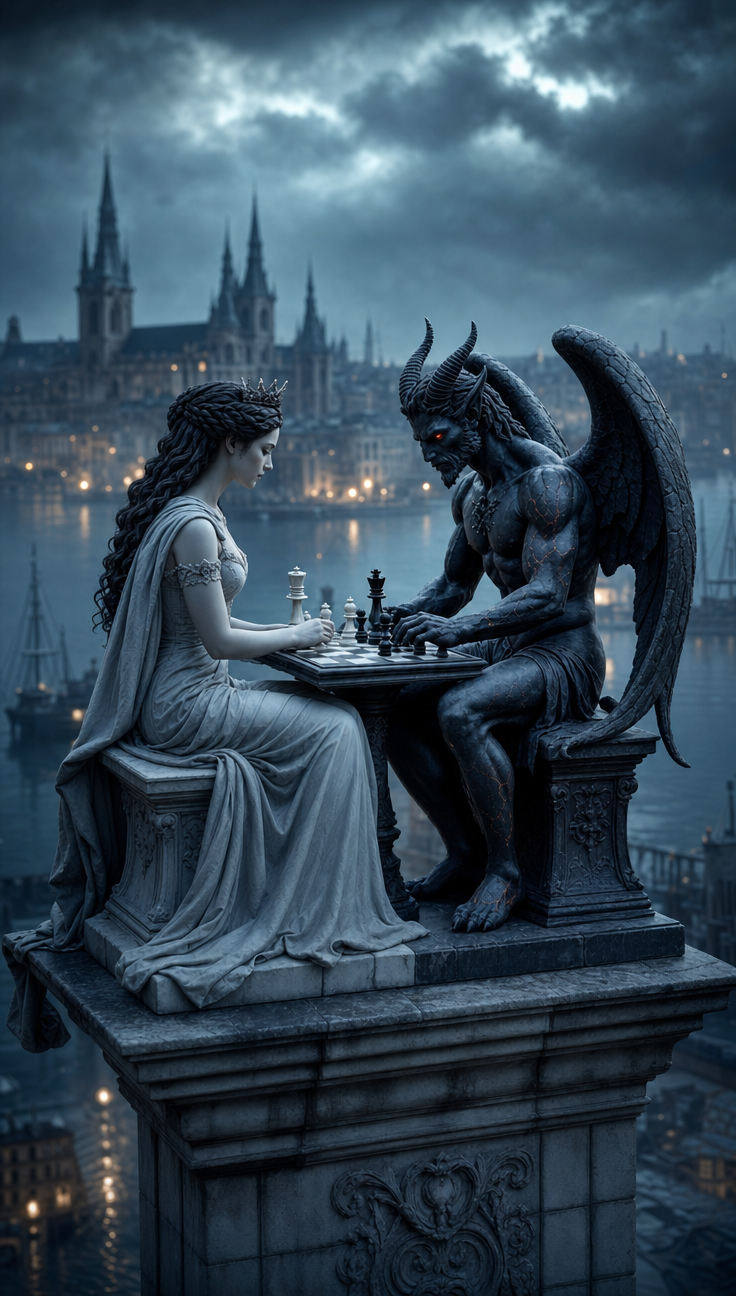
The tightly staged interaction comes from “playing chess on an ornate rooftop pedestal,” while “shallow depth of field focused tightly on the chessboard and their sculpted hands” makes the game and tactile stone materials the visual anchor. “Late twilight with teal-blue storm light,” “glowing window lights,” and “strong atmospheric haze” produce the dominant blue-and-black palette with small warm points in the harbor. The “foggy harbor waterfront” and “blurred old European rooftops and church spires in the far distance” create layered depth behind the portrait-oriented, full-body figures without competing with the board.
FAQ
→How do I make the demon more prominent than the stone woman?
Replace “a white stone woman and a dark horned winged demon playing chess” with “a towering dark horned winged demon dominates the composition, looming over a smaller white stone woman during a tense chess match.” Change “focus tightly on the chessboard and their sculpted hands” to “focus on the demon’s ember-red eyes, horns, and cracked wings, with the chessboard in the lower foreground.”
→How do I shift the scene from moody drama to a warmer, ominous tone?
Replace “late twilight with teal-blue storm light” and “stormy teal-blue color grading” with “pre-dawn copper and bruised-purple lighting with ominous red accents.” Change “glowing harbor window lights” to “isolated amber lamps and reflected firelight in the fog,” while keeping “strong atmospheric haze” for the obscured, threatening atmosphere.
→How do I create a series of related chess scenes with different moves?
Keep the fixed phrases “white stone woman,” “dark horned winged demon,” “foggy harbor waterfront,” and “late twilight with teal-blue storm light” unchanged for visual continuity. Make each variation by replacing “playing chess” with a specific action such as “the demon moving a black queen,” “the stone woman capturing a bishop,” or “both players frozen before checkmate,” and replace “focus tightly on the chessboard and their sculpted hands” with the exact move’s focal detail, such as “focus on the captured bishop and the woman’s hand releasing the queen.”
Learn the technique behind this
- Why can't AI spell, and how do I get readable text in an image? — Older diffusion models had no character-level representation of text, so they produced letterform-shaped texture instead of words.
- Why does AI get hands and faces wrong, and how do I fix it? — Hands fail because they're small in frame, extremely variable in pose, and self-occluding — the model has less usable signal per pixel than for any other body part.
- How should a prompt be structured, and does word order matter? — A prompt that behaves predictably names one subject first, then what it is doing, then where, then the light, then the lens or medium, then the style.
Related prompts
Young girl with dog in tornado
Headless sitter atop a giant head
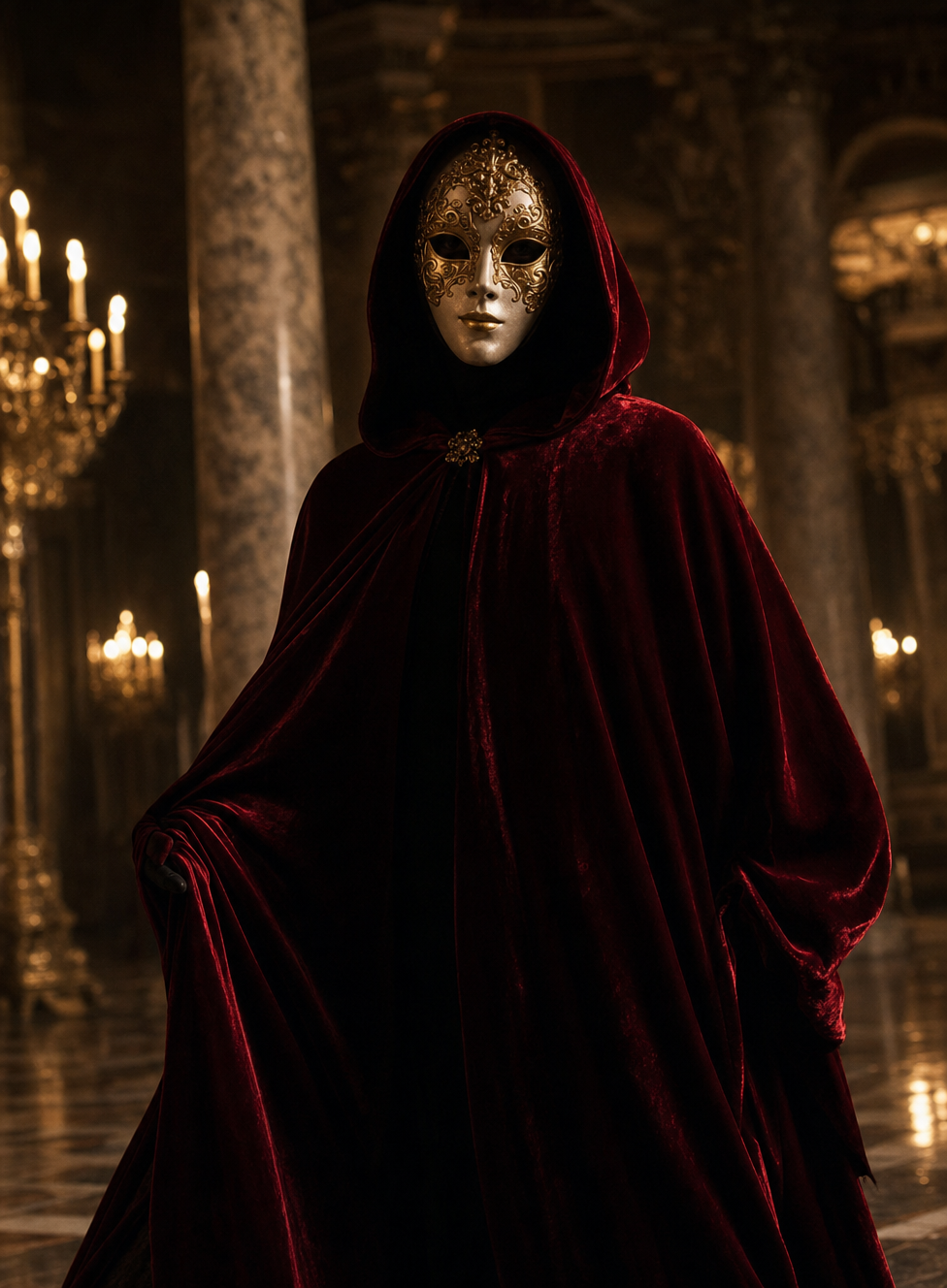
Crimson-Cloaked Specter in Candlelit Ballroom

Violet Holographic Hands Almost Touching