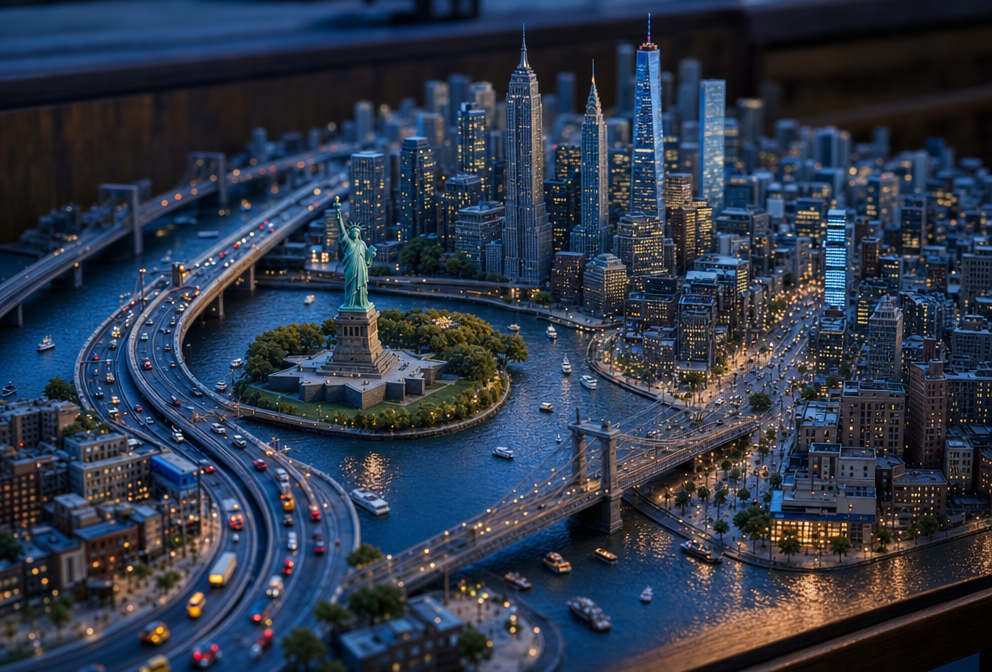
Same prompt, generated with each model separately — click one to see how it holds up.
Why this works
“Statue of Liberty at the center” gives the wide shot a clear anchor, while “dense skyline of skyscrapers and arched bridge spans over the water” builds layered scale around it. The miniature illusion comes from “built as a tiny diorama on a polished wooden table,” reinforced by “tilt-shift miniature perspective” and “shallow depth of field.” “Cooler evening twilight with soft blue highlights” supplies the gray-blue city atmosphere, while “warm amber reflections only on the tabletop” concentrates the brown warmth below instead of letting neon traffic dominate; “ultra-detailed textures” keeps windows, streets, and bridge cables legible within the cinematic framing.
FAQ
→How do I make the Statue of Liberty more prominent than the surrounding skyline?
Replace “surrounded by a dense skyline of skyscrapers” with “towering Statue of Liberty as the dominant subject, with a lower, more distant skyline,” and add “central foreground placement, unobstructed silhouette, brighter cool rim light on the statue.” Keep “wide-shot” for context, or change it to “medium-wide shot” for a tighter emphasis.
→How do I turn the cool twilight scene into a warmer, more nostalgic miniature?
Replace “cooler evening twilight with soft blue highlights” with “late golden-hour light with soft honey and rose highlights,” and change “warmer amber reflections only on the tabletop” to “broad amber reflections across the tabletop and water.” Replace “less intense traffic glow” with “subtle warm window and streetlight glow” to preserve detail without returning to a neon-heavy look.
→How do I create a matching series with different landmark cities?
Keep the structural phrases “dramatic cinematic tilt-shift miniature city scene,” “built as a tiny diorama on a polished wooden table,” “shallow depth of field,” and “filmic color grading.” Swap “New York Cityscape” and “Statue of Liberty” for a landmark pair such as “miniature Paris cityscape centered on the Eiffel Tower,” then replace “arched bridge spans” with location-specific forms such as “stone river bridges and Haussmann rooftops,” while retaining the same “cool evening twilight” and “warm amber reflections” for visual consistency.
Learn the technique behind this
- Why can't AI spell, and how do I get readable text in an image? — Older diffusion models had no character-level representation of text, so they produced letterform-shaped texture instead of words.
- How should a prompt be structured, and does word order matter? — A prompt that behaves predictably names one subject first, then what it is doing, then where, then the light, then the lens or medium, then the style.
- Do negative prompts work, and what should go in one? — Negative prompts work on models that support a separate negative conditioning channel — mainly Stable Diffusion and FLUX-family models.
Related prompts
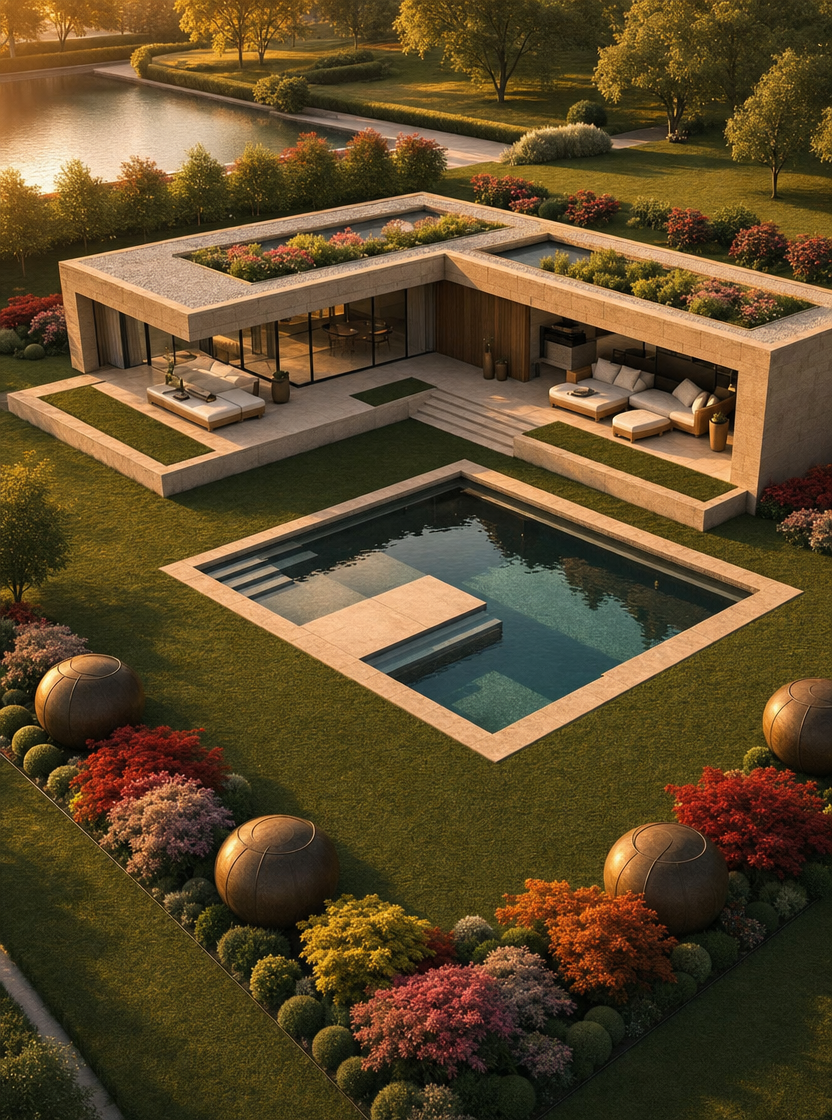
Beige Modern Villa with Rectangular Pool Garden
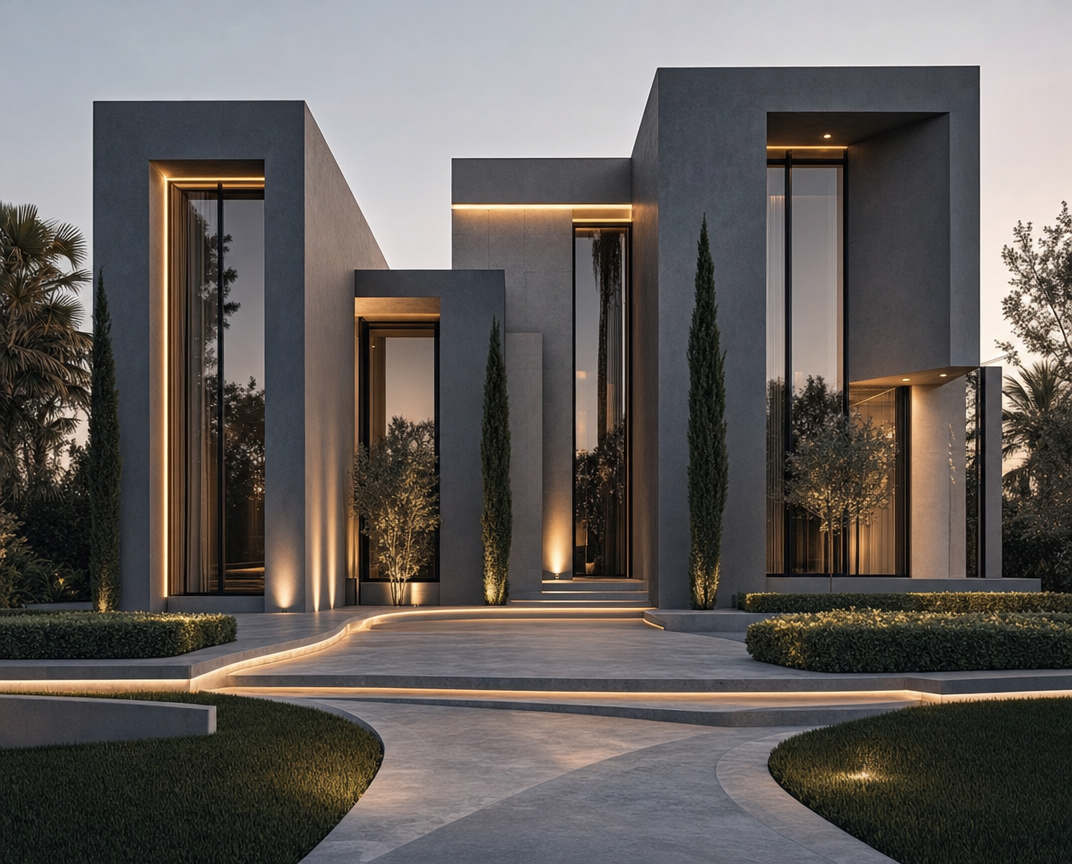
Luxury modern villa with dark concrete facade and vertical windows
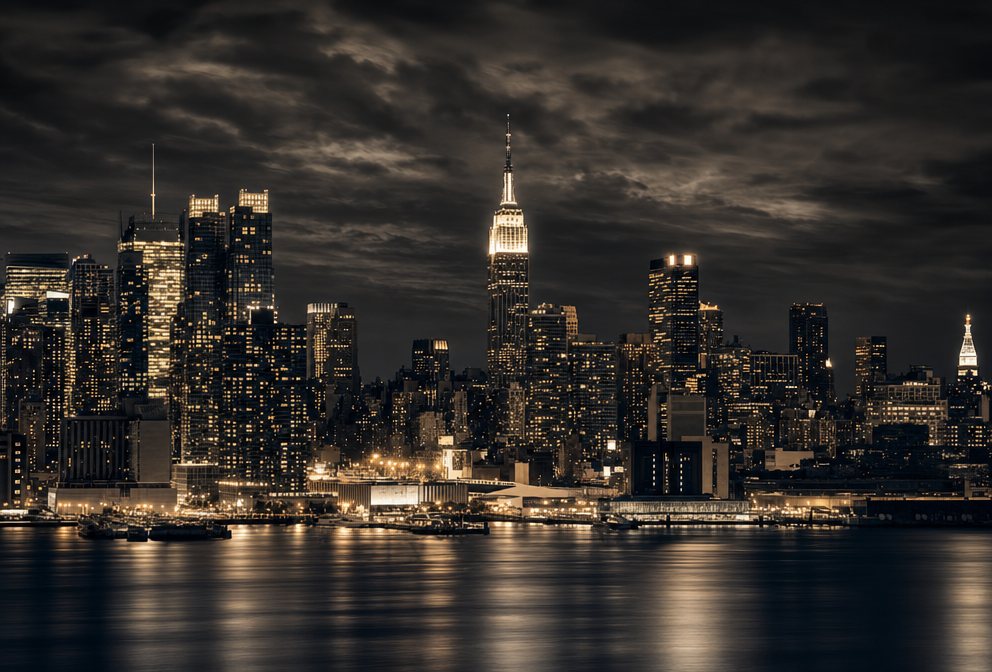
Night City Skyline with Amber Windows and Sepia Water
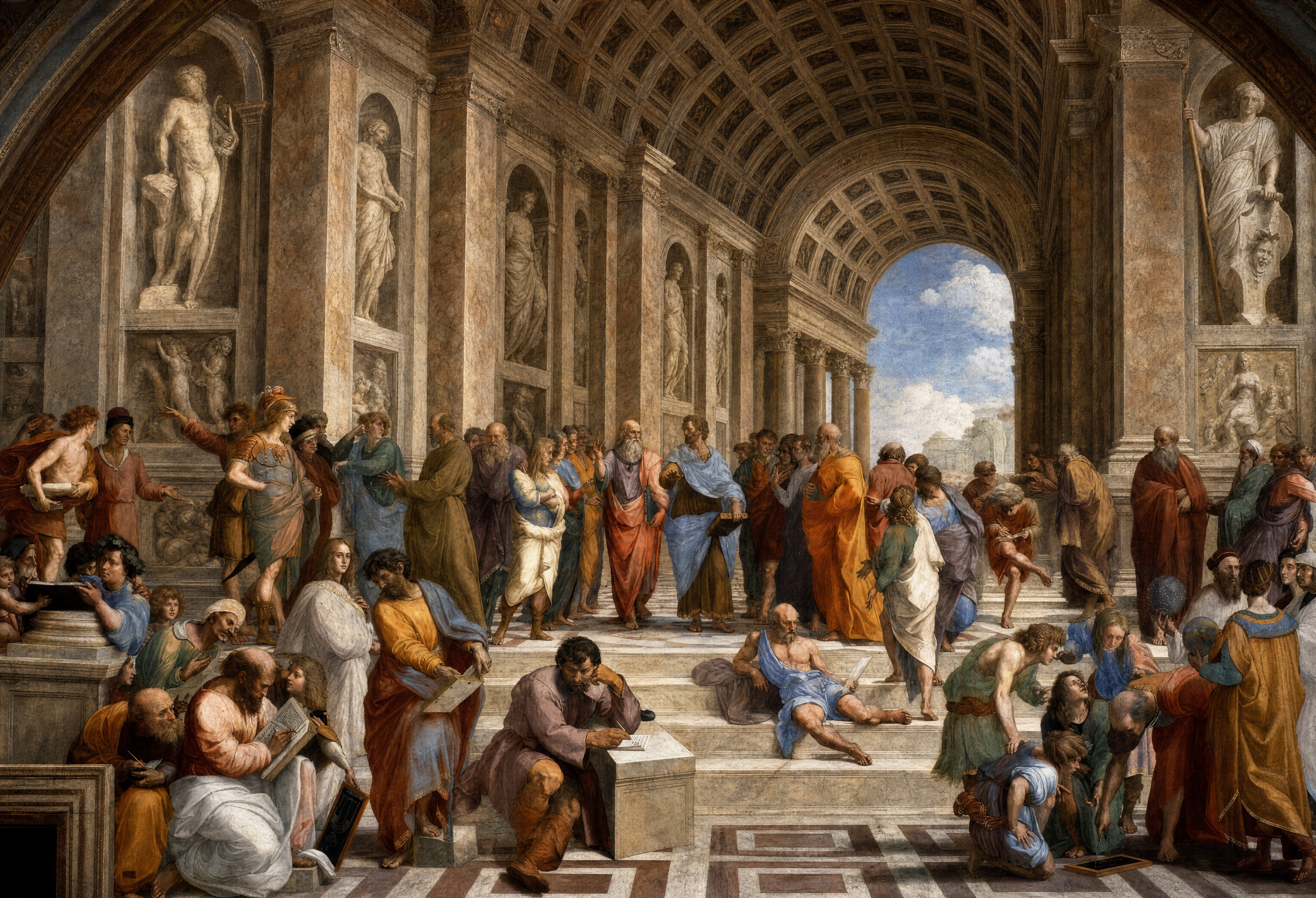
Renaissance Scholars in Ornate Vaulted Hall