Why this works
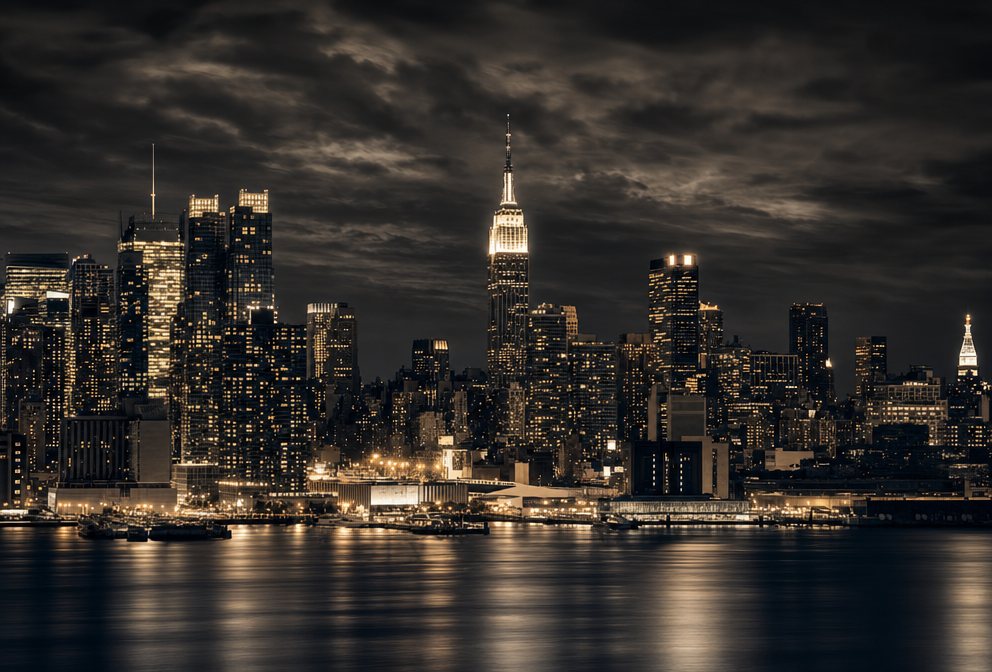
“Ultra-wide panoramic framing” and “skyline over still water” establish the broad, balanced wide-shot composition, while “taller glass-and-steel skyscrapers standing out among dense midrise buildings” creates a clear vertical hierarchy. The calm mood comes from “still water,” “darker cooler sky with more visible cloud texture,” and the explicit “cinematic and calm atmosphere”; “subtle warm amber glow from windows” against the cool sky supplies the gray-and-gold contrast. “Long-exposure water reflections with slight streaking” adds the image’s strongest motion effect without disturbing the quiet scene, and “photorealistic long-exposure photography” keeps the architecture and reflections sharply credible.
FAQ
→How do I make one skyscraper the clear focal point?
Replace “taller glass-and-steel skyscrapers standing out among dense midrise buildings” with “one dominant glass-and-steel tower centered in the skyline, far taller and brighter than the surrounding midrise buildings.” Add “slightly brighter amber windows on the central tower” to direct attention without changing the nighttime setting.
→How do I shift this from calm cinematic photography to a more dramatic stormy mood?
Replace “still water,” “subtle warm amber glow,” and “cinematic and calm atmosphere” with “wind-ruffled water,” “bold golden window light breaking through heavy rain,” and “tense cinematic storm atmosphere.” Keep “darker cooler sky with more visible cloud texture,” but change it to “dense storm clouds with sharply defined texture” for stronger drama.
→How do I create a matching daytime variation from this prompt?
Replace “nighttime city skyline,” “warm amber glow from windows,” and “darker cooler sky” with “bright overcast daytime city skyline,” “cool daylight reflecting across glass facades,” and “pale textured sky.” Change “muted sepia monochrome” to “muted blue-gray natural color palette” while retaining “ultra-wide panoramic framing” and “long-exposure water reflections” for series consistency.
Learn the technique behind this
- Why can't AI spell, and how do I get readable text in an image? — Older diffusion models had no character-level representation of text, so they produced letterform-shaped texture instead of words.
- How do I keep one consistent style across a whole set of images? — Style consistency is more achievable than character consistency because style lives in describable attributes.
- How should a prompt be structured, and does word order matter? — A prompt that behaves predictably names one subject first, then what it is doing, then where, then the light, then the lens or medium, then the style.
Related prompts
Beige Modern Villa with Rectangular Pool Garden
Luxury modern villa with dark concrete facade and vertical windows
Miniature Paris floating above cross-section terrain
Renaissance Scholars in Ornate Vaulted Hall