Why this works
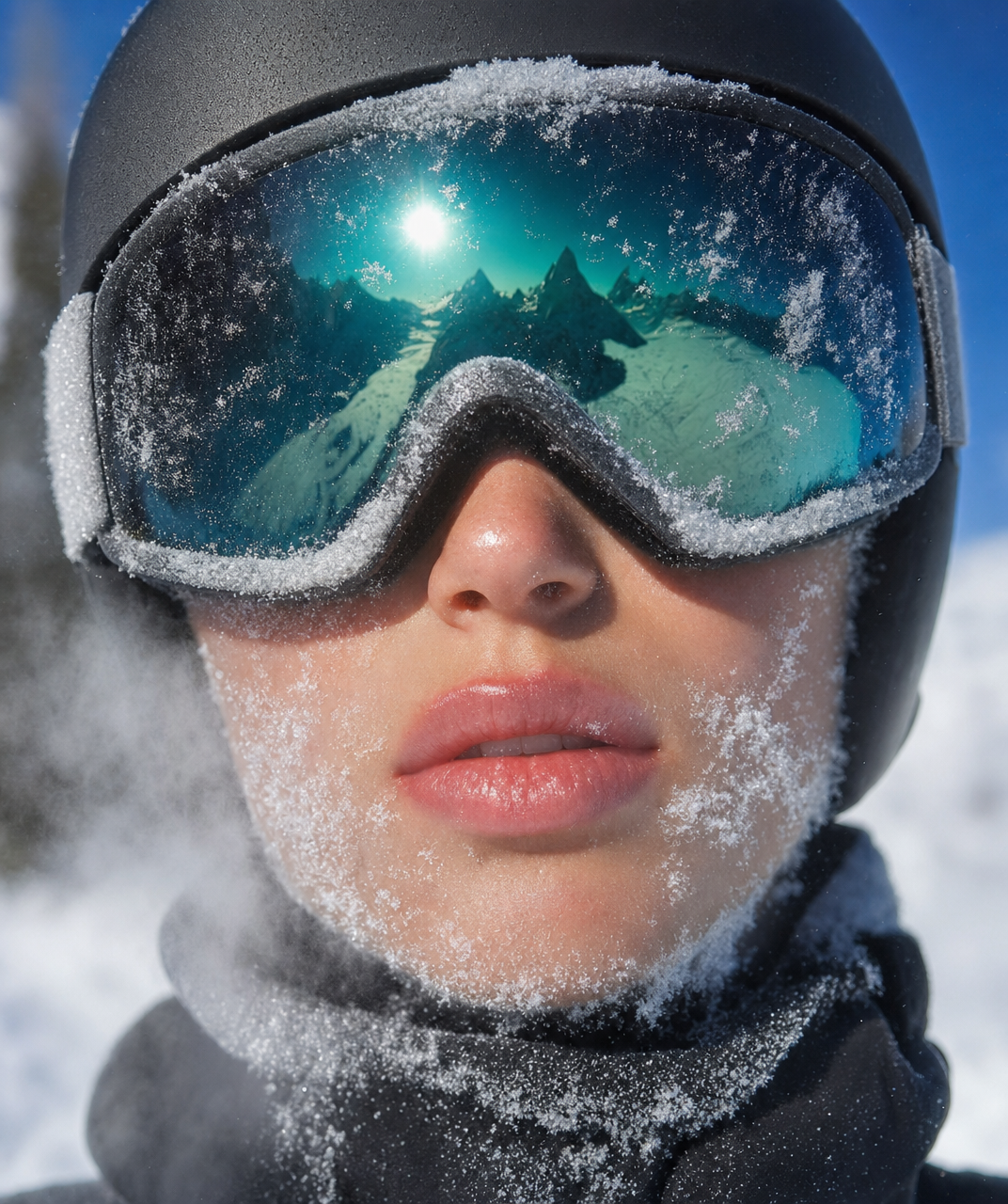
The portrait-closeup framing makes the skier’s face and goggles fill the image, while “shallow depth of field” pushes the snowy background into a soft gray-blue blur. “Harsh bright winter sunlight with crisp highlights and subtle lens flare” supplies the cold, intense brightness, and the teal-tinted goggles add blue and sky-blue color against the matte black helmet. “Fine frost crystals,” “faintly visible” breath, and “colorful mountain scenery” reflected in the goggles provide tactile detail and small pink accents without competing with the face.
FAQ
→How do I make the skier’s eyes or expression more central and prominent?
Replace “teal-tinted oversized reflective ski goggles” with “slightly smaller translucent ski goggles revealing the skier’s focused eyes,” and change “portrait-closeup” to “tight face portrait centered on the eyes.” Keep “fine frost crystals” on the cheeks, but remove “reflective” if the goggles still obscure too much facial detail.
→How do I change the bright, intense mood into a darker stormy one?
Replace “harsh bright winter sunlight” with “diffuse blue-gray light beneath an approaching snowstorm,” and remove “crisp highlights and subtle lens flare.” Change “softly blurred snowy background” to “windblown snowfall and dark alpine ridges,” while keeping “faintly visible” breath to preserve the cold atmosphere.
→How do I build a matching series with different winter subjects?
Keep the shared structure “photorealistic editorial close-up portrait,” “harsh bright winter sunlight,” “shallow depth of field,” and “fine frost crystals,” then replace “a skier wearing a matte black ski helmet” with subjects such as “a snowboarder in a white helmet” or “an ice climber in a red hood.” Replace “colorful mountain scenery” in the goggles with a setting-specific reflection such as “a crowded ski village” or “sheer frozen cliffs,” while retaining the same close-up framing and lens treatment.
Learn the technique behind this
- Why can't AI spell, and how do I get readable text in an image? — Older diffusion models had no character-level representation of text, so they produced letterform-shaped texture instead of words.
- How should a prompt be structured, and does word order matter? — A prompt that behaves predictably names one subject first, then what it is doing, then where, then the light, then the lens or medium, then the style.
- Why does the model ignore parts of my prompt? — Ignored instructions are almost always conflicts, counts, or spatial relationships — three things current models handle badly — rather than the model failing to read you.
Related prompts
Woman in Teal Light, Shadowed Fashion Portrait
Eerie Elegance Among Marble Busts
Charcoal turtleneck with red eye-beam
Dreamy Macro Portrait in Cool Water