Why this works
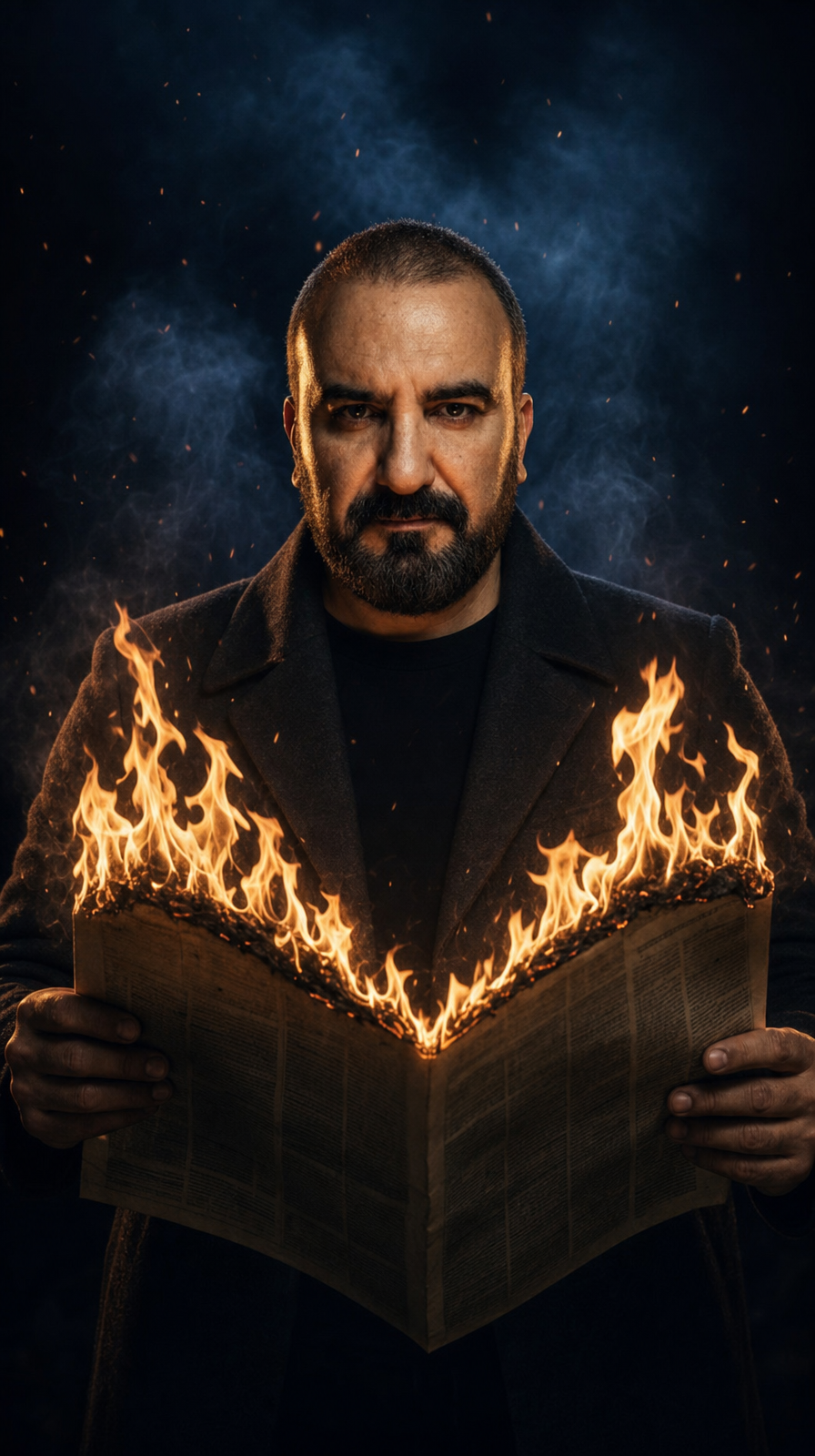
The centered composition and portrait-full-body framing make the man and the burning newspaper the immediate focal structure, while “intense expression” gives the face a controlled dramatic anchor. The warm-versus-cool color harmony comes from “warm amber light” on the face and coat against the “deep bluish-gray smoky studio background,” with the “bright flames rising from the paper” supplying the orange focal point and brown coat tones. “Dramatic low-key lighting with high contrast” deepens the stern mood by preserving dark areas, while “glowing embers floating through the air” add motion around the otherwise fixed studio portrait.
FAQ
→How do I make the burning newspaper feel more central and visually dominant?
Replace “centered composition” with “tight waist-up composition with the burning newspaper occupying the lower center foreground,” and change “bright flames rising from the paper” to “large flames dominating the lower half of the frame, partially overlapping the hands.” Keep “warm amber light” so the enlarged fire remains the brightest focal element.
→How do I shift this from an ominous portrait to a calmer, reflective mood?
Replace “stern” and “intense expression” with “quiet, contemplative expression,” and change “dramatic low-key lighting with high contrast” to “soft diffused studio lighting with gentle shadows.” Replace “deep bluish-gray smoky studio background” with “muted blue-gray background with light haze” and reduce “glowing embers floating through the air” to “a few fading sparks.”
→How do I build a series of variations without losing the visual identity?
Keep the fixed phrases “centered composition,” “deep bluish-gray smoky studio background,” “warm amber light,” and “photorealistic skin texture and fabric detail.” Create variants by replacing “a stern middle-aged man with a short dark beard” with subjects such as “an elderly woman with silver hair” or “a young firefighter,” and replace “burning newspaper” with “burning letter,” “old photograph,” or “folded map,” while preserving “flames rising from the paper” as “flames rising from the object.”
Learn the technique behind this
- Why does AI get hands and faces wrong, and how do I fix it? — Hands fail because they're small in frame, extremely variable in pose, and self-occluding — the model has less usable signal per pixel than for any other body part.
- Why can't AI spell, and how do I get readable text in an image? — Older diffusion models had no character-level representation of text, so they produced letterform-shaped texture instead of words.
- How should a prompt be structured, and does word order matter? — A prompt that behaves predictably names one subject first, then what it is doing, then where, then the light, then the lens or medium, then the style.
Related prompts
Woman in Teal Light, Shadowed Fashion Portrait

Eerie Elegance Among Marble Busts
Charcoal turtleneck with red eye-beam

Dreamy Macro Portrait in Cool Water