Why this works
The close-up, eye-level framing makes the smiling man’s face and friendly expression the clear focal point, while “ultra-detailed facial features” preserves texture around his eyes and mouth. “Warm afternoon sunlight with a gentle golden tint” supplies the approachable mood, and “solid navy polo shirt” anchors the dominant blue against the brown tortoiseshell glasses and beige-gold skin and background tones. “Shallow depth of field” and “softly blurred outdoor background with bokeh” separate the subject from the setting without losing the portrait’s natural outdoor context.
FAQ
→How do I change this prompt for a cooler, more serious portrait?
Replace “smiling” and “friendly approachable expression” with “reserved, thoughtful expression,” and change “warm afternoon sunlight with a gentle golden tint” to “cool overcast daylight with soft blue-gray shadows.” Keep “natural skin tones” to prevent the cooler lighting from making the face look unnaturally pale.
→How do I make the glasses and face more visually prominent?
Replace “close-up” with “tight extreme close-up from forehead to chin,” and add “round tortoiseshell eyeglasses sharply in focus, crisp reflections on the lenses.” Retain “shallow depth of field” and “softly blurred outdoor background with bokeh” so the background recedes while the eyewear and facial details stay dominant.
→How do I turn this into a consistent series with different subjects?
Keep the fixed visual structure, including “eye-level close-up,” “warm afternoon sunlight with a gentle golden tint,” “shallow depth of field,” “natural skin tones,” and “softly blurred outdoor background with bokeh.” Replace only “smiling man with round tortoiseshell eyeglasses and a solid navy polo shirt” with a controlled subject slot such as “smiling woman with silver hoop earrings and a cream linen blouse,” then repeat the same framing and lighting for each variation.
Learn the technique behind this
- Why can't AI spell, and how do I get readable text in an image? — Older diffusion models had no character-level representation of text, so they produced letterform-shaped texture instead of words.
- How should a prompt be structured, and does word order matter? — A prompt that behaves predictably names one subject first, then what it is doing, then where, then the light, then the lens or medium, then the style.
- Do negative prompts work, and what should go in one? — Negative prompts work on models that support a separate negative conditioning channel — mainly Stable Diffusion and FLUX-family models.
Related prompts
Woman in Teal Light, Shadowed Fashion Portrait
Eerie Elegance Among Marble Busts
Charcoal turtleneck with red eye-beam
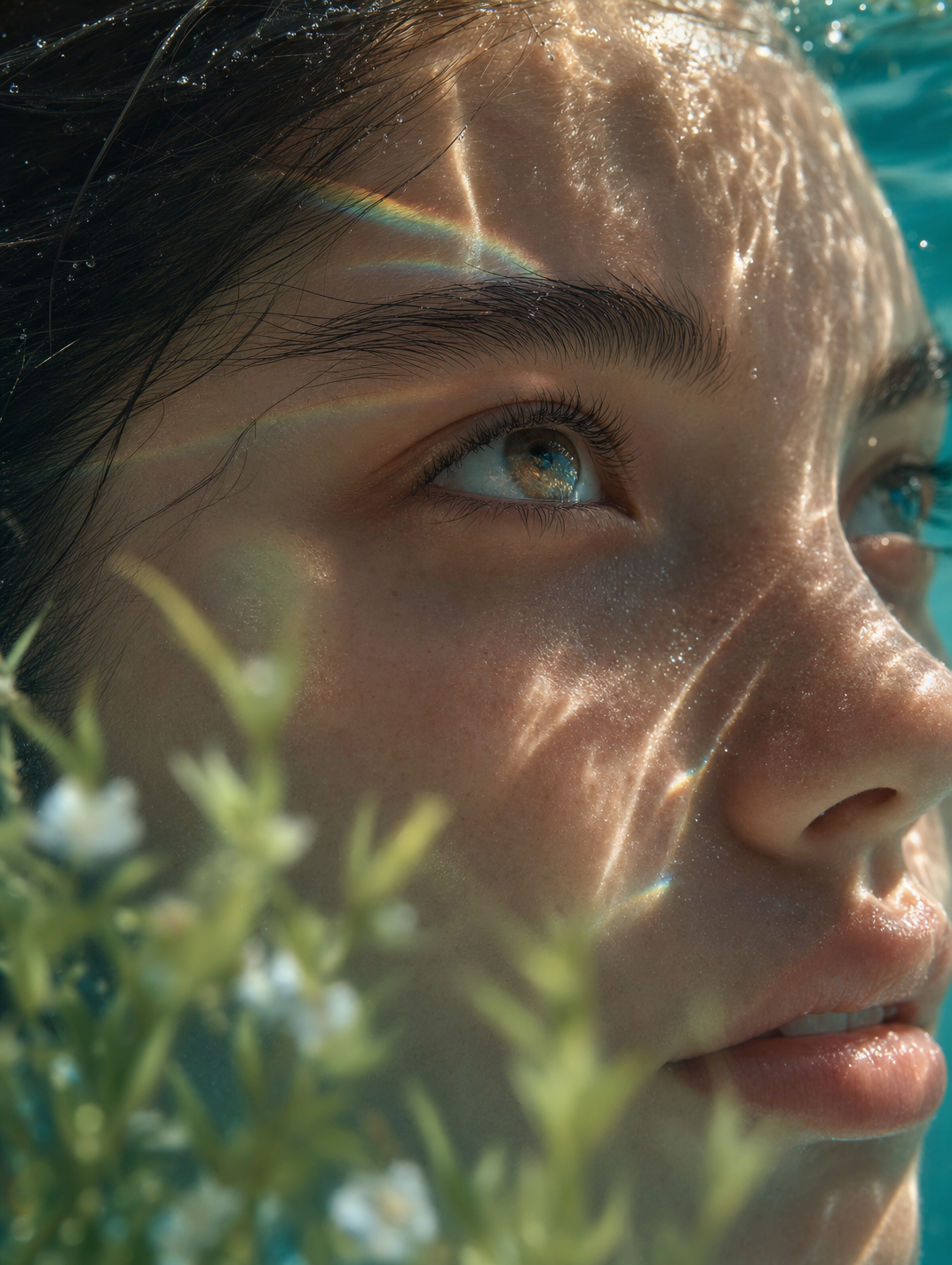
Dreamy Macro Portrait in Cool Water