Why this works
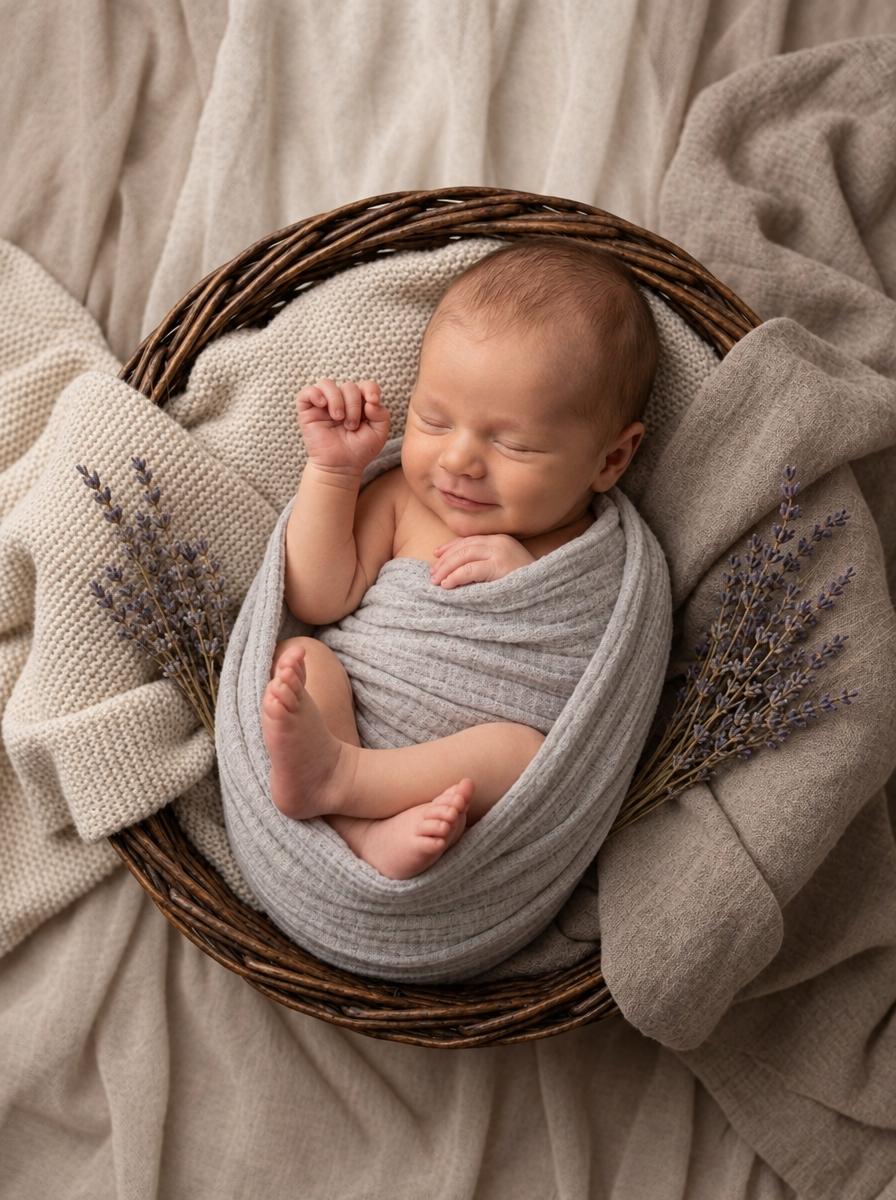
The centered, top-down composition comes directly from “sleeping newborn baby nestled in a round woven wicker basket” and “top-down framing,” keeping the basket’s circular shape as the visual anchor. “Warm morning window light” and the “creamy off-white and warm beige color palette” establish a serene, softly illuminated mood, while the actual brown wicker and gray swaddle provide restrained contrast. “Gentle shallow depth of field” isolates the baby and makes the “ultra-high detail skin and fabric texture” read as the image’s tactile focus against the cozy studio background.
FAQ
→How do I make the baby’s face more prominent in the composition?
Replace “top-down framing” with “close three-quarter overhead framing focused on the baby’s face,” and add “face occupying the central third of the image, eyes and eyelashes in sharp focus.” Keep “gentle shallow depth of field,” but change the basket description to “basket softly cropped around the edges” so it supports rather than dominates the subject.
→How do I change the serene palette into a warmer, more rustic newborn portrait?
Replace “creamy off-white and warm beige color palette” with “warm terracotta, honey, and muted rust palette,” and change “light gray swaddle cloth” to “soft oatmeal linen swaddle.” You can also replace “warm morning window light” with “golden late-afternoon window light” to deepen the brown wicker and blanket tones.
→How do I create several consistent variations from this prompt?
Keep “photorealistic newborn photography,” “top-down framing,” “warm morning window light,” and “gentle shallow depth of field” unchanged, then swap only the prop cluster. For example, replace “small dried lavender sprigs and eucalyptus leaves” with “tiny dried wheat stems and chamomile flowers,” or replace “round woven wicker basket” with “small cream knit nest,” while retaining the centered composition and “creamy off-white and warm beige color palette.”
Learn the technique behind this
- Why can't AI spell, and how do I get readable text in an image? — Older diffusion models had no character-level representation of text, so they produced letterform-shaped texture instead of words.
- How should a prompt be structured, and does word order matter? — A prompt that behaves predictably names one subject first, then what it is doing, then where, then the light, then the lens or medium, then the style.
- Do negative prompts work, and what should go in one? — Negative prompts work on models that support a separate negative conditioning channel — mainly Stable Diffusion and FLUX-family models.
Related prompts
Woman in Teal Light, Shadowed Fashion Portrait

Charcoal turtleneck with red eye-beam

Eerie Elegance Among Marble Busts

Dreamy Macro Portrait in Cool Water