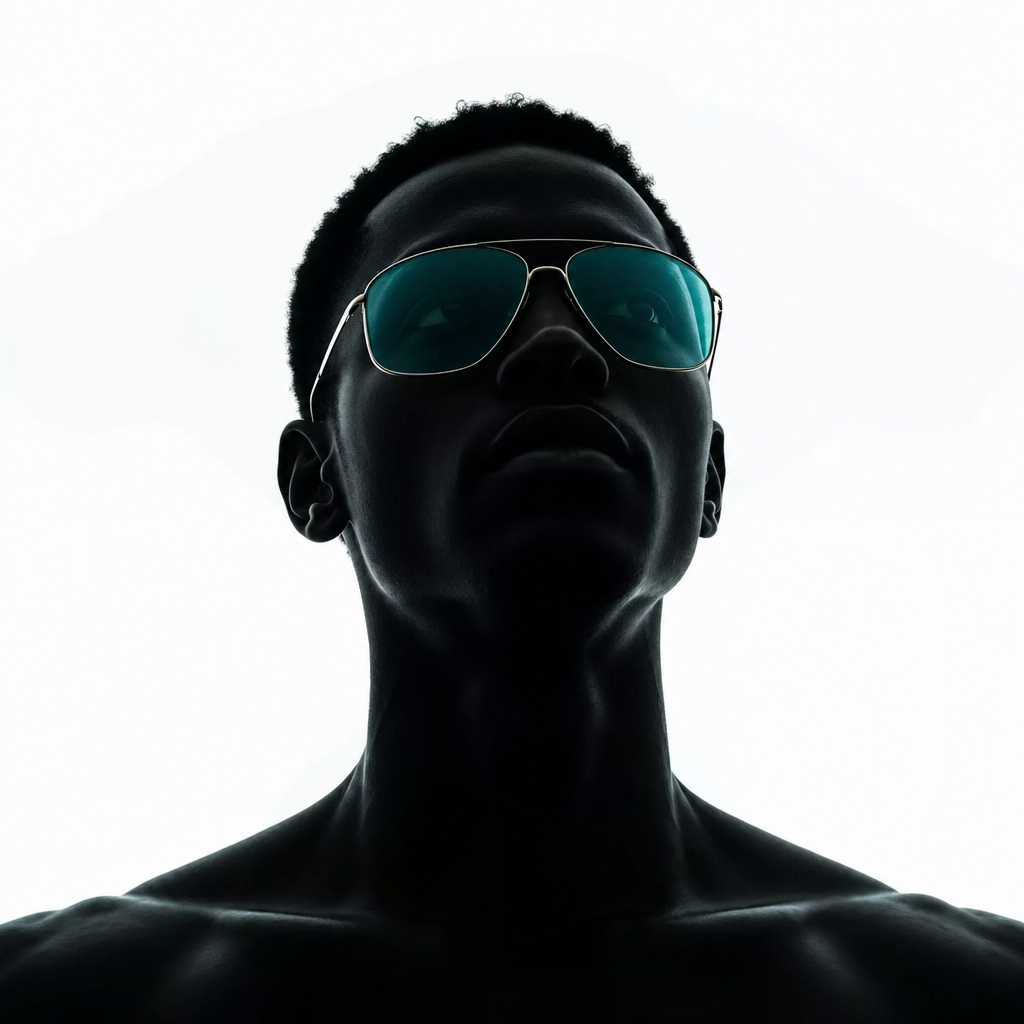
Why this works
The phrase “centered composition” paired with “bright cool-white backlit background” creates the stark, portrait-closeup structure, while “smooth dark contours of head, neck, and shoulders” gives the subject a graphic silhouette against the white field. “Crisp rim light” and “high-contrast lighting” define the facial outline without revealing features, and “teal-tinted lenses” supplies the only strong color accent. The “slight three-quarter turn with upward-facing gaze” adds mystery and directional tension, while “thin metallic frame,” “clean sci-fi mood,” and “subtle studio grain” keep the futuristic styling restrained rather than decorative.
FAQ
→How do I change this prompt for a warmer, less mysterious portrait?
Replace “bright cool-white backlit background” with “soft warm-gray studio background,” change “high-contrast lighting” and “crisp rim light” to “large diffused key light with gentle facial modeling,” and replace “silhouetted man” with “man with softly visible facial features.” Keep “teal-tinted lenses” if you want a cool accent against the warmer setting, or change it to “amber-tinted lenses” for a fully warm palette.
→How do I make the glasses more central and visually prominent?
Replace “portrait-closeup” with “extreme close-up focused on the eyes and glasses,” and change “centered composition” to “symmetrical head-and-glasses framing.” Expand “sleek futuristic glasses with teal-tinted lenses and a thin metallic frame” to “oversized futuristic glasses with luminous teal lenses, reflective surfaces, and a clearly visible brushed-metal frame,” while reducing “smooth dark contours of head, neck, and shoulders” to “only the upper face and glasses visible.”
→How do I build a varied series from this portrait without losing its identity?
Keep the fixed anchor phrases “photorealistic minimalist studio portrait,” “sleek futuristic glasses,” “centered composition,” and “crisp rim light,” then vary one controlled block per image. Swap “bright cool-white backlit background” for “deep cobalt gradient,” “soft silver haze,” or “matte black studio,” and replace “upward-facing gaze” with “direct eye contact,” “downward gaze,” or “profile-facing gaze” to create distinct compositions while preserving the same subject and lighting signature.
Learn the technique behind this
- Why can't AI spell, and how do I get readable text in an image? — Older diffusion models had no character-level representation of text, so they produced letterform-shaped texture instead of words.
- How should a prompt be structured, and does word order matter? — A prompt that behaves predictably names one subject first, then what it is doing, then where, then the light, then the lens or medium, then the style.
- Why does the model ignore parts of my prompt? — Ignored instructions are almost always conflicts, counts, or spatial relationships — three things current models handle badly — rather than the model failing to read you.
Related prompts
Woman in Teal Light, Shadowed Fashion Portrait
Eerie Elegance Among Marble Busts
Charcoal turtleneck with red eye-beam
Dreamy Macro Portrait in Cool Water