Why this works
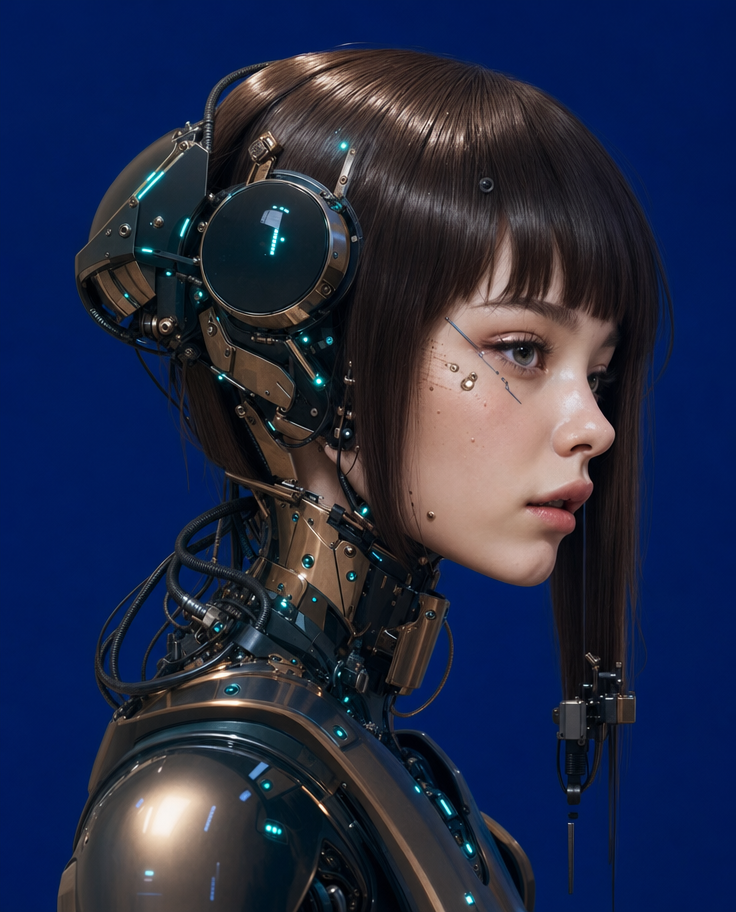
The close side profile and "85mm lens look, shallow depth of field" keep the woman’s face and augmentation network dominant, while "sharp focus" preserves fine detail across the eye line, ear, neck, and shoulder. "Dramatic high-contrast rim lighting" separates the dark-brown bob and brushed-metal exoskeletal parts from the "solid deep-blue background," creating the intense, sleek mood; bronze, teal, gray, and black details provide controlled contrast against that blue field. The phrases "ultra-detailed skin and metal textures" and "subtle healed skin scars and small bioluminescent indicator lights" make the portrait feel tactile and lived-in rather than like a generic futuristic costume.
FAQ
→How do I make the cybernetic augmentations more prominent than the woman’s face?
Replace "side-profile editorial sci-fi portrait" with "three-quarter close-up portrait with the cybernetic augmentations as the primary subject," and change "intricate bronze and teal cybernetic augmentations integrated around the head, ear, neck, and upper shoulder" to "large, highly visible bronze-and-teal cybernetic structures framing the cheek, eye, ear, neck, and shoulder." Add "augmentation details in the foreground" to reinforce their priority.
→How do I change the intense studio portrait into a colder, more ominous scene?
Replace "bold solid deep-blue background" with "near-black industrial laboratory background with faint teal haze," and change "dramatic high-contrast rim lighting" to "cold directional top light with narrow teal edge lighting and deep facial shadows." Replace "cinematic atmosphere" with "ominous clinical atmosphere" while keeping "sharp focus" and "ultra-detailed skin and metal textures" for the same precision.
→How do I build a series of variations while keeping this character consistent?
Keep the fixed identity phrases "young woman with glossy dark-brown hair" and "subtle healed skin scars," plus the exact bronze-and-teal augmentation design, and vary only the scene block. For example, replace "solid deep-blue studio background" with "rain-soaked neon city alley," "sterile white surgical bay," or "deserted orbital observation deck," then swap "dramatic high-contrast rim lighting" for "colored neon reflections," "soft overhead surgical lighting," or "hard sunlight through a viewport."
Learn the technique behind this
- Why can't AI spell, and how do I get readable text in an image? — Older diffusion models had no character-level representation of text, so they produced letterform-shaped texture instead of words.
- How should a prompt be structured, and does word order matter? — A prompt that behaves predictably names one subject first, then what it is doing, then where, then the light, then the lens or medium, then the style.
- Why does AI get hands and faces wrong, and how do I fix it? — Hands fail because they're small in frame, extremely variable in pose, and self-occluding — the model has less usable signal per pixel than for any other body part.
Related prompts
Woman in Teal Light, Shadowed Fashion Portrait
Eerie Elegance Among Marble Busts
Charcoal turtleneck with red eye-beam
Dreamy Macro Portrait in Cool Water