Why this works
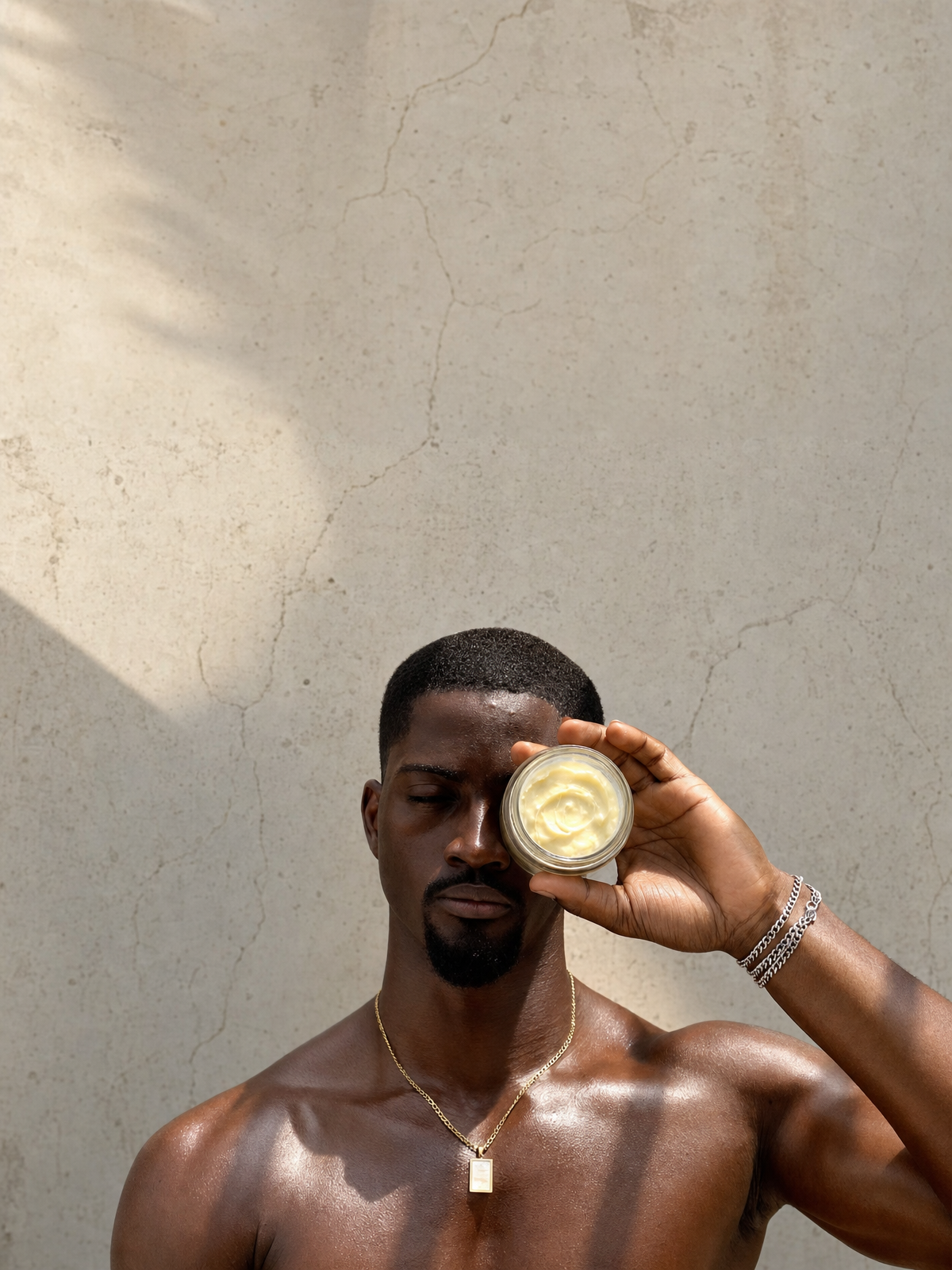
The phrase “small glass jar of pale cream up over one eye” supplies the image’s focal gesture, while the “square composition,” “portrait-closeup,” and “clean negative space” keep the face and prop dominant. “Warm late-afternoon sunlight with crisp, graphic shadow patterns” produces the bold, sunlit mood and the strong brown-and-black tonal structure visible across the skin, wall, and shadows. “Pale limestone wall with subtle cracks” adds restrained texture without competing with the subject, and “shallow depth of field for a slightly separated background” preserves that wall detail while isolating the man.
FAQ
→How do I make the jar and eye gesture more visually dominant?
Replace “small glass jar of pale cream” with “large transparent glass jar of pale cream with clearly visible highlights,” and change “up over one eye” to “centered directly over his nearer eye, filling the foreground.” Keep “portrait-closeup,” but replace “clean negative space” with “tight facial framing” to give the prop more area in the composition.
→How do I shift this from warm and bold to a cooler, quieter portrait?
Replace “warm late-afternoon sunlight with crisp, graphic shadow patterns” with “soft overcast daylight with diffuse shadows,” and change “warm, bold sunlit mood” to “cool, restrained contemplative mood.” Swap the dominant palette from brown and black toward “pale gray, muted blue, and ivory,” while retaining “natural skin texture detail” for realism.
→How do I build a series of variations while keeping the same editorial look?
Keep “photorealistic editorial lifestyle photography,” “square composition,” “shallow depth of field,” and “clean negative space” unchanged, then replace the subject phrase with variants such as “shirtless man holding a small amber perfume bottle near his cheek” or “shirtless man holding a folded white towel over one shoulder.” For location changes, replace “pale limestone wall with subtle cracks” with “smooth white plaster wall,” “brushed concrete wall,” or “weathered sand-colored stone,” and match each version with “warm late-afternoon sunlight with crisp, graphic shadow patterns.”
Learn the technique behind this
- Why can't AI spell, and how do I get readable text in an image? — Older diffusion models had no character-level representation of text, so they produced letterform-shaped texture instead of words.
- Which aspect ratio should I use, and how does it change the image? — Aspect ratio determines what the model composes, not how it's cropped afterwards.
- How should a prompt be structured, and does word order matter? — A prompt that behaves predictably names one subject first, then what it is doing, then where, then the light, then the lens or medium, then the style.
Related prompts
Woman in Teal Light, Shadowed Fashion Portrait
Eerie Elegance Among Marble Busts
Charcoal turtleneck with red eye-beam
Dreamy Macro Portrait in Cool Water