Why this works
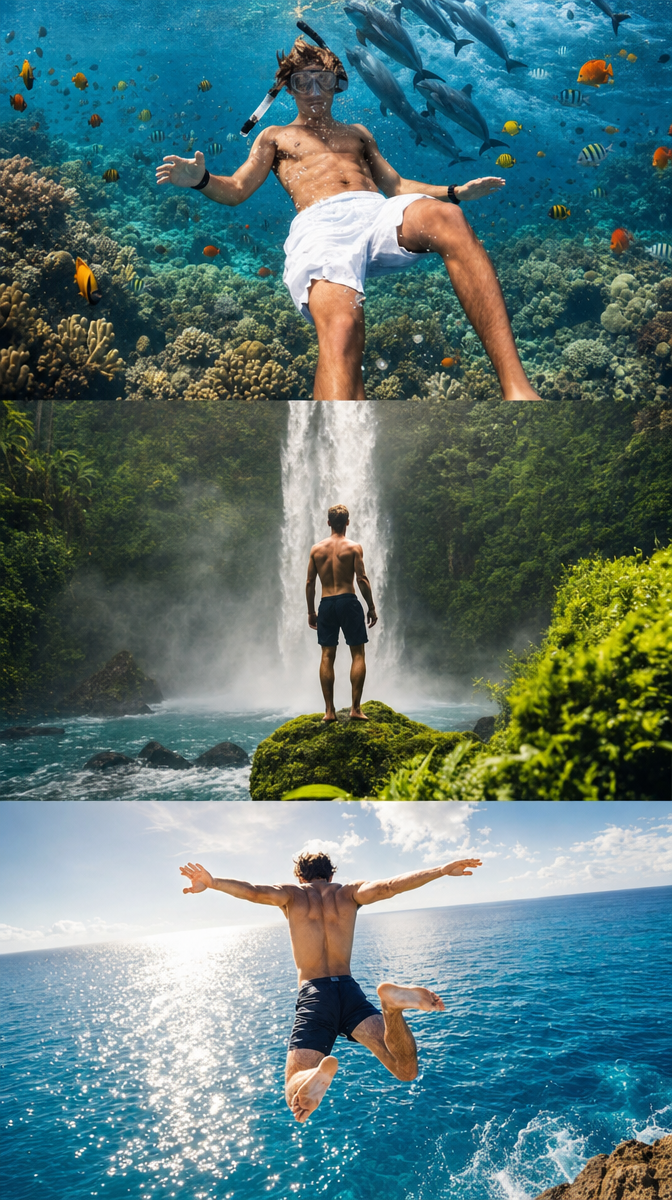
The three-part structure, explicitly marked “(1), (2), (3),” gives the image a readable collage rhythm while “dynamic travel-photo angles across a three-panel collage framing” keeps each scene active rather than static. “Cinematic natural light,” “sunlight sparkling on the waves,” and “water mist catching the light” explain the white highlights, while “dense green jungle,” “mossy rock,” and “coral and colorful tropical fish” supply the dominant green foundation. The repeated description “the same shirtless adventurer” provides continuity across underwater, jungle, and ocean scenes, and “realistic skin pores and wet water droplets” anchors the energetic action in photorealistic detail.
FAQ
→How do I make the jungle waterfall scene the visual centerpiece?
Replace “three dynamic scenes” with “a large central jungle waterfall scene flanked by two smaller inset scenes,” and change “he stands on a mossy rock” to “he stands prominently in the foreground on a mossy rock, occupying the central third of the composition.” Keep “water mist catching the light” to preserve the brightest atmospheric detail behind him.
→How do I make the collage feel more calm and cinematic instead of energetic?
Replace “energetic adventurous atmosphere” with “quiet, contemplative expedition atmosphere,” and change “he jumps with arms out” to “he stands still at the ocean’s edge, looking toward the horizon.” Replace “dynamic angles and framing like real travel photography” with “wide, steady editorial travel-photography framing with generous negative space.”
→How do I create a new variation with a different adventure subject while preserving the three-scene format?
Replace every instance of “shirtless adventurer” and “same man” with a consistent subject such as “female expedition photographer in a red waterproof jacket, the same woman across all three scenes.” Adjust “realistic skin pores and wet water droplets” to “realistic jacket fabric, wet seams, and water droplets,” while retaining the numbered underwater, jungle-waterfall, and ocean actions.
Learn the technique behind this
- Why can't AI spell, and how do I get readable text in an image? — Older diffusion models had no character-level representation of text, so they produced letterform-shaped texture instead of words.
- How should a prompt be structured, and does word order matter? — A prompt that behaves predictably names one subject first, then what it is doing, then where, then the light, then the lens or medium, then the style.
- Why does the model ignore parts of my prompt? — Ignored instructions are almost always conflicts, counts, or spatial relationships — three things current models handle badly — rather than the model failing to read you.
Related prompts
Tiny wanderer in pastel sunrise meadow
Quiet desk on a cliff terrace
Luxury yacht near chalk cliffs at dusk
Night Helicopter Escape Over New York