Why this works
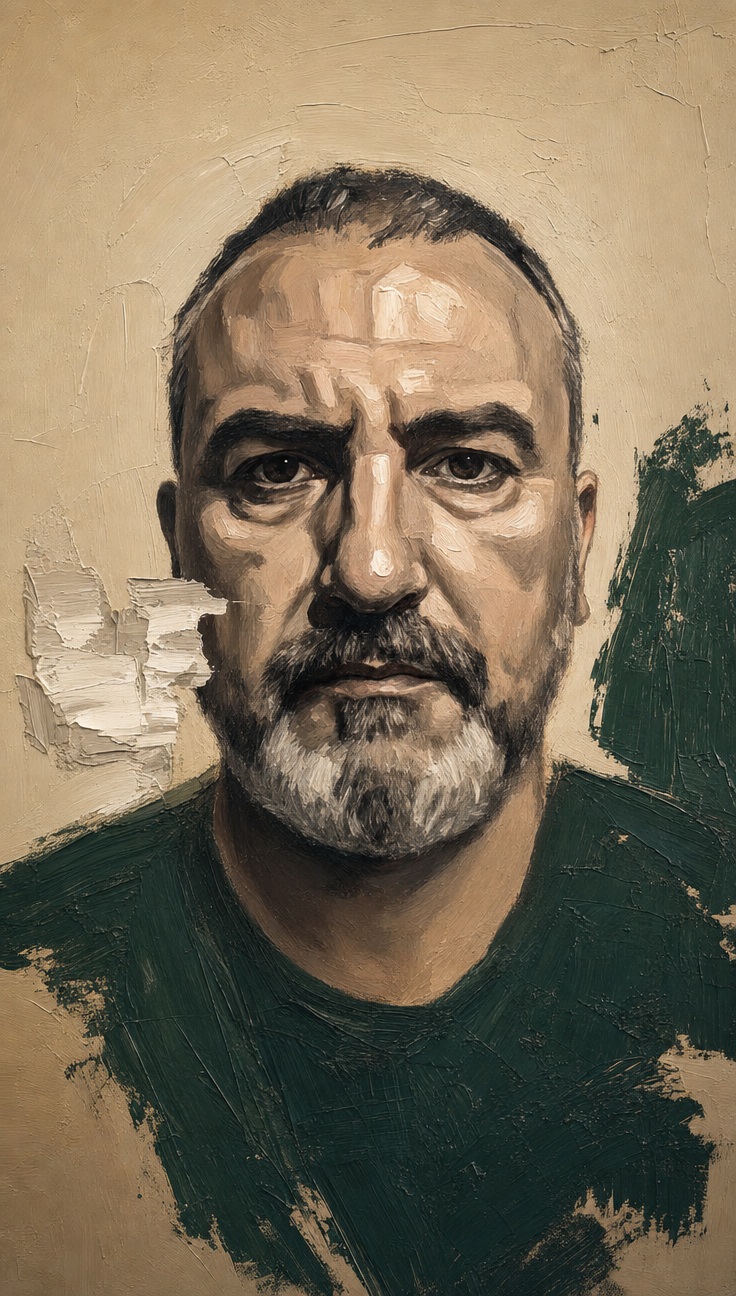
The “close-up portrait framing emphasizing the eyes and facial texture” makes the direct gaze and graying beard the compositional anchor, while “realistic facial structure” keeps the expressive distortion controlled. “Loose impasto brushstrokes” and “visible paint texture across the face and shoulders” create the raw, tactile surface, and “soft studio lighting that preserves strong facial contrast” maintains the serious intensity without flattening the features. The muted warm beige backdrop gives the black, gray, and forest-green strokes a restrained contrast, while “deeper forest-green accent strokes along the edges” adds color rhythm without competing with the eyes.
FAQ
→How do I make the portrait feel darker and more psychologically intense?
Replace “muted warm beige studio backdrop” with “deep charcoal-gray studio backdrop,” and change “soft studio lighting that preserves strong facial contrast” to “hard single-source side lighting with deep facial shadows.” Keep “intense direct gaze,” but add “subtle under-eye shadows and compressed lips” for a more severe expression.
→How do I make the beard and facial texture more prominent?
Change “close-up portrait framing emphasizing the eyes and facial texture” to “extreme close-up framing centered on the eyes, beard, and mouth.” Replace “visible paint texture across the face and shoulders” with “thick, sharply ridged impasto concentrated in the beard, mustache, wrinkles, and cheek planes,” while reducing the shoulder area to “only a narrow lower-edge crop.”
→How do I build a varied portrait series from this prompt without losing its identity?
Keep “serious middle-aged man with a graying beard and mustache,” “realistic facial structure,” and “intense direct gaze” fixed, then vary the backdrop and edge accents in separate versions. For example, replace “muted warm beige studio backdrop” with “dusty mauve studio backdrop” and “deeper forest-green accent strokes” with “burnt-orange accent strokes,” or use “cool slate-blue backdrop” with “muted ochre accent strokes” for a cooler alternate palette.
Learn the technique behind this
- Why can't AI spell, and how do I get readable text in an image? — Older diffusion models had no character-level representation of text, so they produced letterform-shaped texture instead of words.
- How should a prompt be structured, and does word order matter? — A prompt that behaves predictably names one subject first, then what it is doing, then where, then the light, then the lens or medium, then the style.
- Which aspect ratio should I use, and how does it change the image? — Aspect ratio determines what the model composes, not how it's cropped afterwards.
Related prompts
Woman in Teal Light, Shadowed Fashion Portrait
Eerie Elegance Among Marble Busts
Charcoal turtleneck with red eye-beam
Dreamy Macro Portrait in Cool Water