Why this works
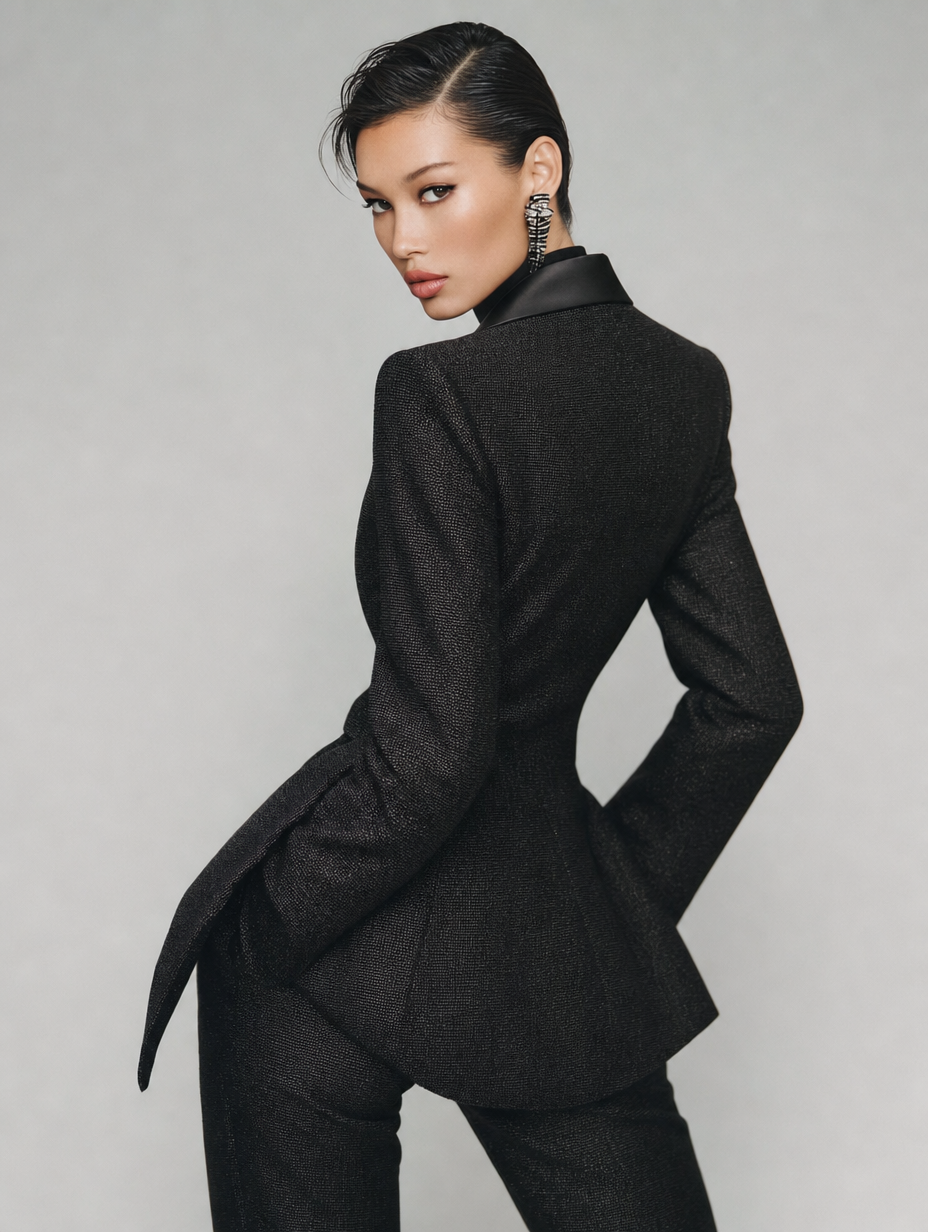
The phrase “dramatic over-the-shoulder pose” gives the portrait its directional tension, while “tight framing emphasizing face and upper torso” makes the strong jawline, statement earrings, and satin lapel the visual anchors. “Minimal cool-gray studio background” and the black suit create a restrained gray-and-black palette, and “crisp highlights and soft falloff” isolates the satin sheen and facial structure without adding a busy setting. “Ultra-sharp fabric and facial detail” supports the photorealistic editorial finish, especially across the tailored seams, dark hair, and blazer texture.
FAQ
→How do I make the statement earrings and face more central?
Keep “dramatic over-the-shoulder pose,” but replace “tight framing emphasizing face and upper torso” with “tight head-and-shoulders crop with the face and statement earrings centered.” Add “direct gaze toward camera” if you want stronger eye contact, and reduce “ultra-sharp fabric and facial detail” to “ultra-sharp facial and jewelry detail” so the suit receives less emphasis.
→How do I make the portrait mood softer and less severe?
Replace “dramatic over-the-shoulder pose” with “relaxed three-quarter pose with a gentle expression,” and change “crisp highlights and soft falloff” to “large diffused window light with delicate wraparound shadows.” Swap “sleek, dramatic, glamorous” for “quiet, graceful, understated,” while keeping “minimal cool-gray studio background” for the controlled editorial setting.
→How do I build a coordinated series with different suit colors?
Keep the fixed identity phrases “same person,” “strong jawline,” “statement earrings,” and “slightly tousled side-part texture,” then replace “black tailored fashion suit” and “fitted black suit” with a shared color slot such as “ivory tailored fashion suit” or “deep burgundy tailored fashion suit.” For each variation, change “minimal cool-gray studio background” to a complementary neutral such as “warm beige studio background,” while preserving “luxury fashion editorial,” “tight framing,” and “clean high-end fashion lighting” for consistency.
Learn the technique behind this
- Why can't AI spell, and how do I get readable text in an image? — Older diffusion models had no character-level representation of text, so they produced letterform-shaped texture instead of words.
- How do I keep the same character across multiple images? — Text prompts alone won't hold a face across images — a description defines a type, not a person.
- How should a prompt be structured, and does word order matter? — A prompt that behaves predictably names one subject first, then what it is doing, then where, then the light, then the lens or medium, then the style.
Related prompts
Woman in Teal Light, Shadowed Fashion Portrait
Eerie Elegance Among Marble Busts
Charcoal turtleneck with red eye-beam
Dreamy Macro Portrait in Cool Water