Why this works
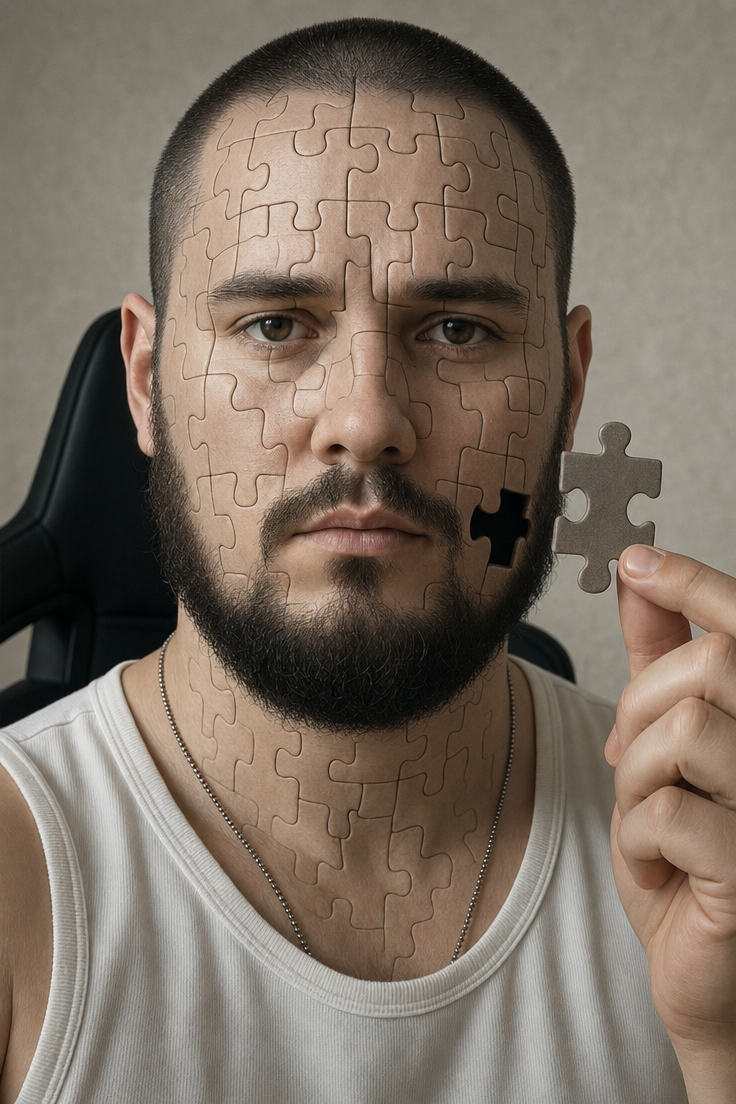
The centered frontal close-up makes the puzzle-face immediately dominant, while “holds a single puzzle piece between his fingers beside his cheek” adds a precise secondary focal point. “Entire face and neck are formed from interconnected jigsaw puzzle pieces,” combined with “sharply defined” pieces, “realistic bevels,” and “subtle depth between seams,” creates the tactile surrealism; the gray, black, and white palette reinforces its restrained, eerie tone. “Softly blurred neutral indoor background” isolates the subject, and “soft, diffused lighting with neutral color balance” preserves realistic skin tones where the seams meet instead of turning the image into a high-contrast horror scene.
FAQ
→How do I make the loose puzzle piece more prominent than the man’s face?
Replace “holds a single puzzle piece between his fingers beside his cheek” with “holds a large puzzle piece directly in front of his eye, occupying the foreground,” and change “centered frontal composition” to “asymmetrical close-up with the hand and puzzle piece in the immediate foreground.”
→How do I make the portrait feel more unsettling and horror-oriented?
Replace “soft, diffused lighting with neutral color balance” with “hard directional underlighting with deep shadows,” and change “softly blurred neutral indoor background” to “dark, indistinct interior with faint shadowy forms.” Keep “realistic bevels” and “subtle depth between seams” to preserve the disturbing physical detail.
→How do I create a series of related portraits with different subjects?
Keep “photorealistic surreal portrait,” “centered frontal composition,” “softly blurred neutral indoor background,” and “soft, diffused lighting” fixed as the series language. Swap “bearded man whose entire face and neck are formed from interconnected jigsaw puzzle pieces” for variants such as “elderly woman whose face is formed from cracked porcelain tiles,” “child whose face is formed from layered paper fragments,” or “robot whose head is formed from interlocking metal panels,” while retaining “highly detailed realistic seams” for visual consistency.
Learn the technique behind this
- Why can't AI spell, and how do I get readable text in an image? — Older diffusion models had no character-level representation of text, so they produced letterform-shaped texture instead of words.
- How should a prompt be structured, and does word order matter? — A prompt that behaves predictably names one subject first, then what it is doing, then where, then the light, then the lens or medium, then the style.
- Why does AI get hands and faces wrong, and how do I fix it? — Hands fail because they're small in frame, extremely variable in pose, and self-occluding — the model has less usable signal per pixel than for any other body part.
Related prompts
Woman in Teal Light, Shadowed Fashion Portrait
Eerie Elegance Among Marble Busts
Charcoal turtleneck with red eye-beam
Dreamy Macro Portrait in Cool Water