Why this works
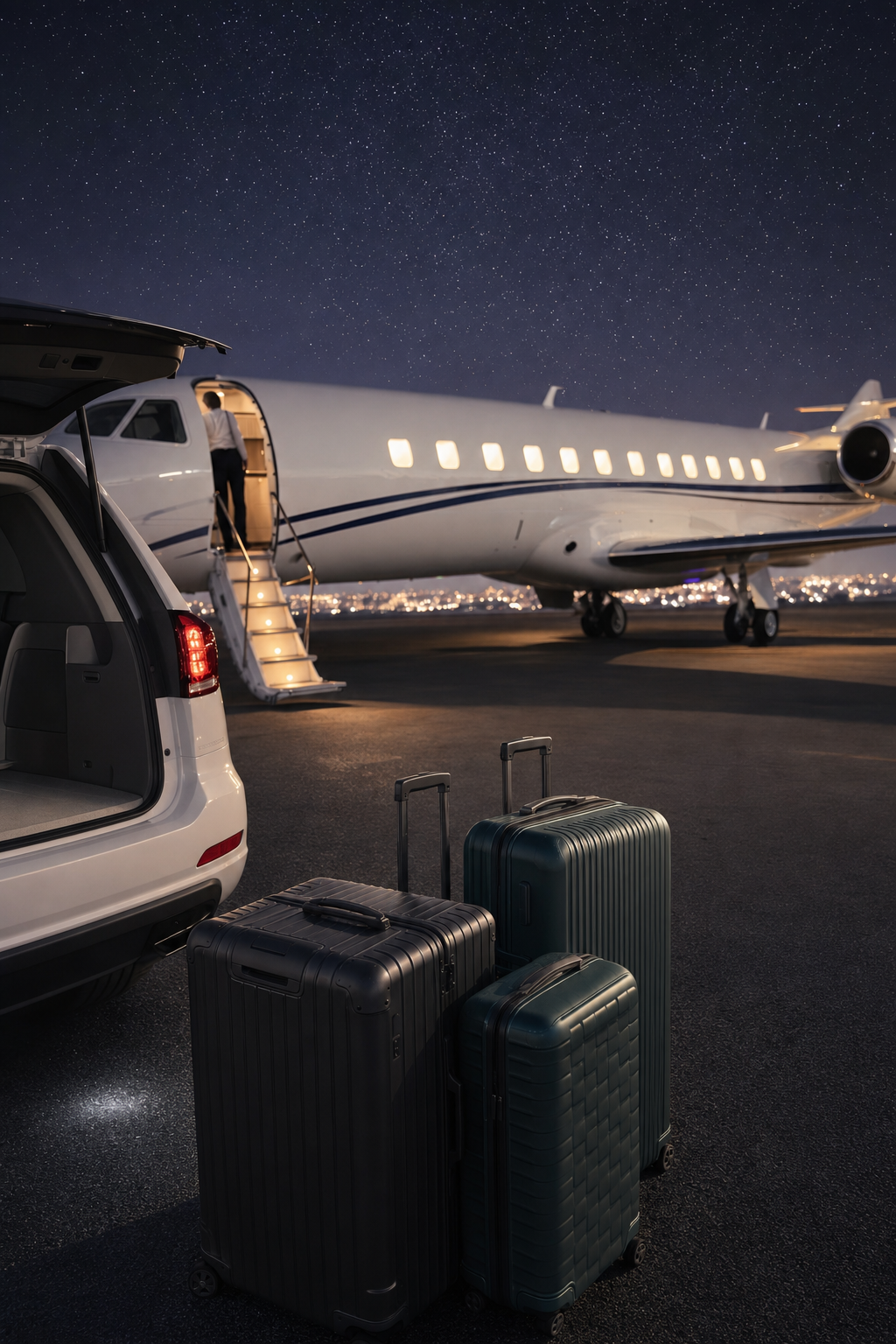
The wide-shot framing makes the private jet, open-trunk SUV, and luggage read as one luxury-travel narrative, while “airport tarmac at night with distant city lights on the horizon” supplies clear depth and scale. “Softly illuminated cabin stairs” gives the jet a warm focal anchor against the dominant gray, white, and navy palette, and “cinematic night lighting with realistic reflections on the tarmac” ties the vehicles and suitcases into a polished commercial scene. “Crisp, star-filled sky with light haze” adds glamour without competing with the sharp-focus, ultra-high-detail treatment of the foreground objects.
FAQ
→How do I make the luggage the main visual subject instead of the private jet?
Replace “a private jet parked with softly illuminated cabin stairs, an elegant SUV with its trunk open in the foreground, and several premium hard-shell suitcases” with “a close foreground arrangement of premium hard-shell suitcases, with the private jet and SUV secondary in the background.” Change “wide-shot” to “medium close-up,” and add “suitcases occupy the central third of the frame, jet softly receding behind them.”
→How do I change the glamorous nighttime mood into a calmer, more understated luxury look?
Replace “aspirational, exclusive, glamorous nighttime mood” and “crisp, star-filled sky” with “quiet, refined, understated nighttime mood” and “deep blue sky with minimal stars.” Change “cinematic night lighting” to “soft, low-contrast ambient lighting” and replace “realistic reflections” with “subtle controlled reflections on the tarmac.”
→How do I turn this into a consistent series of luxury travel images?
Keep “photorealistic cinematic commercial photography, sharp focus, high detail,” the matte black and deep teal luggage, and the “gray, white, navy” palette unchanged. Swap only “airport tarmac at night” for settings such as “private marina at blue hour,” “snowy alpine helipad at dawn,” or “desert runway at sunset,” then replace “private jet” with a matching subject such as “sleek yacht,” “luxury helicopter,” or “vintage grand touring car.”
Learn the technique behind this
- Why can't AI spell, and how do I get readable text in an image? — Older diffusion models had no character-level representation of text, so they produced letterform-shaped texture instead of words.
- How should a prompt be structured, and does word order matter? — A prompt that behaves predictably names one subject first, then what it is doing, then where, then the light, then the lens or medium, then the style.
- Do negative prompts work, and what should go in one? — Negative prompts work on models that support a separate negative conditioning channel — mainly Stable Diffusion and FLUX-family models.
Related prompts
Tiny wanderer in pastel sunrise meadow
Young woman pulling teal suitcase in airport
Portuguese Fishing Village at Golden Sunset
Quiet desk on a cliff terrace