Why this works
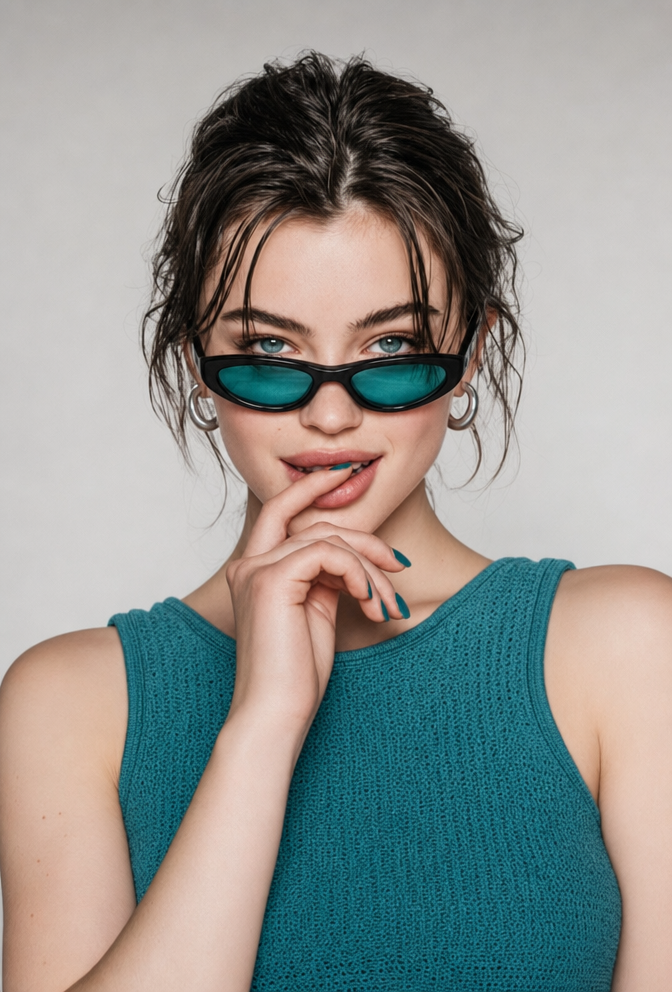
The close-up, front-view framing keeps the woman’s natural smile, hand-near-mouth gesture, oversized sunglasses, and silver hoops as the immediate focal details. “Bright minimalistic fashion editorial lighting” against a “clean light-gray background” produces the bright, uncluttered mood, while “teal-tinted lenses,” “teal sleeveless knit top,” and “cool teal accents” create a controlled color link within the image’s predominantly gray palette. “Modern fashion magazine style” and “crisp detail” give the portrait its polished editorial finish rather than a casual snapshot.
FAQ
→How do I make the sunglasses more central and visually dominant?
Replace “close-up portrait framing” with “extreme close-up centered on the sunglasses and eyes,” and change “sharp focus on face and accessories” to “primary focus on the oversized black sunglasses, teal-tinted lenses, and reflective frames.” Keep the hand near the mouth, but specify “secondary gesture” so it does not compete with the eyewear.
→How do I shift this from bright and playful to dramatic and cinematic?
Replace “bright minimalistic fashion editorial lighting” with “low-key cinematic side lighting with deep shadows and a narrow rim light,” and change “clean light-gray background” to “dark charcoal studio background.” Replace “smiling naturally” with “confident, serious expression” while retaining “cool teal accents” for a restrained color contrast.
→How do I create a coordinated series of variations from this portrait?
Keep “close-up studio portrait, front view,” “modern fashion magazine style,” and “crisp detail” unchanged as the series anchors. Swap the accessory and top colors in controlled pairs, such as “amber-tinted lenses and mustard knit top,” “rose-tinted lenses and blush knit top,” or “cobalt lenses and cobalt knit top,” while changing the gesture to “fingertips at chin,” “adjusting the sunglasses,” or “hand resting beside cheek.”
Learn the technique behind this
- Why can't AI spell, and how do I get readable text in an image? — Older diffusion models had no character-level representation of text, so they produced letterform-shaped texture instead of words.
- How should a prompt be structured, and does word order matter? — A prompt that behaves predictably names one subject first, then what it is doing, then where, then the light, then the lens or medium, then the style.
- Why does AI get hands and faces wrong, and how do I fix it? — Hands fail because they're small in frame, extremely variable in pose, and self-occluding — the model has less usable signal per pixel than for any other body part.
Related prompts
Woman in Teal Light, Shadowed Fashion Portrait
Eerie Elegance Among Marble Busts
Charcoal turtleneck with red eye-beam
Dreamy Macro Portrait in Cool Water