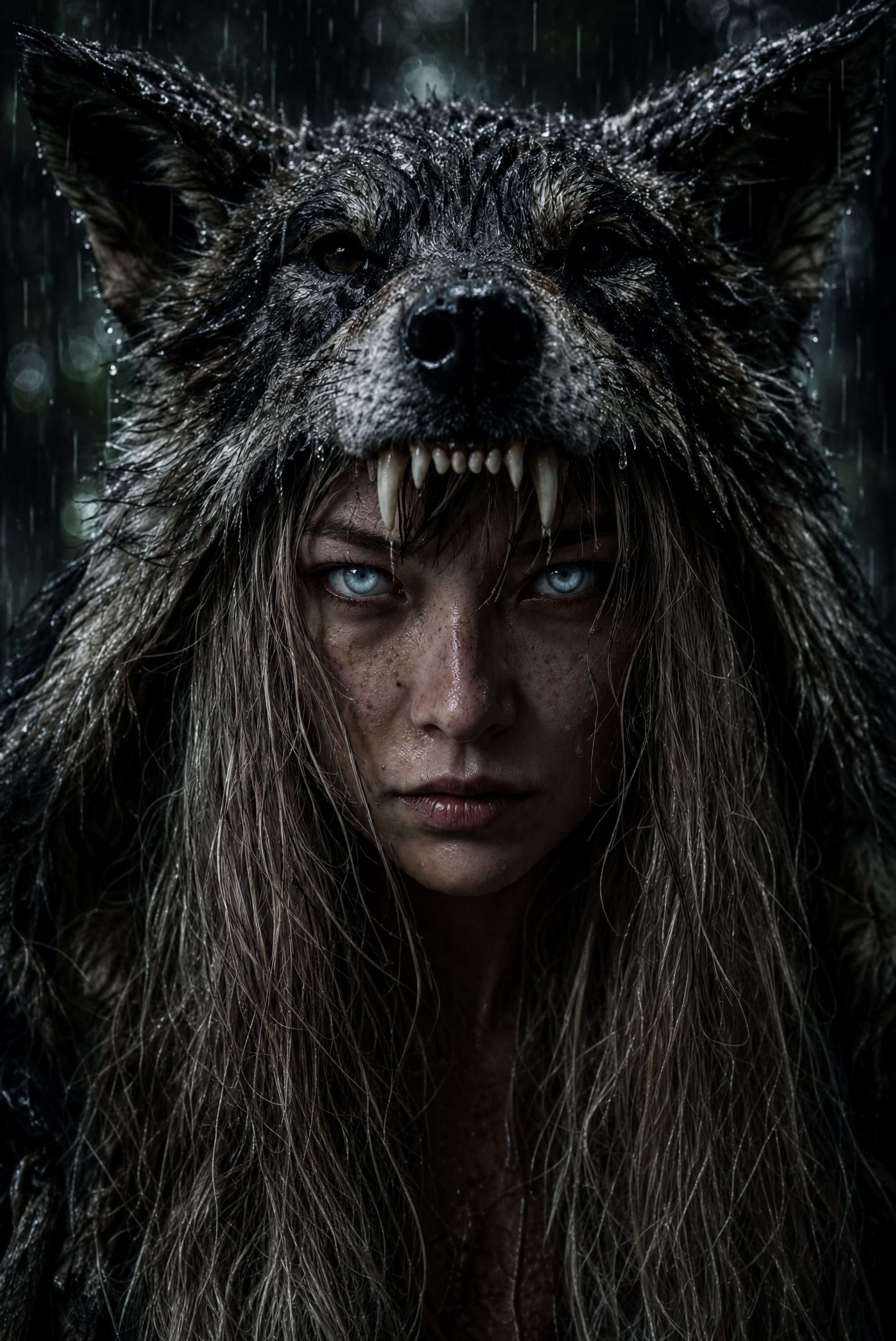
Why this works
“Extreme close-up” and “sharp focus on the eyes” make the pale-blue glow the compositional anchor, while the dark ash-blond hair and wolf pelt headdress frame the face inside the portrait-closeup. The ominous tone comes from the combined phrases “cinematic dark fantasy lighting,” “misty forest at night,” and “subtle sharp fangs,” with “rain-slicked fur details” and “visible wet texture across her skin” supplying tactile realism. The specified “dark green and charcoal color palette” supports the gray-dominant image by keeping the surroundings subdued, so the blue eyes remain the strongest color contrast.
FAQ
→How do I make the wolf headdress more prominent than the eyes?
Replace “extreme close-up” with “tight head-and-shoulders portrait” and change “sharp focus on the eyes” to “sharp focus across the wolf pelt headdress and face.” Expand “rain-slicked fur details on the headdress” to “large wolf pelt headdress dominating the upper frame, clearly visible ears, muzzle, and layered wet fur.”
→How do I make the scene feel more threatening and less sorrowful?
Replace “subtle sharp fangs visible” with “clearly exposed predatory fangs and a tense snarling expression,” and change “misty forest at night” to “claustrophobic forest under a moonless storm.” Add “hard underlighting, deep eye sockets, and aggressive forward-facing posture” after “cinematic dark fantasy lighting.”
→How do I create a set of variations while keeping this character consistent?
Keep the fixed identity phrases “pale woman,” “long and dark ash-blond” hair, “pale-blue glowing eyes,” and “wolf pelt headdress,” then swap only the setting and lighting blocks. For example, replace “misty forest at night” with “abandoned frozen village at dusk” and “cinematic dark fantasy lighting” with “cold blue sidelight and drifting snow,” while retaining “extreme close-up” and “sharp focus on the eyes” for consistent framing.
Learn the technique behind this
- Why can't AI spell, and how do I get readable text in an image? — Older diffusion models had no character-level representation of text, so they produced letterform-shaped texture instead of words.
- How do I keep the same character across multiple images? — Text prompts alone won't hold a face across images — a description defines a type, not a person.
- How should a prompt be structured, and does word order matter? — A prompt that behaves predictably names one subject first, then what it is doing, then where, then the light, then the lens or medium, then the style.
Related prompts
Woman in Teal Light, Shadowed Fashion Portrait
Eerie Elegance Among Marble Busts
Charcoal turtleneck with red eye-beam
Dreamy Macro Portrait in Cool Water