Why this works
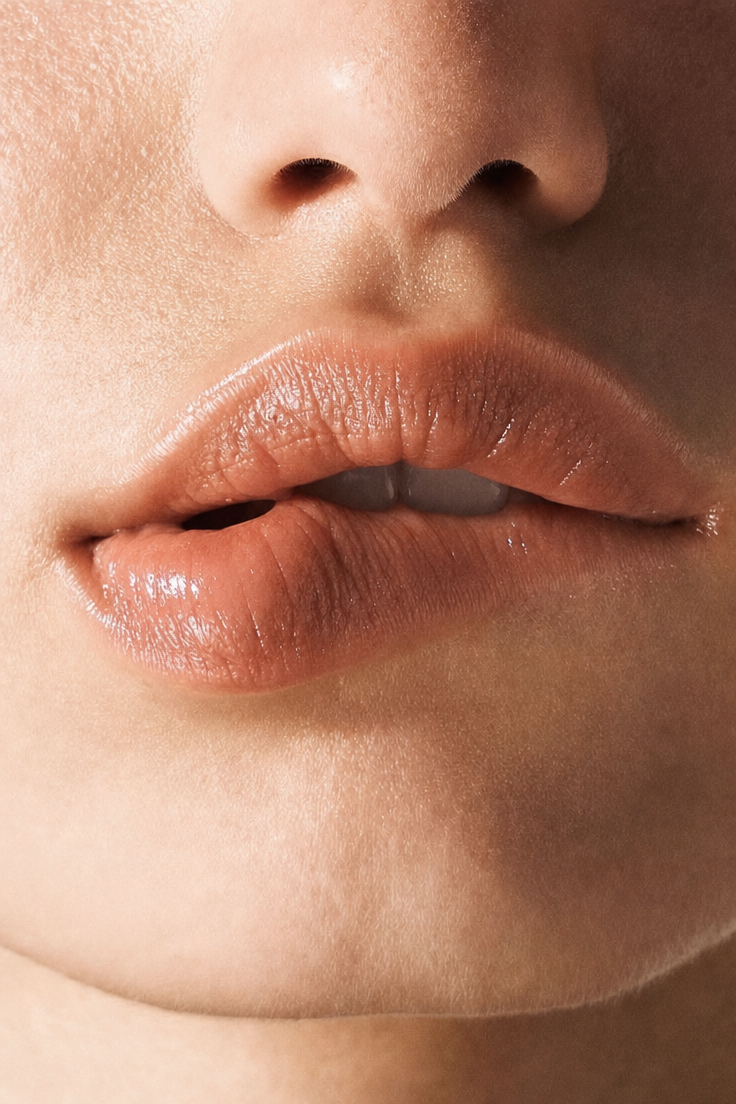
The phrase “lower half of a face—nose, soft shaded nostrils, and lips with the chin filling the frame” creates the tight portrait-closeup and makes the mouth the visual anchor without showing the eyes. “Natural skin texture and pores” paired with “ultra-high detail” preserves realism, while “warm nude-peach tone” and “realistic skin tones” explain the dominant tan and brown harmony. The polished intimacy comes from “clean studio lighting with a soft key light and delicate shadow falloff,” and “shallow depth of field with the background fully smoothed out” removes environmental distractions and concentrates focus on the lips and skin.
FAQ
→How do I make the lips more prominent and visually dominant?
Replace “nose, soft shaded nostrils, and lips with the chin filling the frame” with “extreme close-up centered on the lips, with only the lower nose and a small portion of the chin visible.” Strengthen “gentle highlight on the cupid’s bow” to “bright, controlled highlight across the cupid’s bow and lower-lip center,” while keeping “slightly parted” for the defined mouth shape.
→How do I shift this from polished studio beauty to a moodier, more dramatic portrait?
Replace “clean studio lighting with a soft key light and delicate shadow falloff” with “single directional side light with pronounced shadow falloff and subtle chiaroscuro.” Change “minimal studio background with no discernible environment” to “deep matte brown background fading into black,” and replace “faint natural sheen” with “restrained glossy highlights” to keep the lips realistic without making the image feel brightly commercial.
→How do I build a series of variations while preserving this close-up style?
Keep the fixed structure “photorealistic beauty portrait close-up,” “natural skin texture and pores,” and “shallow depth of field with the background fully smoothed out.” For each variation, swap “warm nude-peach tone” for controlled palette choices such as “muted rose,” “terracotta,” or “cool mauve,” and replace “soft key light” with “cool window light,” “warm diffused beauty light,” or “soft overhead light” to create distinct but consistent portraits.
Learn the technique behind this
- Why can't AI spell, and how do I get readable text in an image? — Older diffusion models had no character-level representation of text, so they produced letterform-shaped texture instead of words.
- How should a prompt be structured, and does word order matter? — A prompt that behaves predictably names one subject first, then what it is doing, then where, then the light, then the lens or medium, then the style.
- Which aspect ratio should I use, and how does it change the image? — Aspect ratio determines what the model composes, not how it's cropped afterwards.
Related prompts
Woman in Teal Light, Shadowed Fashion Portrait
Eerie Elegance Among Marble Busts
Charcoal turtleneck with red eye-beam
Dreamy Macro Portrait in Cool Water