Why this works
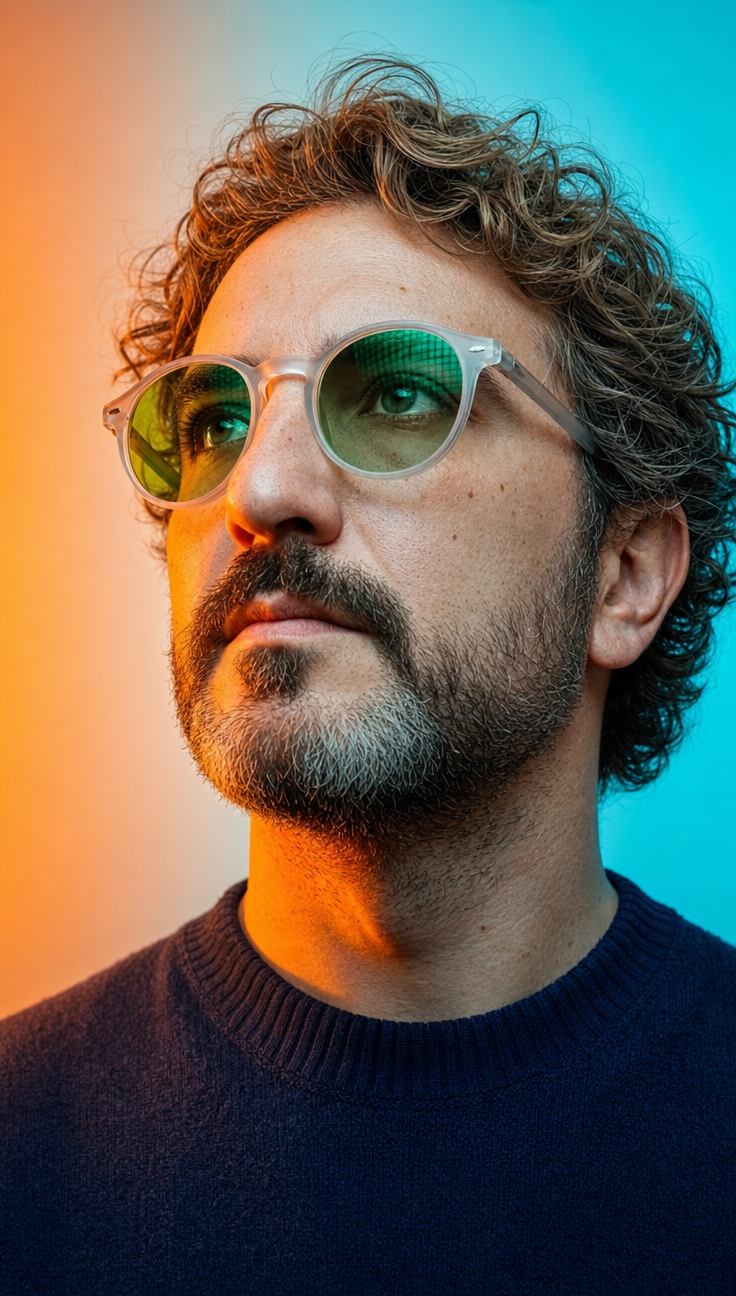
The close-up, low-angle framing and the instruction to look “dramatically upward and to the left” make the face and glasses dominate the portrait while adding a thoughtful, aspirational angle. “Dramatic split lighting with warm amber highlights and cool teal shadows” supplies the strongest color tension, with the amber side explaining the image’s dominant orange cast against the otherwise smooth gradient. “Highly detailed skin texture,” “crisp lens reflections,” and “shallow depth of field” keep attention on the freckles, beard, and green-tinted lenses while suppressing detail in the background.
FAQ
→How do I make the portrait feel softer and less dramatic?
Replace “dramatically upward and to the left” with “gazing calmly toward the camera,” and change “dramatic split lighting with warm amber highlights and cool teal shadows” to “soft, even window light with gentle warm fill.” Keep “shallow depth of field” if you still want the face isolated.
→How do I make the glasses and eyes the central feature?
Replace “close-up, low-angle” with “extreme close-up centered on the eyes and glasses,” and change “crisp lens reflections” to “controlled reflections that reveal the eyes beneath the green-tinted lenses.” Retain “round frosted-frame glasses” while reducing “highly detailed skin texture” to “subtle skin detail” so facial texture does not compete with the eyewear.
→How do I turn this into a coordinated series of portraits?
Keep the fixed phrases “close-up, low-angle editorial portrait,” “dramatic split lighting,” and “smooth dual-toned gradient background,” then swap the subject description for consistent variants such as “young woman with short copper hair and silver geometric glasses” or “older man with silver curls and a charcoal turtleneck.” Change the color pair together for each variation, for example replacing “warm amber highlights and cool teal shadows” with “violet highlights and soft gold shadows,” while preserving “stylized cinematic color contrast.”
Learn the technique behind this
- Why can't AI spell, and how do I get readable text in an image? — Older diffusion models had no character-level representation of text, so they produced letterform-shaped texture instead of words.
- How should a prompt be structured, and does word order matter? — A prompt that behaves predictably names one subject first, then what it is doing, then where, then the light, then the lens or medium, then the style.
- Why does the model ignore parts of my prompt? — Ignored instructions are almost always conflicts, counts, or spatial relationships — three things current models handle badly — rather than the model failing to read you.
Related prompts
Eerie Elegance Among Marble Busts
Woman in Teal Light, Shadowed Fashion Portrait
Charcoal turtleneck with red eye-beam
Dreamy Macro Portrait in Cool Water