Why this works
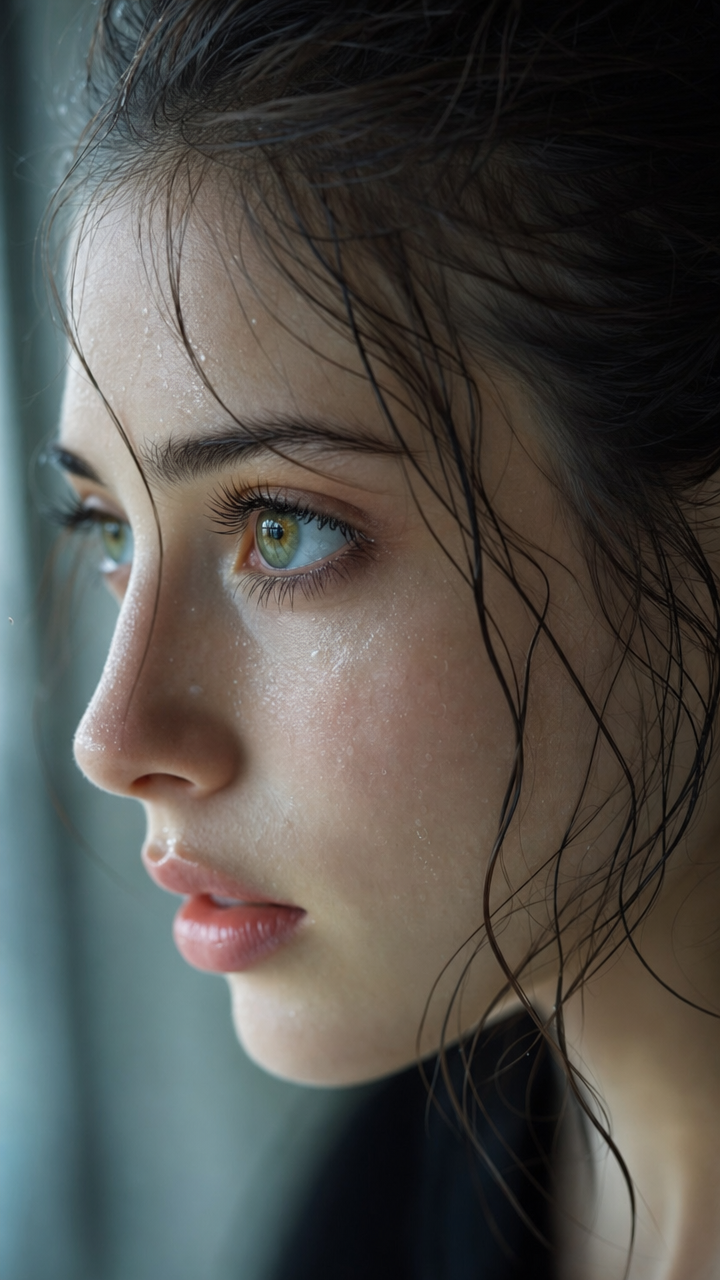
The “close-up” profile framing and “shallow depth of field” keep attention on the reflective hazel-green eyes, fine water droplets, and ultra-detailed skin texture, while the softly blurred background removes competing detail. “Soft cool-toned window light with a gentle rim highlight” gives the wet updo and cheek a restrained edge of separation, and the black-and-beige dominant palette supports the “intimate moody contemplative atmosphere” without overpowering the face. The phrase “a few strands trailing near her cheek” adds a precise directional detail that makes the still, profile composition feel quietly windblown.
FAQ
→How do I make her eyes the unmistakable focal point?
Keep “close-up photorealistic cinematic portrait” and replace “reflective hazel-green eyes” with “striking emerald-green eyes in razor-sharp focus, catchlights clearly visible.” Change “ultra-detailed skin texture” to “natural detailed skin texture, secondary to the eyes,” and retain “shallow depth of field” so the background and hair fall away.
→How do I shift this from contemplative to warmer and more hopeful?
Replace “soft cool-toned window light” with “warm golden late-afternoon window light,” and change “intimate moody contemplative atmosphere” to “quietly hopeful, tender atmosphere.” Swap the dominant black-and-beige treatment for “warm beige, honey, and muted rose tones,” while keeping the “gentle rim highlight” to preserve separation around the wet hair.
→How do I build a matching series with a different subject or setting?
Preserve the structural phrases “close-up photorealistic cinematic portrait,” “profile,” “shallow depth of field,” and “soft window light,” then replace “young woman” with a new subject such as “older man with silver hair” and “muted, softly blurred background” with a specific location such as “rain-streaked café window background.” Replace “windswept updo” and “few strands trailing near her cheek” with subject-specific texture, such as “damp silver curls framing the temple,” while keeping “dewy skin with fine water droplets” only if moisture remains part of the series concept.
Learn the technique behind this
- How should a prompt be structured, and does word order matter? — A prompt that behaves predictably names one subject first, then what it is doing, then where, then the light, then the lens or medium, then the style.
- Why can't AI spell, and how do I get readable text in an image? — Older diffusion models had no character-level representation of text, so they produced letterform-shaped texture instead of words.
- Why does AI get hands and faces wrong, and how do I fix it? — Hands fail because they're small in frame, extremely variable in pose, and self-occluding — the model has less usable signal per pixel than for any other body part.
Related prompts
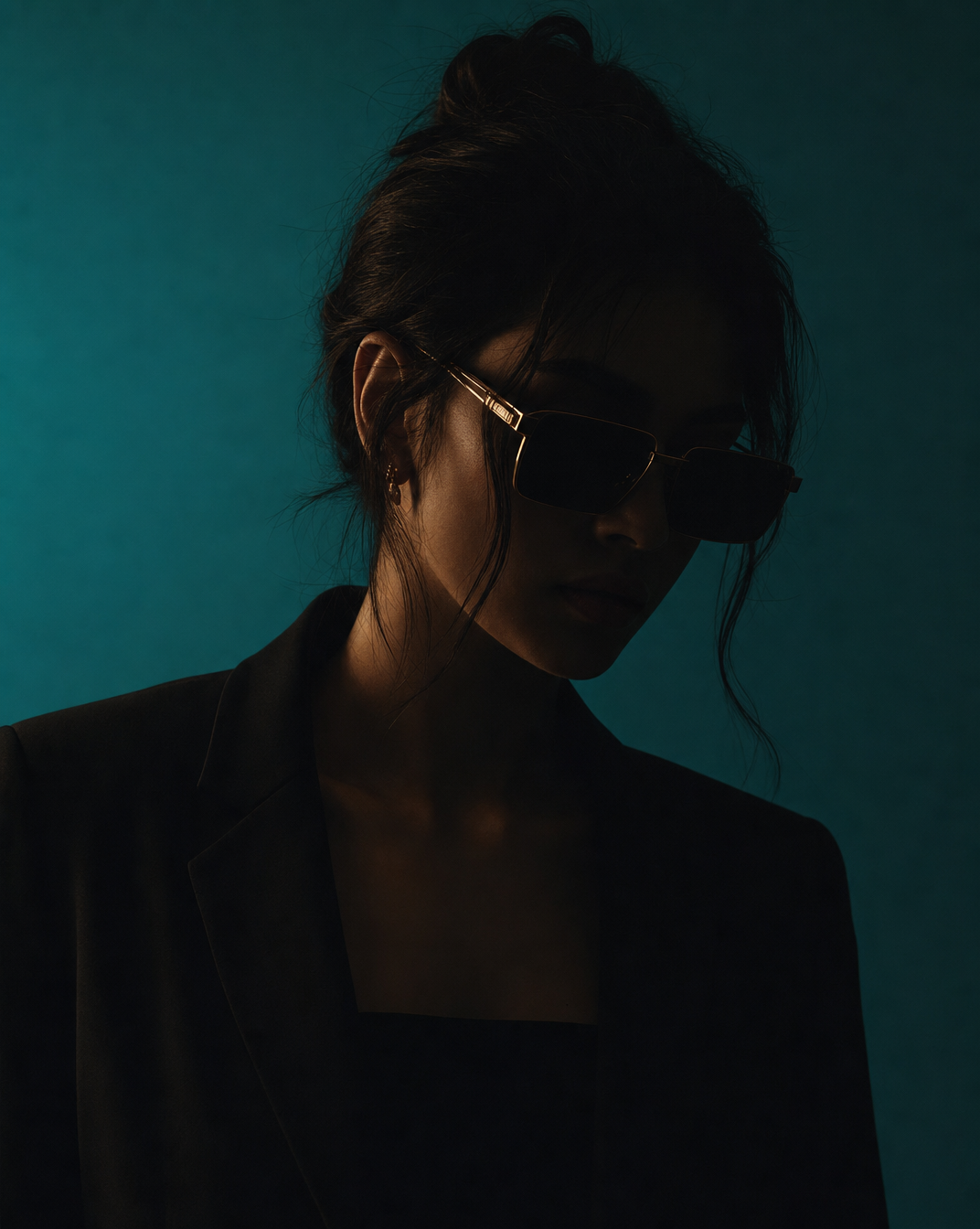
Woman in Teal Light, Shadowed Fashion Portrait

Eerie Elegance Among Marble Busts

Charcoal turtleneck with red eye-beam

Dreamy Macro Portrait in Cool Water