Why this works
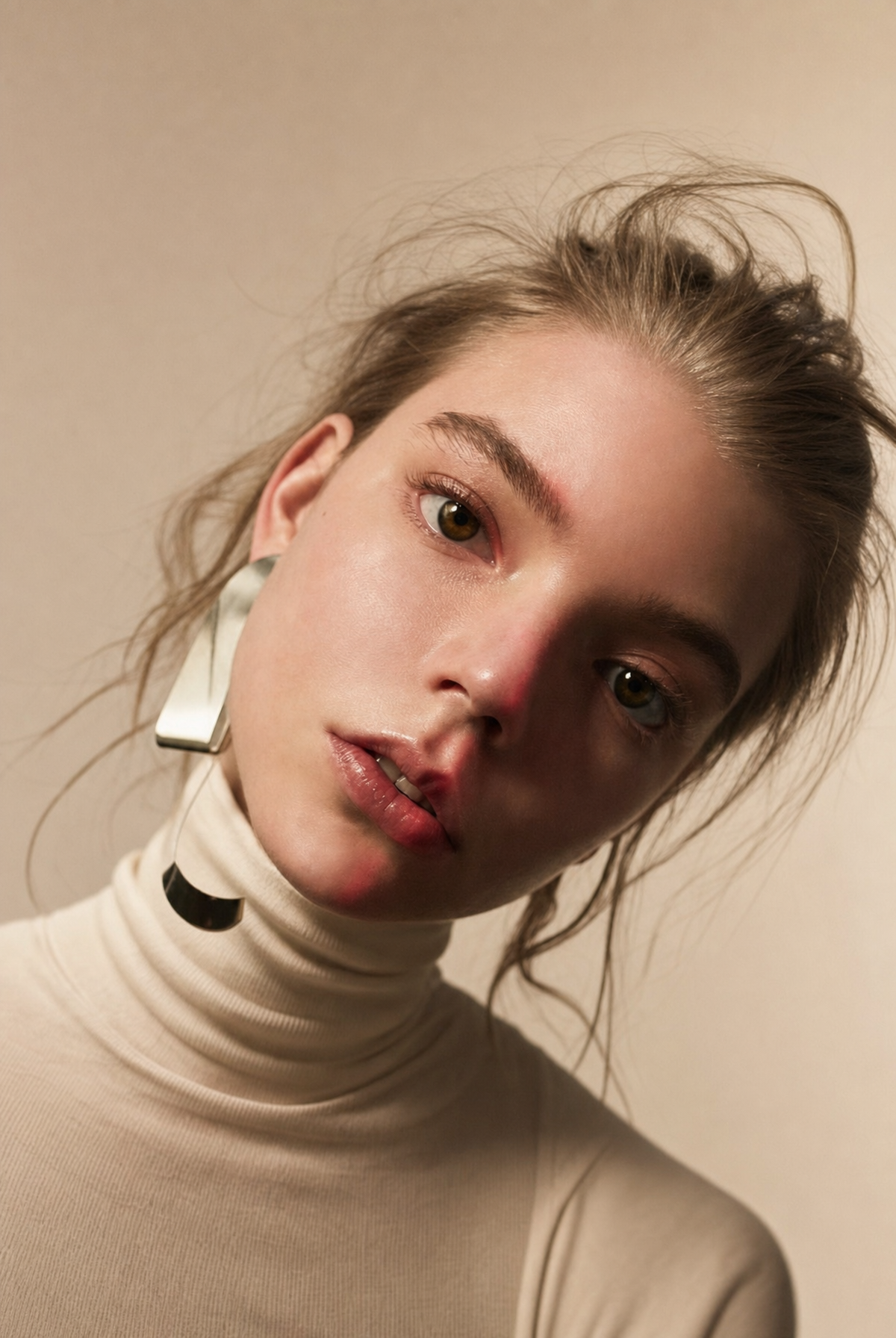
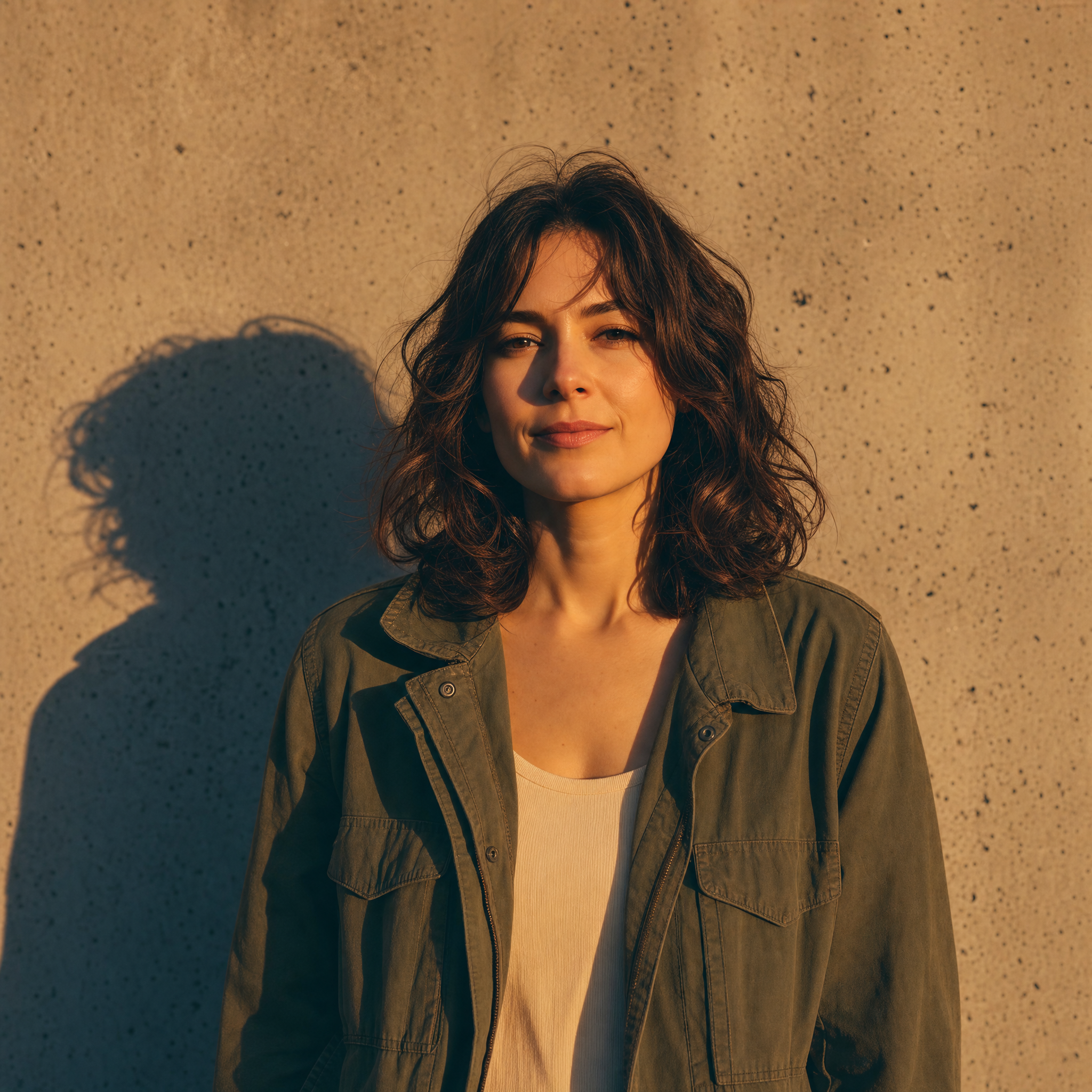
The phrase “warm late-afternoon side lighting” supplies the brown warmth and strong directional modeling, while “a dramatic shadow across the wall” gives the gray concrete background a graphic compositional role. “Cinematic portrait framing” and “portrait-full-body” keep the woman readable from head to stance, and “shallow depth of field” separates her from the textured wall without losing its tactile surface. The “deep olive utility jacket over a cream top” anchors the green-and-neutral palette, while “natural skin texture visible” and “confidently posed” prevent the editorial finish from becoming overly polished or passive.
FAQ
→How do I make the woman’s face and expression more central?
Replace “portrait-full-body” with “tight chest-up portrait framing” and add “face centered, eyes as the primary focal point, direct eye contact.” Keep “shallow depth of field,” but change “dramatic shadow across the wall” to “soft controlled shadow falling behind her” so the wall pattern does not compete with her features.
→How do I shift this from moody editorial drama to a brighter, more approachable portrait?
Replace “warm late-afternoon side lighting with strong shadows on the wall” with “diffused open-shade daylight with gentle facial fill,” and change “high-contrast and moody” to “low-contrast, airy, welcoming.” Swap the “deep olive utility jacket” for “light sage linen jacket” to retain green while reducing the heavy brown-and-gray tonal weight.
→How do I create a matching series with different subjects and locations?
Keep the structural phrases “photorealistic cinematic editorial portrait,” “cinematic portrait framing,” “natural skin texture visible,” and “confidently posed” unchanged. Replace “a woman with shoulder-length loose waves” with a new subject such as “a man with close-cropped hair,” and replace “textured concrete wall” with a location like “weathered red-brick facade,” while adapting “deep olive utility jacket over a cream top” to a coordinated wardrobe for each variation.
Learn the technique behind this
- Why can't AI spell, and how do I get readable text in an image? — Older diffusion models had no character-level representation of text, so they produced letterform-shaped texture instead of words.
- How should a prompt be structured, and does word order matter? — A prompt that behaves predictably names one subject first, then what it is doing, then where, then the light, then the lens or medium, then the style.
- Why does AI get hands and faces wrong, and how do I fix it? — Hands fail because they're small in frame, extremely variable in pose, and self-occluding — the model has less usable signal per pixel than for any other body part.
Related prompts
Woman in Teal Light, Shadowed Fashion Portrait
Eerie Elegance Among Marble Busts
Charcoal turtleneck with red eye-beam
Dreamy Macro Portrait in Cool Water