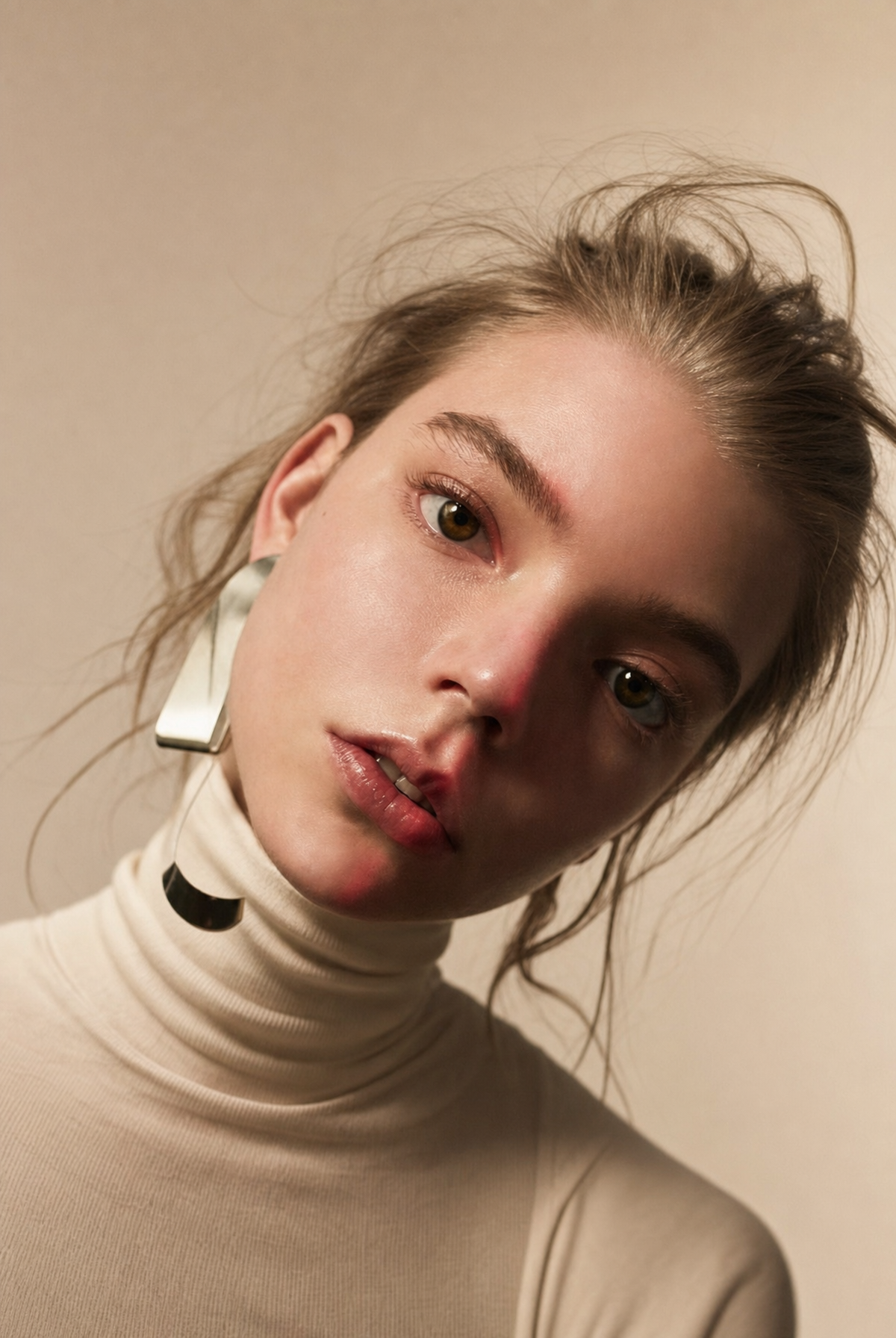
Why this works
The close portrait framing keeps the pale young man’s defined cheekbones, tousled ash-brown hair, and brooding expression dominant, while “shallow depth of field” separates him from the stone-and-iron arches. The mood comes from the specific combination of “low-key lighting,” “cooler moonlight spill,” “warm candlelight accents,” and “deep shadows,” which gives the gray and brown palette controlled tonal contrast rather than flat darkness. “Subtle velvet texture,” “realistic skin texture,” and “slight film-grain atmosphere” add tactile detail that supports the editorial fashion-photography finish.
FAQ
→How do I change this prompt for a softer, more romantic mood?
Replace “brooding expression,” “low-key lighting,” and “deep shadows” with “gentle, introspective expression,” “soft diffused window light,” and “delicate lifted shadows.” Change “cooler moonlight spill plus warm candlelight accents” to “warm golden candlelight with a subtle rosy fill” to shift the gray-brown gothic palette toward warmer skin and fabric tones.
→How do I make the gothic interior more prominent instead of keeping the portrait as a close-up?
Replace “cinematic close portrait framing” with “medium-wide environmental portrait framing” and replace “shallow depth of field” with “moderate depth of field, architectural details clearly visible.” Add “full arched recesses, iron columns, worn stone floor, and candlelit background” after “gothic interior” so the setting occupies more of the composition.
→How do I build a consistent series with different characters or settings?
Keep the fixed visual anchors “cinematic editorial fashion photography,” “realistic skin texture,” “low-key lighting,” and “slight film-grain atmosphere,” then swap only the subject and setting blocks. For example, replace “pale young man with tousled ash-brown hair” with “silver-haired woman in a structured black gown,” and replace “stone-and-iron gothic interior with arched recesses” with “rainy Art Nouveau conservatory with fogged glass.”
Learn the technique behind this
- Why can't AI spell, and how do I get readable text in an image? — Older diffusion models had no character-level representation of text, so they produced letterform-shaped texture instead of words.
- How should a prompt be structured, and does word order matter? — A prompt that behaves predictably names one subject first, then what it is doing, then where, then the light, then the lens or medium, then the style.
- Do negative prompts work, and what should go in one? — Negative prompts work on models that support a separate negative conditioning channel — mainly Stable Diffusion and FLUX-family models.
Related prompts
Woman in Teal Light, Shadowed Fashion Portrait
Eerie Elegance Among Marble Busts
Charcoal turtleneck with red eye-beam
Dreamy Macro Portrait in Cool Water