Why this works
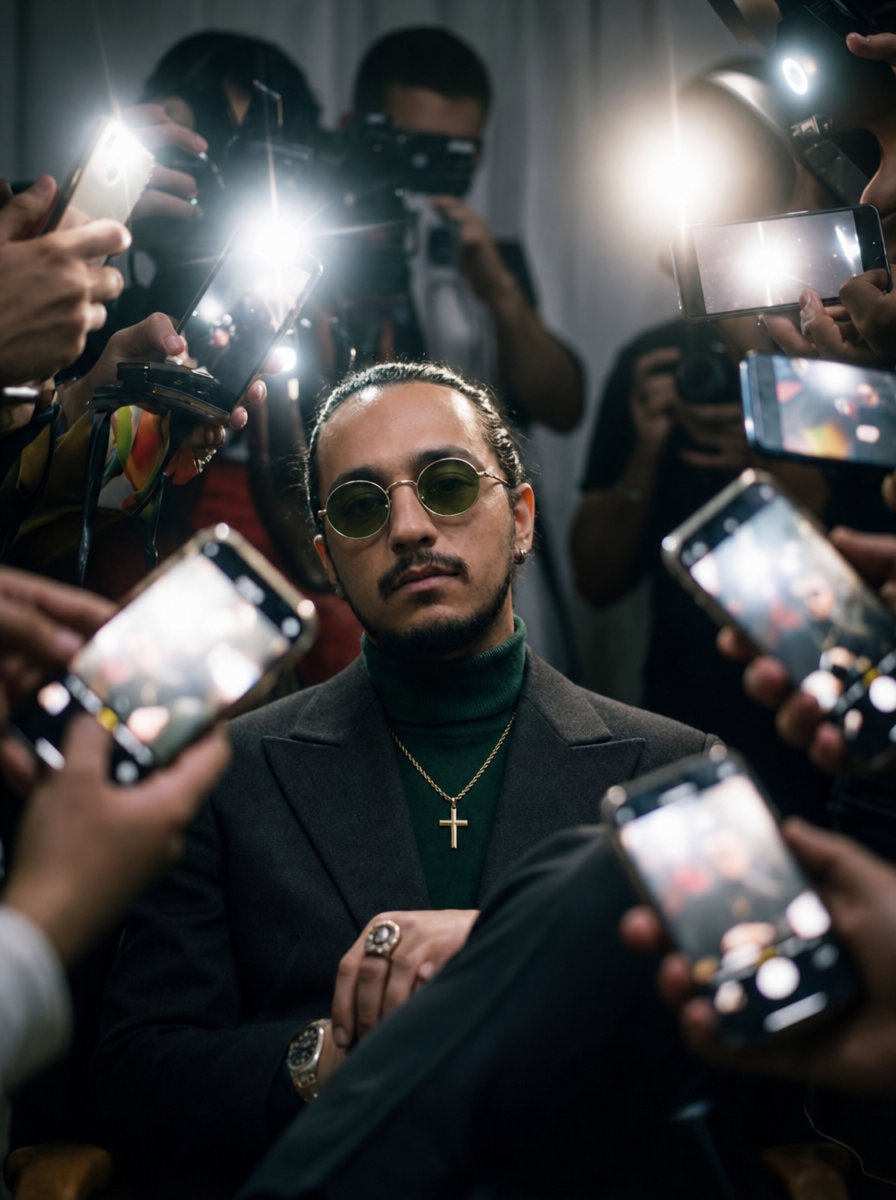
“Tight portrait framing” and “shallow depth of field” keep the stylish man’s face, tinted round glasses, and realistic skin texture dominant while the surrounding crowd dissolves into pressure rather than competing detail. The moody, tense glamour comes from the specific combination of “dramatic low-key lighting with cool highlights,” “bright camera flashes,” and the deep-green turtleneck against the charcoal blazer, with white flash points cutting through the black-and-green palette. “Subtle luxury jewelry details,” especially the watch and signet ring, add controlled status cues without breaking the close-up composition.
FAQ
→How do I make the celebrity look more central and dominant?
Replace “surrounded by a crowd of people holding up smartphones” with “a blurred paparazzi crowd confined to the extreme background,” and change “tight portrait framing” to “extreme close-up on the face and upper chest.” Keep “shallow depth of field” so the tinted round glasses and facial expression remain the sharpest elements.
→How do I change the tense paparazzi mood into a warmer, more glamorous portrait?
Replace “dramatic low-key lighting with cool highlights” and “intense paparazzi atmosphere” with “soft warm key lighting with golden rim light and a controlled red-carpet atmosphere.” Change the “bright camera flashes” to “diffused editorial flashes” to retain celebrity context without the harsh white interruptions.
→How do I build a series of variations from this portrait?
Keep “photorealistic,” “cinematic composition,” “realistic skin texture,” and “shallow depth of field” fixed, then swap the “deep-green turtleneck and charcoal blazer” for coordinated looks such as “midnight-blue velvet tuxedo,” “ivory silk shirt with black suit,” or “burgundy turtleneck with dark tailored jacket.” For matching locations, replace “paparazzi crowd pressing in around the seated subject” with “press line at a film premiere,” “luxury hotel entrance,” or “nightclub arrival,” while preserving “bright camera flashes” as the recurring visual motif.
Learn the technique behind this
- Why can't AI spell, and how do I get readable text in an image? — Older diffusion models had no character-level representation of text, so they produced letterform-shaped texture instead of words.
- How should a prompt be structured, and does word order matter? — A prompt that behaves predictably names one subject first, then what it is doing, then where, then the light, then the lens or medium, then the style.
- Why does the model ignore parts of my prompt? — Ignored instructions are almost always conflicts, counts, or spatial relationships — three things current models handle badly — rather than the model failing to read you.
Related prompts
Woman in Teal Light, Shadowed Fashion Portrait
Eerie Elegance Among Marble Busts
Charcoal turtleneck with red eye-beam
Dreamy Macro Portrait in Cool Water