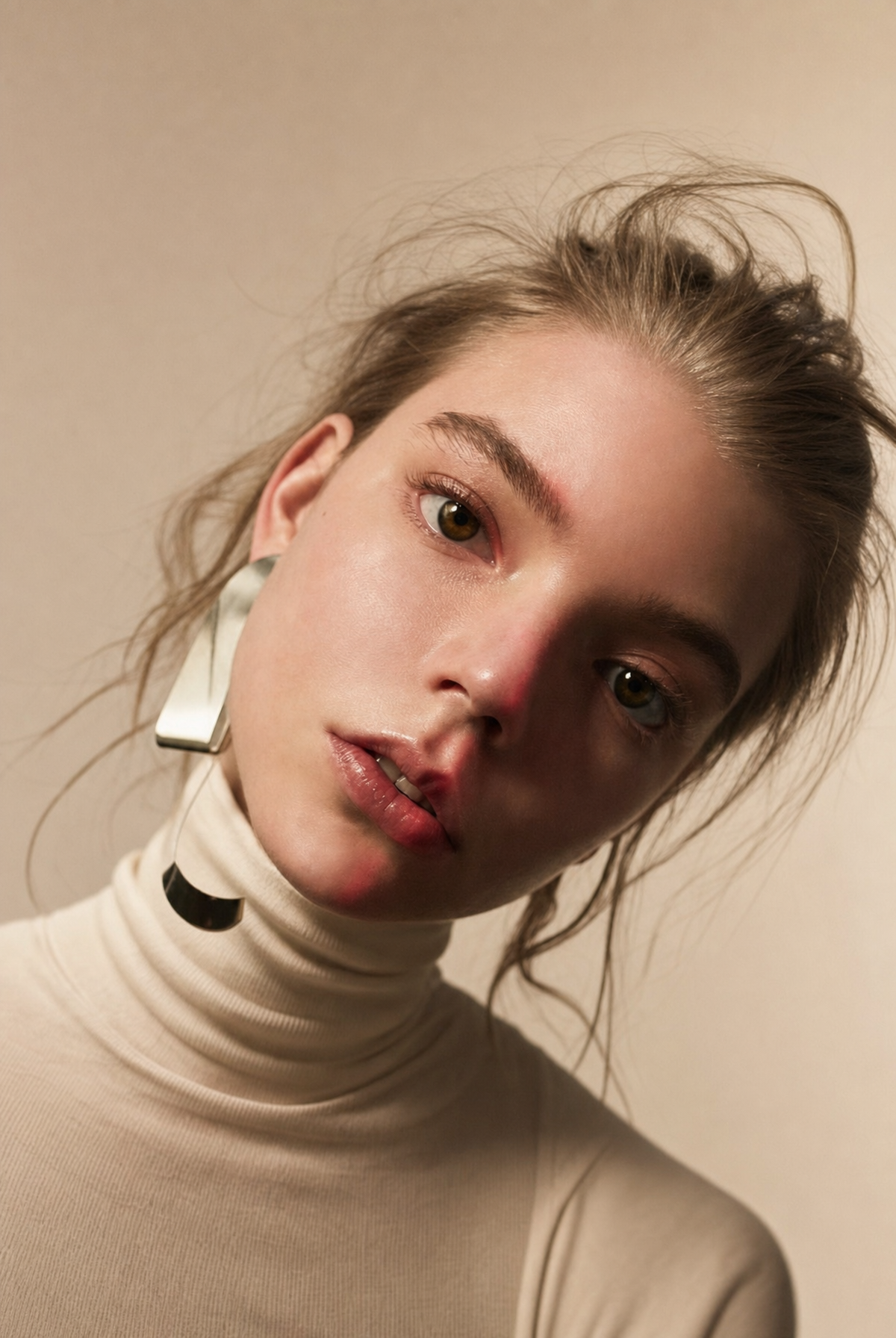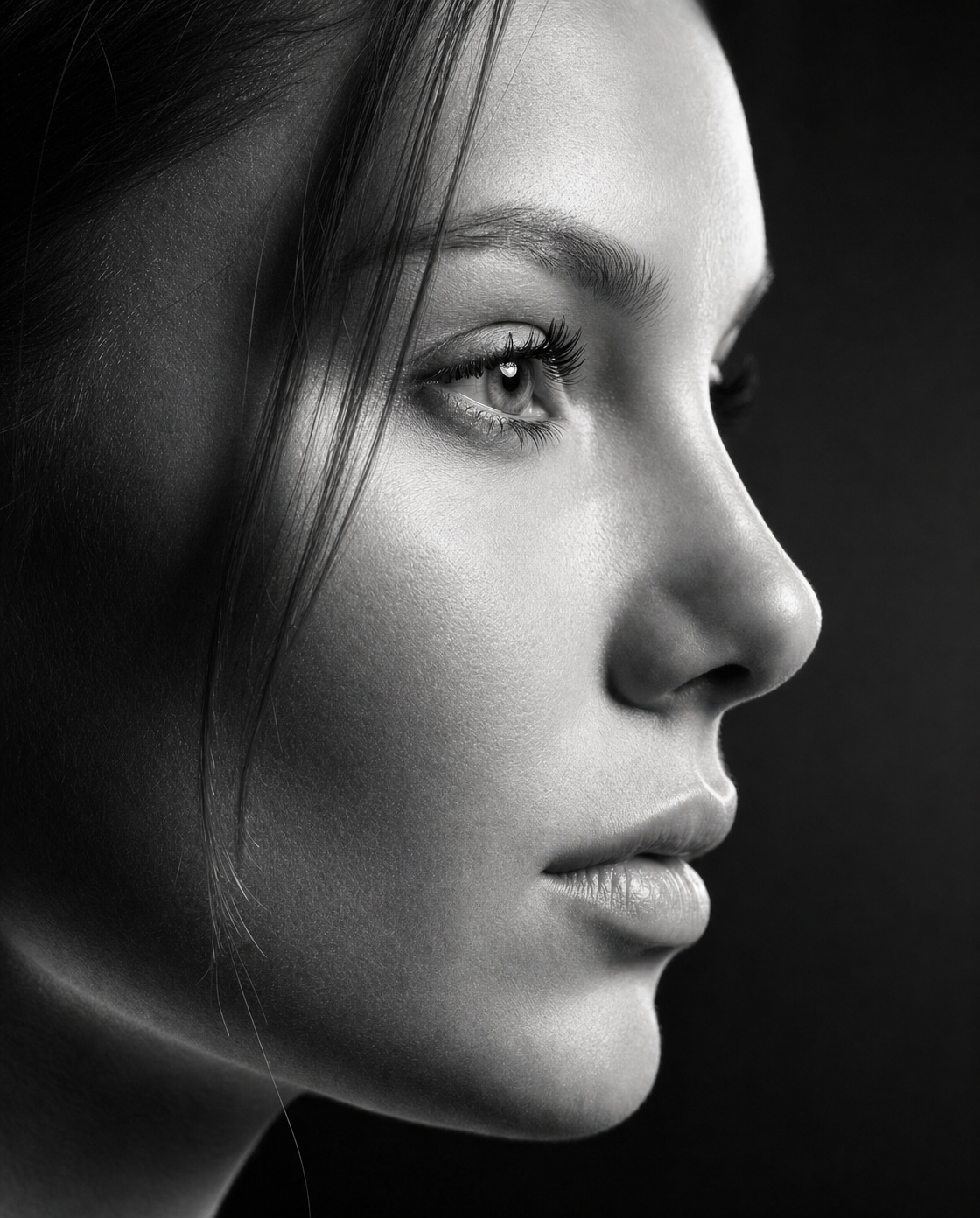
Same prompt, generated with each model separately — click one to see how it holds up.
Why this works
“Close-up side-profile” and “facing right” create a tightly controlled portrait silhouette, while “smooth dark seamless background” removes competing shapes and keeps the face dominant. The mood balances restraint and drama because “soft key light from above” preserves the calm tone, while “gentle rim light” and “crisp, high-contrast monochrome look” define the cheekbone and jawline against the black-and-white field. “Sharp focus on eyelashes and fine facial contour details” makes small anatomical textures carry the image’s intensity without sacrificing “natural skin texture.”
FAQ
→How do I change this prompt for a softer, more tender portrait?
Replace “crisp, high-contrast monochrome look” with “low-contrast grayscale with soft tonal transitions,” and change “dramatic editorial” to “quiet, intimate editorial.” Keep “soft key light from above,” but replace “gentle rim light” with “broad diffused frontal fill” to reduce the hard separation along the cheek and jaw.
→How do I make the eyes and expression more central than the profile silhouette?
Replace “close-up side-profile portrait” with “tight three-quarter close-up portrait,” and change “facing right” to “gazing slightly past the camera.” Replace “sharp focus on eyelashes and fine facial contour details” with “sharp focus on the visible eye, iris, and subtle expression lines,” while retaining “smooth dark seamless background” for an uncluttered frame.
→How do I build a consistent series of variations from this portrait?
Keep the fixed anchors “young woman,” “close-up profile framing,” “smooth dark seamless background,” “natural skin texture,” and “high-contrast black-and-white look.” Change only one controlled variable per image, such as replacing “facing right” with “facing left,” “soft key light from above” with “soft key light from the side,” or “calm introspective mood” with “quietly defiant mood,” so the series changes direction, lighting, or expression without losing its visual identity.
Learn the technique behind this
- Why can't AI spell, and how do I get readable text in an image? — Older diffusion models had no character-level representation of text, so they produced letterform-shaped texture instead of words.
- How should a prompt be structured, and does word order matter? — A prompt that behaves predictably names one subject first, then what it is doing, then where, then the light, then the lens or medium, then the style.
- Which aspect ratio should I use, and how does it change the image? — Aspect ratio determines what the model composes, not how it's cropped afterwards.
Related prompts
Woman in Teal Light, Shadowed Fashion Portrait
Eerie Elegance Among Marble Busts
Charcoal turtleneck with red eye-beam
Dreamy Macro Portrait in Cool Water