Same prompt, generated with each model separately — click one to see how it holds up.
Why this works
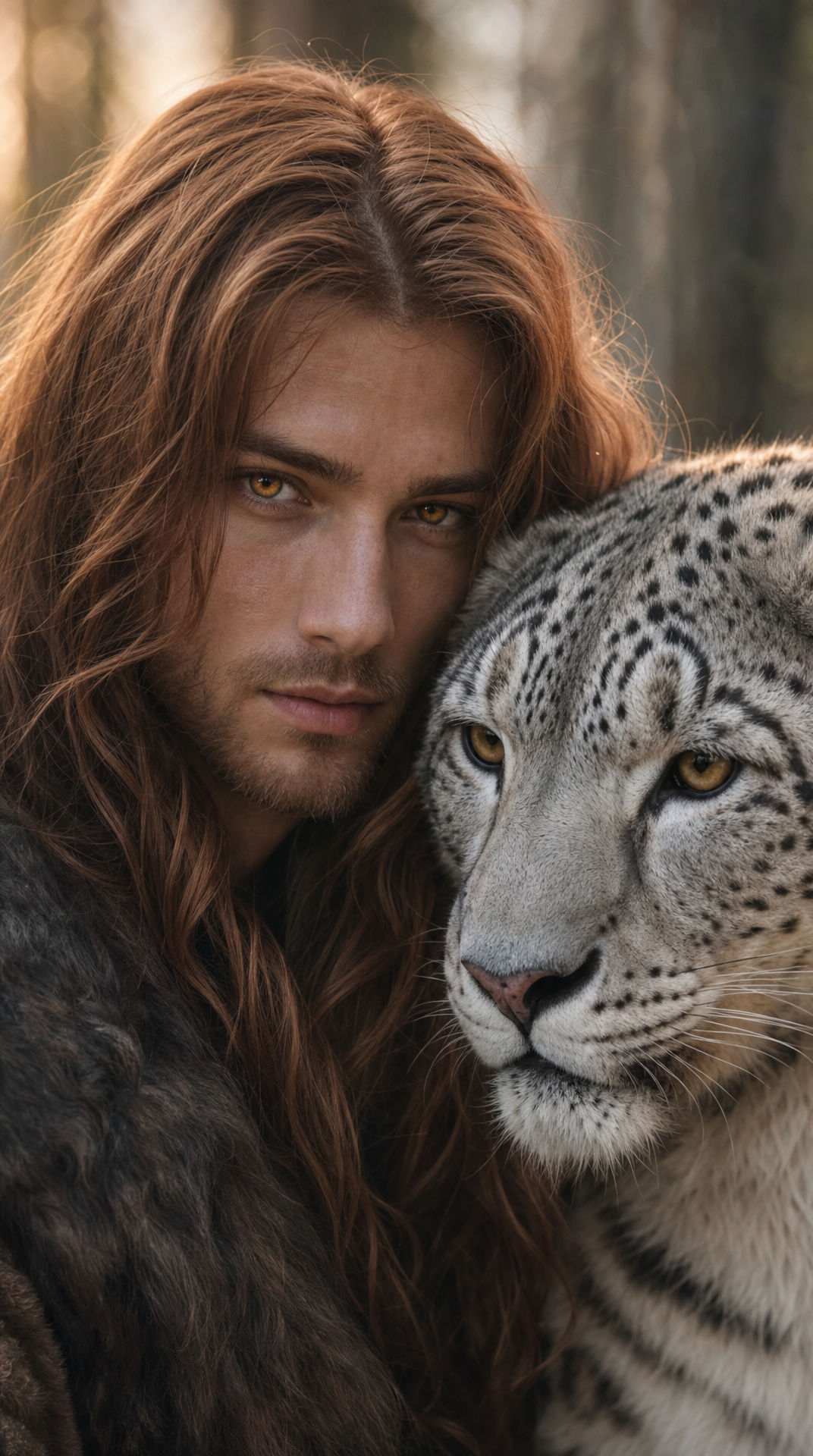
The color match between 'copper-red hair and striking amber eyes' and the leopard's 'matching golden eyes' is what makes the pairing feel unified rather than random, and the dominant amber/brown palette in the actual image confirms that phrase did the work. 'Resting its head gently near his shoulder' is the specific action that generates the intimate and protective mood, not the lighting alone. The '3/4 view close-up portrait' plus 'softly blurred forest background' is what produces the shallow-depth, portrait-closeup composition, pushing the environment out of focus so the two faces dominate the frame. 'Soft, warm diffused lighting with dominant cream and warm gray tones' is the direct cause of the washed, gentle color harmony rather than any high-contrast studio look.
FAQ
→How do I make the snow leopard the primary subject instead of a co-star?
Move it to the front of the sentence and demote the man: try 'Hyper-realistic close-up portrait of a majestic snow leopard with thick spotted coat and golden eyes, a man with copper-red hair resting his hand gently on its shoulder in the background.' Also change '3/4 view' to 'full-face view of the leopard' so the camera language locks onto the animal first.
→How do I shift this from a serene mood to something more tense or wild?
Replace 'Soft, warm diffused lighting' with 'harsh raking side light with deep shadows' and swap 'intimate and protective atmosphere' for 'tense, feral atmosphere.' Also change 'resting its head gently near his shoulder' to 'baring its teeth close to his face' to change the physical action driving the emotion.
→How do I build a series of variations from this same prompt structure?
Keep the framing language ('3/4 view close-up portrait,' '8k resolution, photorealistic, raw photo') fixed and swap only the subject-pairing clause and setting. For example, replace 'man with long copper-red hair... snow leopard' with 'woman with silver-white hair... arctic fox' and change 'softly blurred forest background' to 'softly blurred snowfield background,' keeping the lighting and color-tone phrases identical so the series reads as one family.
Learn the technique behind this
- Why can't AI spell, and how do I get readable text in an image? — Older diffusion models had no character-level representation of text, so they produced letterform-shaped texture instead of words.
- How should a prompt be structured, and does word order matter? — A prompt that behaves predictably names one subject first, then what it is doing, then where, then the light, then the lens or medium, then the style.
- Do negative prompts work, and what should go in one? — Negative prompts work on models that support a separate negative conditioning channel — mainly Stable Diffusion and FLUX-family models.
Related prompts
Woman in pale blue dress in lily boat

Woman and Man in Intimate Studio Portrait
Older Couple in Tender Watercolor Embrace

Elderly Couple Embracing in Golden Afternoon Light