Why this works
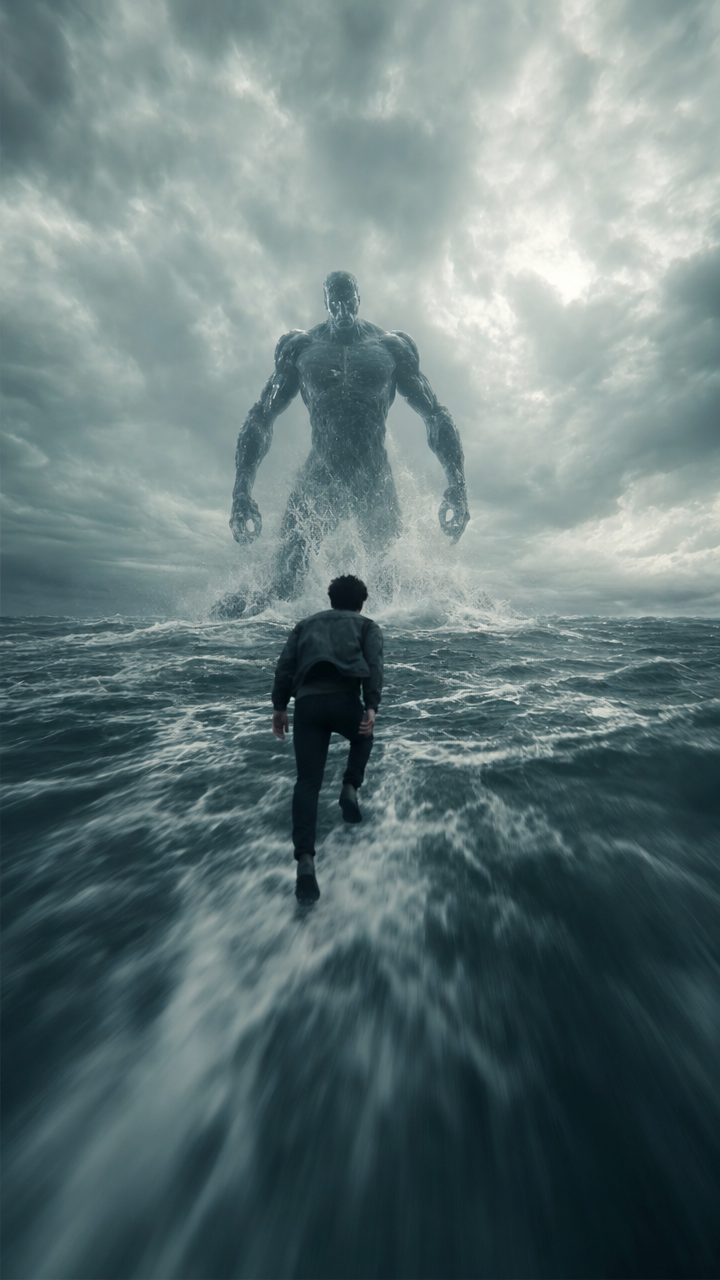
The phrase “lower, wider angle emphasizing the giant’s towering silhouette above him” makes the scale contrast the image’s central compositional fact, while “a lone man sprinting across a dark, choppy ocean toward” gives the scene a clear diagonal action line. “Cold teal-gray overcast,” “stronger white foam highlights,” and “realistic reflections” produce the blue-and-white palette without letting it become flat; “subtle wind-driven spray and mist between the runner and the rising figure” adds a visual barrier that reinforces the ominous tension. “Motion blur on the water and the runner’s legs” supplies kinetic urgency, while “moody cinematic lighting” and “high-contrast shadows under” the overcast keep the giant readable against the storm.
FAQ
→How do I make the sea giant feel even more threatening and central?
Replace “a colossal humanoid giant emerging from the water” with “an immense sea giant filling the upper two-thirds of the frame, shoulders and head dominating the horizon,” and change “emphasizing the giant’s towering silhouette above him” to “extreme low angle placing the runner at the bottom edge beneath the giant’s overwhelming body.”
→How do I shift this from ominous tension to frantic survival action?
Replace “moody cinematic lighting” with “hard, strobing lightning flashes with violent backlight,” and change “subtle wind-driven spray and mist” to “blown spray and sheets of rain obscuring the runner.” Increase the motion language by replacing “motion blur on the runner’s legs” with “strong directional motion blur on the legs, arms, foam, and spray.”
→How do I build a different variation while keeping the same dramatic scale contrast?
Keep “lower, wider angle emphasizing the giant’s towering silhouette above him” and “dramatic scale contrast,” then replace “dark, choppy ocean” with “a flooded coastal city at night” and “a lone man” with “a small rescue boat carrying two figures.” Replace “rising from the water” with “emerging between half-submerged skyscrapers” so the giant remains visually dominant in the new setting.
Learn the technique behind this
- Why can't AI spell, and how do I get readable text in an image? — Older diffusion models had no character-level representation of text, so they produced letterform-shaped texture instead of words.
- How should a prompt be structured, and does word order matter? — A prompt that behaves predictably names one subject first, then what it is doing, then where, then the light, then the lens or medium, then the style.
- What resolution do AI images come out at, and does upscaling help? — Current models generate around one to two megapixels natively, which is fine on screen and short for print.
Related prompts
Young girl with dog in tornado
Headless sitter atop a giant head
Crimson-Cloaked Specter in Candlelit Ballroom

Violet Holographic Hands Almost Touching