Why this works
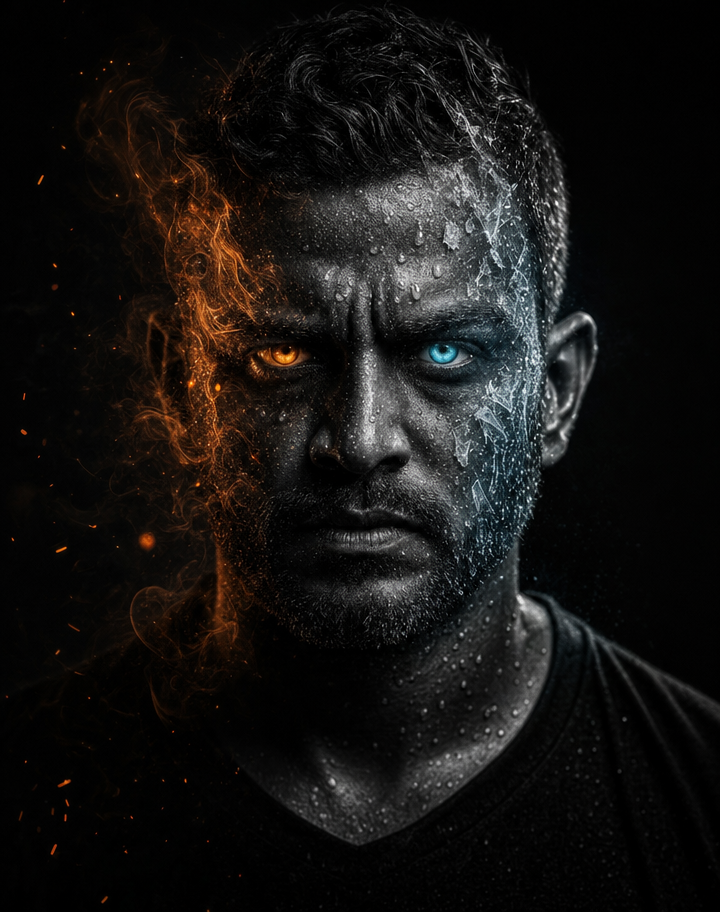
The “tight close-up,” “centered composition,” and “intense stare directly into the camera” make the face and split elemental treatment immediately dominant. The “high-contrast black-and-white” and “dark moody background with subtle vignette” suppress distractions, while the “swirling, ashy orange plume,” “thin ice crystals,” and restrained “warm amber” and “cool cyan-blue” eye glows create a controlled gray-orange-blue harmony. The left-versus-right construction gives the portrait a clear visual tension: “ember-like smoke and flame” supplies turbulent texture, while “frosty condensation” and “ice crystals” provide a sharper counterpoint.
FAQ
→How do I make the elemental contrast feel more aggressive and dangerous?
Replace “softly glowing warm amber eye” with “blazing molten-orange eye with sharp internal light,” and replace “cool cyan-blue eye glow” with “electric blue-white eye emitting a piercing glow.” Change “swirling, ashy orange plume” to “violent curling firestorm with incandescent embers,” and “frosty condensation and thin ice crystals” to “jagged frost shards and cracked frozen skin.”
→How do I make the man’s eyes and expression more central than the smoke and ice?
Keep “tight close-up” and “centered composition,” but add “eyes occupying the visual focal point, unobstructed face, elemental effects receding behind the eyes.” Replace “left side of his face is engulfed” with “left cheek edged by a controlled ember plume,” and replace “right side is coated” with “right cheek lightly traced with delicate ice crystals.”
→How do I turn this into a consistent series with different elemental pairings?
Preserve “tight close-up, centered composition, direct eye contact,” “high-contrast black-and-white,” and “dark moody background with subtle vignette” as the fixed structure. Swap “left elemental heat, right elemental cold” for a new pair such as “left side charged with violet lightning, right side covered in smoky emerald moss,” then replace “warm amber and cool cyan eye glow accents” with “violet and emerald eye glow accents” while keeping the same restrained color treatment.
Learn the technique behind this
- Why can't AI spell, and how do I get readable text in an image? — Older diffusion models had no character-level representation of text, so they produced letterform-shaped texture instead of words.
- How should a prompt be structured, and does word order matter? — A prompt that behaves predictably names one subject first, then what it is doing, then where, then the light, then the lens or medium, then the style.
- Why does the model ignore parts of my prompt? — Ignored instructions are almost always conflicts, counts, or spatial relationships — three things current models handle badly — rather than the model failing to read you.
Related prompts
Woman in Teal Light, Shadowed Fashion Portrait
Eerie Elegance Among Marble Busts
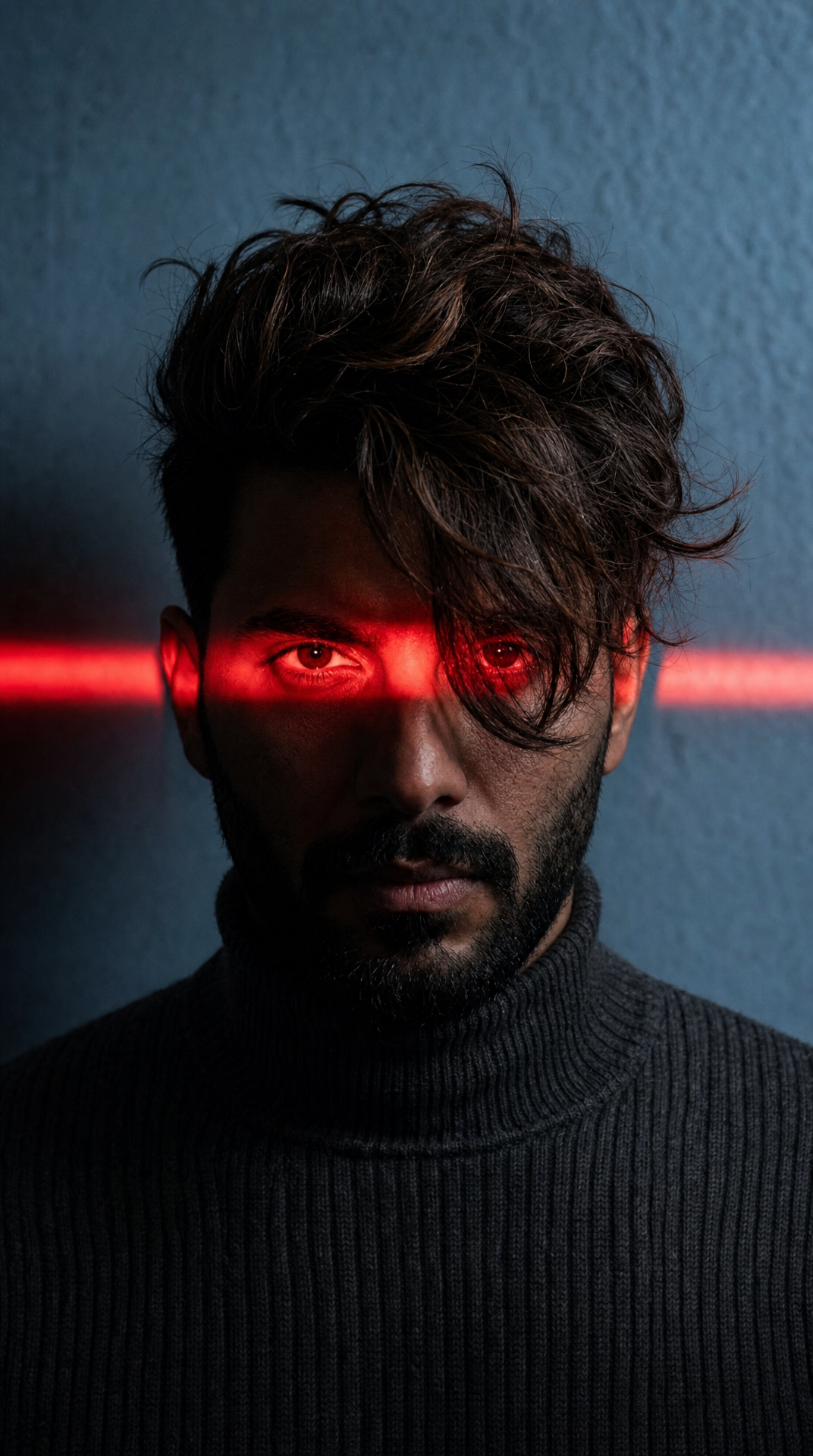
Charcoal turtleneck with red eye-beam
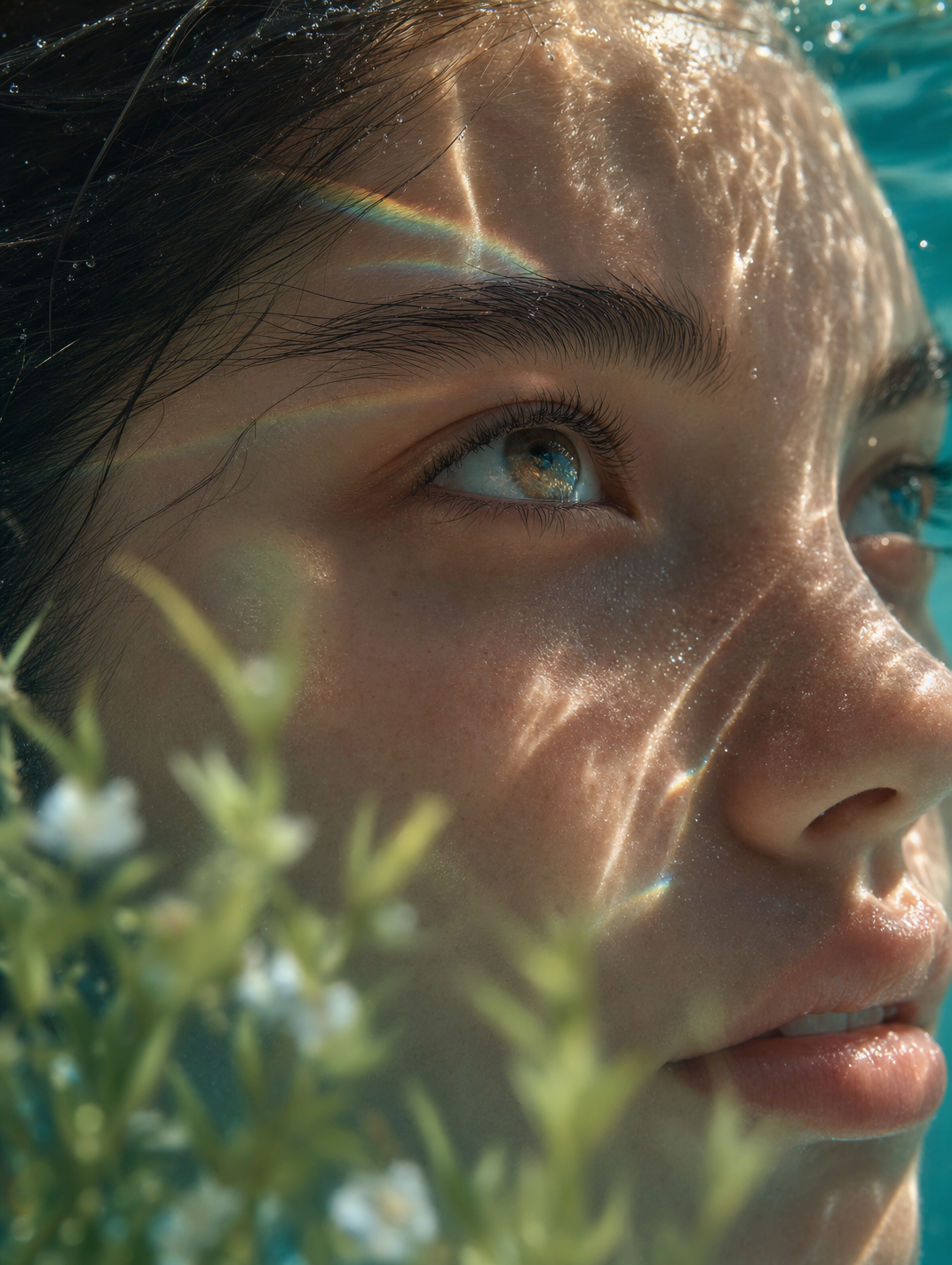
Dreamy Macro Portrait in Cool Water