Why this works
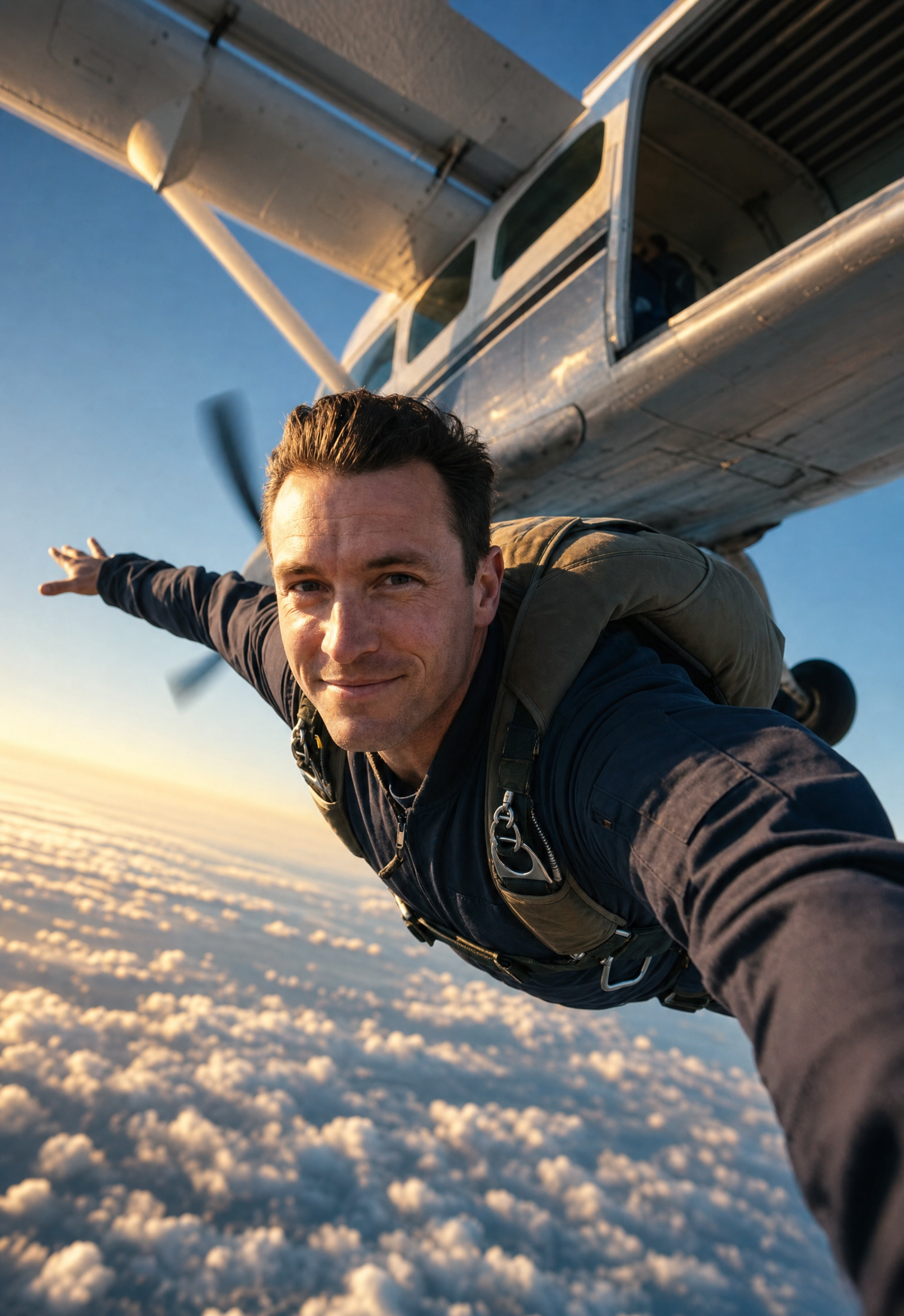
The phrase “dynamic low-angle wide-angle perspective that feels close and action-focused” puts the skydiver in immediate foreground while the plane cuts across the frame, giving the candid-action composition its rush and scale. “One arm extended toward the camera” creates the strongest leading line and makes the confident expression feel interactive rather than posed. “Bright late-afternoon sunlight casting warm highlights and cooler shadows” supplies the adventurous contrast, while “detailed harness and parachute gear clearly visible” anchors the photorealistic detail; the generated gray, tan, and black palette tempers the crisp blue-sky setting with grounded equipment tones.
FAQ
→How do I make the skydiver more central and dominant than the plane?
Replace “flying beside a small propeller plane” with “the skydiver centered in the foreground, filling most of the frame, with the small propeller plane distant in the upper background.” Keep “one arm extended toward the camera,” and change “wide-angle perspective” to “moderate wide-angle close-up” to reduce the plane’s visual competition.
→How do I shift this from warm cinematic adventure to a darker, more dangerous mood?
Replace “bright late-afternoon sunlight casting warm highlights and cooler shadows” with “storm-filtered light, deep blue-gray shadows, and brief hard highlights through broken cloud.” Change “crisp blue sky with subtle cloud haze” to “heavy storm clouds and turbulent mist,” while keeping “high contrast” and “dynamic motion feel” to preserve the action.
→How do I build a series of variations without losing the same visual identity?
Keep the fixed anchors “photorealistic cinematic action photography,” “sharp realistic skin texture,” “detailed harness and parachute gear,” and “dynamic low-angle wide-angle perspective.” For each variation, replace only the setting and light phrases, such as “above a soft cloud layer” with “over a rugged coastline” or “over a desert canyon,” and “late-afternoon sunlight” with “cold dawn light” or “neon light from a distant city.”
Learn the technique behind this
- Why can't AI spell, and how do I get readable text in an image? — Older diffusion models had no character-level representation of text, so they produced letterform-shaped texture instead of words.
- How should a prompt be structured, and does word order matter? — A prompt that behaves predictably names one subject first, then what it is doing, then where, then the light, then the lens or medium, then the style.
- Do negative prompts work, and what should go in one? — Negative prompts work on models that support a separate negative conditioning channel — mainly Stable Diffusion and FLUX-family models.
Related prompts
Tiny wanderer in pastel sunrise meadow

Quiet desk on a cliff terrace
Luxury yacht near chalk cliffs at dusk
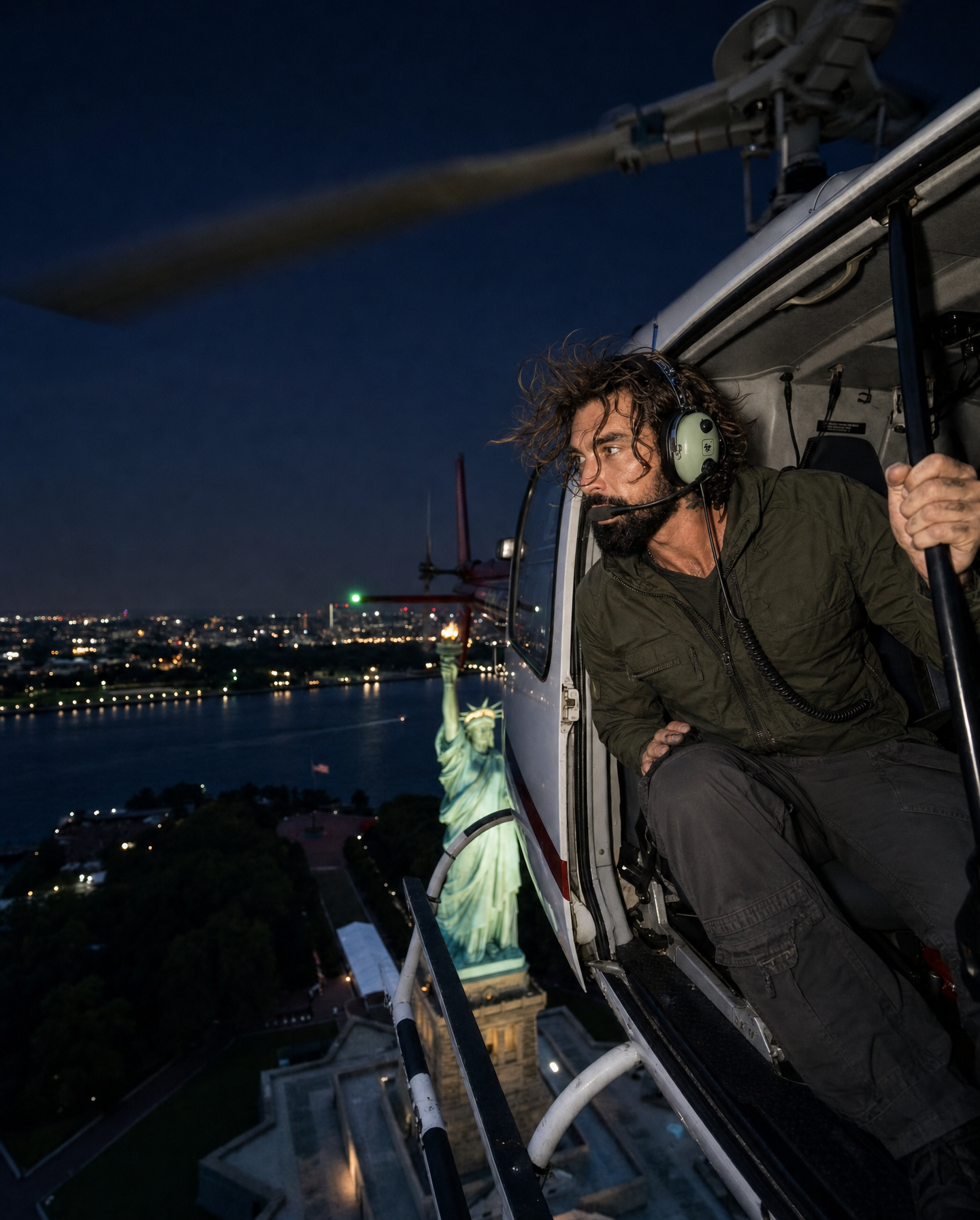
Night Helicopter Escape Over New York