Why this works
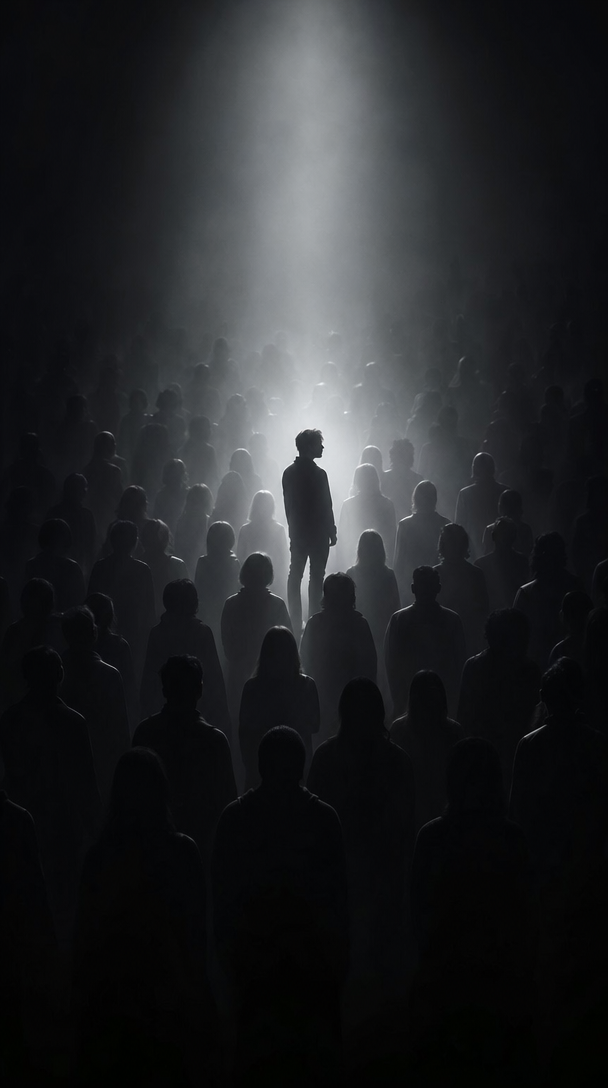
“A lone silhouetted person” inside a “bright spotlight beam” establishes the isolated focal point, while “a dense crowd of shadowy figures forms a dark mass around them” supplies the surrounding scale and pressure. “Dramatic high-contrast lighting,” “heavy atmospheric haze,” and a “stark halo” create the eerie, volumetric separation visible in the gray monochrome palette. “Centered composition” and “realistic documentary-style framing” keep the wide shot direct and observational rather than stylized or chaotic, while “grainy texture” reinforces the austere cinematic realism.
FAQ
→How do I make the lone person feel more vulnerable and psychologically tense?
Replace “standing in a bright spotlight beam” with “small, tense figure standing alone in an overexposed spotlight,” and change “dense crowd of shadowy figures forms a dark mass around them” to “closely packed crowd pressing inward with indistinct faces.” Add “slightly lowered camera angle” or “wide negative space above the figure” if you want the person to appear more exposed.
→How do I make the crowd more prominent than the central figure?
Change “Centered composition” to “off-center composition with the lone person near the lower-right third,” and replace “a bright spotlight beam” with “a narrow, dim spotlight partially swallowed by surrounding darkness.” Expand “dense crowd of shadowy figures” to “foreground crowd filling most of the frame, layered faces and shoulders receding into haze,” while retaining the silhouetted figure as a secondary focal point.
→How do I build a series of variations without losing the original visual identity?
Keep “cinematic black-and-white photograph,” “heavy atmospheric haze,” “grainy texture,” and “dramatic high-contrast lighting” unchanged, then vary one structural element at a time. Swap “dense crowd of shadowy figures” for “empty theater seats,” “fog-covered train platform,” or “narrow protest march,” and replace “a lone silhouetted person” with “a solitary child,” “a uniformed worker,” or “a woman holding an umbrella” to create distinct scenes with the same monochrome, spotlight-driven treatment.
Learn the technique behind this
- Why can't AI spell, and how do I get readable text in an image? — Older diffusion models had no character-level representation of text, so they produced letterform-shaped texture instead of words.
- Which aspect ratio should I use, and how does it change the image? — Aspect ratio determines what the model composes, not how it's cropped afterwards.
- How should a prompt be structured, and does word order matter? — A prompt that behaves predictably names one subject first, then what it is doing, then where, then the light, then the lens or medium, then the style.
Related prompts
Woman in Teal Light, Shadowed Fashion Portrait
Eerie Elegance Among Marble Busts
Charcoal turtleneck with red eye-beam
Dreamy Macro Portrait in Cool Water