Why this works
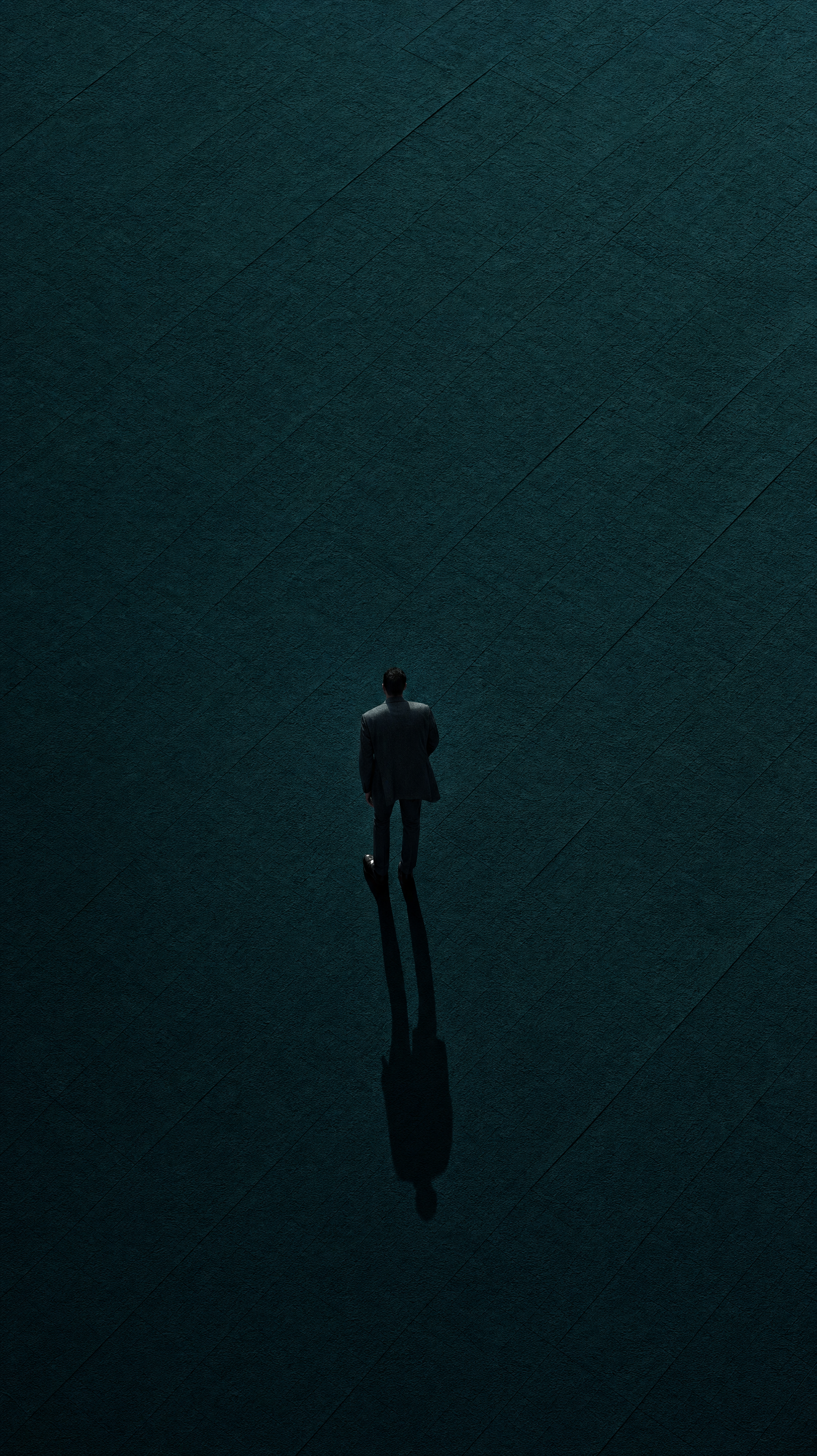
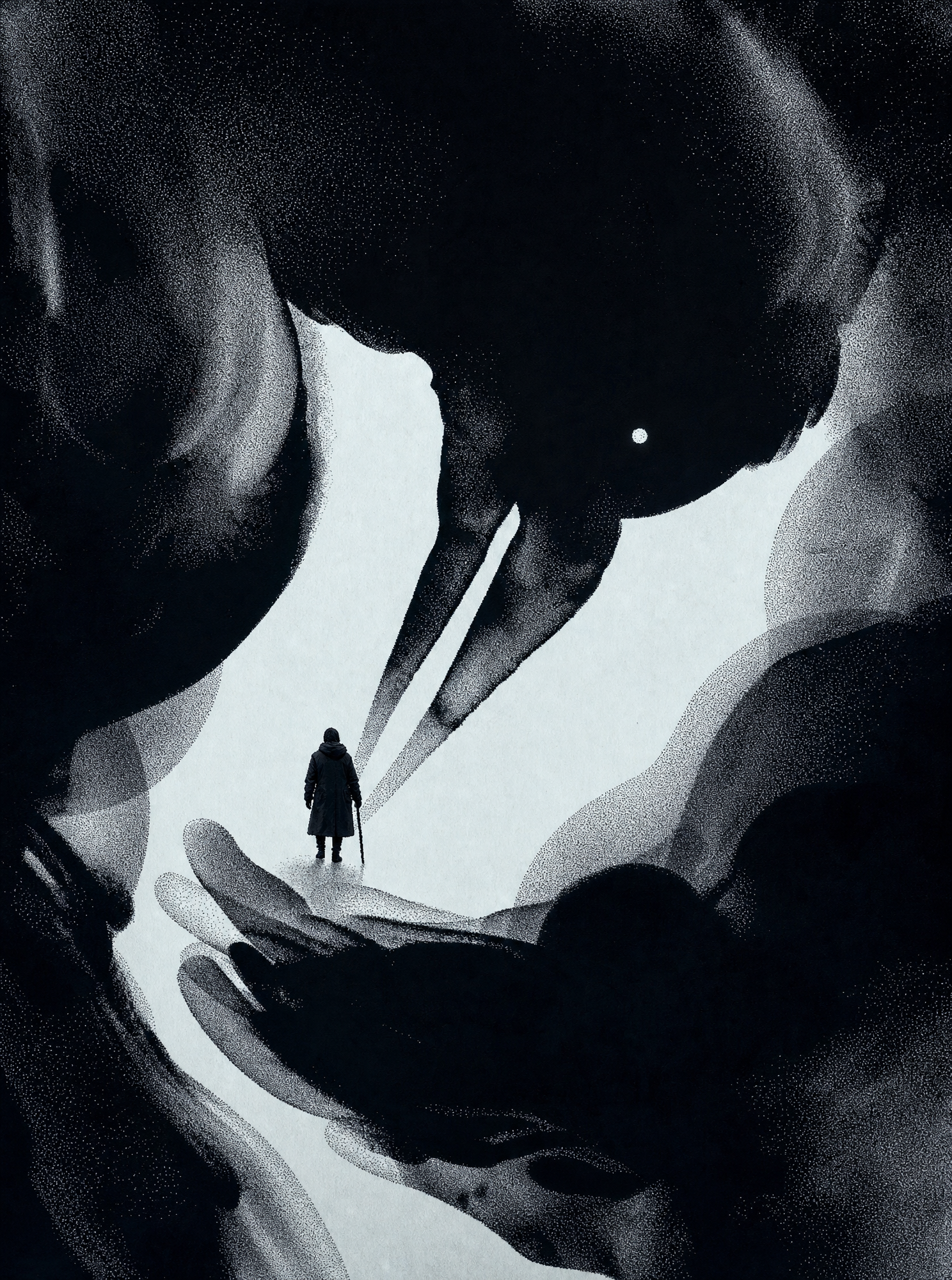
The phrase “a contemplative lone man standing small inside a vast abstract cavern” establishes the centered, diminutive figure and the image’s strong sense of scale, while “minimal composition” and “dramatic negative space” keep the surrounding field visually open. “Swirling ink-like organic tendrils” supplies the enclosing motion, and “high contrast lighting with eerie atmospheric haze” separates the silver-gray forms from the white glow without losing the moody, contemplative tone. “Colder black-and-silver monochrome,” “grainy stippled texture,” and “expressive ink-wash brushwork” give the dominant white-and-gray palette its screen-printed, tactile character.
FAQ
→How do I make the man more central and prominent?
Replace “standing small” with “standing as the dominant central figure, occupying the middle third of the poster,” and replace “vast abstract cavern” with “a cavern that recedes behind him.” Keep “poster-like framing” but reduce “dramatic negative space” to “controlled negative space around the figure” so the composition still feels spare without shrinking him.
→How do I shift the mood from eerie contemplation to menace?
Replace “contemplative” and “eerie atmospheric haze” with “threatened and ominous” and “dense, directional fog cutting across the figure.” Change “slightly wider cream negative-space glow” to “a narrow, harsh silver backlight,” and add “tendrils converging toward the man” to turn the organic forms from a surrounding environment into an active threat.
→How do I build a series of variations from this prompt?
Keep the fixed style phrases “surreal monochrome vintage screen-printed poster illustration,” “grainy stippled texture,” and “high-contrast black-and-silver monochrome,” then swap only the setting and subject nouns. For example, replace “abstract cavern” with “flooded observatory,” “deserted cathedral,” or “subterranean railway tunnel,” and replace “lone man in a dark hooded coat with rolled sleeves” with “masked child in a raincoat,” “seated astronomer,” or “figure carrying a lantern,” while preserving “standing small” and “centered” for a consistent visual series.
Learn the technique behind this
- Why can't AI spell, and how do I get readable text in an image? — Older diffusion models had no character-level representation of text, so they produced letterform-shaped texture instead of words.
- Which aspect ratio should I use, and how does it change the image? — Aspect ratio determines what the model composes, not how it's cropped afterwards.
- What resolution do AI images come out at, and does upscaling help? — Current models generate around one to two megapixels natively, which is fine on screen and short for print.
Related prompts
Young girl with dog in tornado
Headless sitter atop a giant head
Crimson-Cloaked Specter in Candlelit Ballroom
Violet Holographic Hands Almost Touching