Why this works
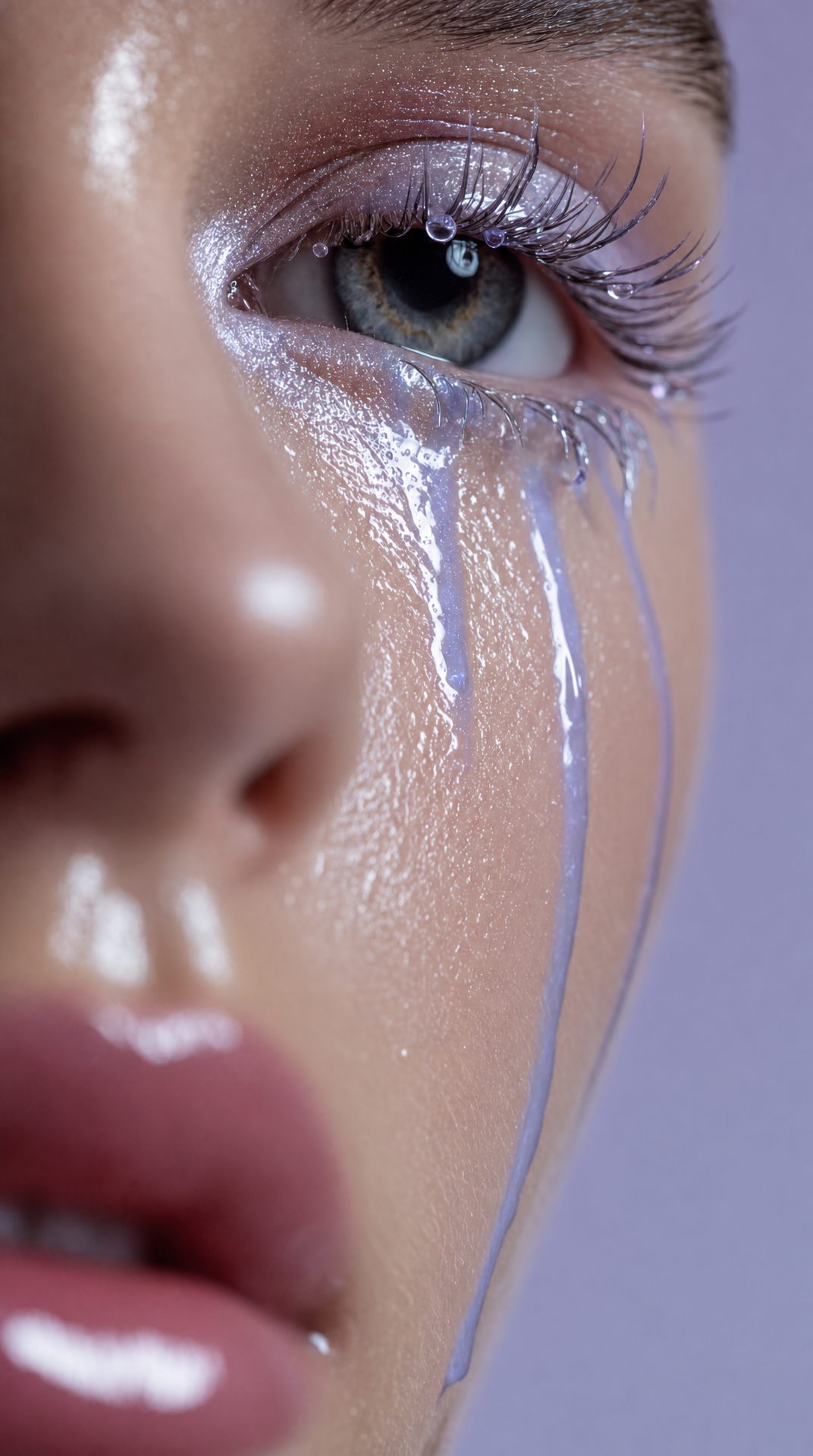
The phrase “cool-toned liquid paint instead of pink paint, flowing like tears from her eyes” supplies the defining visual gesture, while “glossy lips with a deep rose finish” gives the lower face a controlled color anchor. “Soft pale lavender gradient” keeps the background low-contrast, and “fashion editorial close framing” plus “shallow depth of field” locks attention on the eyes, paint trails, and wet cheek texture. “Cinematic highlights and gentle falloff” produces the polished gray-white sheen visible across the skin, while “dreamy, sensual, polished, dramatic mood” pushes the image beyond a neutral beauty headshot.
FAQ
→How do I make the liquid paint and eyes more central in the portrait?
Replace “fashion editorial close framing” with “extreme close-up centered on both eyes,” and change “flowing like tears from her eyes” to “thick reflective paint streams sharply defined from the inner corners of both eyes.” Add “eyes and paint trails occupy the visual center” to prevent the lips from competing for attention.
→How do I shift this from dreamy and sensual to colder and more unsettling?
Replace “dreamy, sensual, polished, dramatic mood” with “clinical, eerie, emotionally detached mood,” and change “soft pale lavender gradient” to “desaturated blue-gray gradient.” For a harder expression, replace “gentle falloff” with “hard directional side-lighting with stark shadow separation,” while keeping “cool-toned liquid paint” to preserve the icy palette.
→How do I build a matching series with different paint colors and backgrounds?
Keep the fixed structure, including “hyper-realistic close-up portrait,” “shallow depth of field,” and “ultra-detailed skin micro-texture,” then swap “cool-toned liquid paint” for variants such as “metallic cobalt paint,” “pearlescent silver paint,” or “acid green paint.” Pair each with a coordinated replacement for “soft pale lavender gradient,” such as “muted cobalt gradient,” “soft silver-gray gradient,” or “dark moss-green gradient,” while retaining “cinematic fashion beauty lighting” for consistency.
Learn the technique behind this
- Why can't AI spell, and how do I get readable text in an image? — Older diffusion models had no character-level representation of text, so they produced letterform-shaped texture instead of words.
- How should a prompt be structured, and does word order matter? — A prompt that behaves predictably names one subject first, then what it is doing, then where, then the light, then the lens or medium, then the style.
- Why does AI get hands and faces wrong, and how do I fix it? — Hands fail because they're small in frame, extremely variable in pose, and self-occluding — the model has less usable signal per pixel than for any other body part.
Related prompts
Woman in Teal Light, Shadowed Fashion Portrait
Eerie Elegance Among Marble Busts
Charcoal turtleneck with red eye-beam
Dreamy Macro Portrait in Cool Water